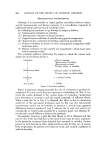
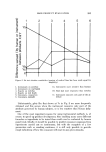
HAIR PRODUCT EVALUATION 567 preference. In many cases human judgment parallels instrumental measure- ments up to a point where fatigue, inhibition, or possibly even heightened sensitivity occurs. At this point, the ability to sense might fall away markedly or, conversely, be heightened depending on the type of stimulus. However, the preference cm've seldom parallels that of either the instru- ment or human judgment as it is obviously strongly influenced by frequently unidentifiable psychological factors, physical factors, or past experience. Another concept in psycho-physics that has proved useful in hair evaluation is that of the "just noticeable difference" (jnd). This is defined as the smallest possible shift in magnitude which is just noticed by three out of four judges. If any particular instrument does measure the perceived attribute then the salient advantages of the psycho-physical approach are: (a) It is possible to predict how many consumers will observe a given shift in physical magnitude based on jnd's. (b) Predictions may be made about the instrumental shift necess•ary for consumers to feel, for example, three times or one-third as strongly about a given attribute, where the zero point is well defined. (c) Thresholds and saturation points can be established. (d) The region of instrumental values where consumers are most sensitive can be established and it is possible to gauge their sensitivity in rela- tion to the instrument. (e) Maximum areas of preference related to instrumental values can be postulated including the preferences of minority groups. (f) Psycho-physical curves can be derived for any given test situation such as monadic, paired comparison, triadic comparison, delayed paired comparison, and so forth. The curves so obtained can then be made completely appropriate to the test situation in which predictions are needed. (g) The data obtained may be employed to select and balance an expert panel of judges for a critical sensory evaluation. Without using psycho-physical techniques, however, it is not really possible to say how strongly people feel the difference to be between two products, but the success of using the method depends largely on the appropriateness and sensitivity of the instrumental method. A•,•,I•CAT•o• ov • Ps¾cHo-•'u¾s•cs To Tm•: EVALUaT•O• OV • "CoMBaBm•T¾" "Combability" is readily translated into scientific terms as "resistance to combing." A comb can be designed so that the forces it experiences during passage through the hair can be displayed and measured. Unlike instruments previously described (14, 15), our instrument for mea- suring combing resistance has been specially designed so that it can be used on switches of hair. The principle of the instrument is based on the use of a piezo-electric transducer, which is cemented to the back of the comb. The

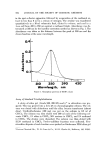
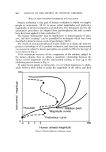
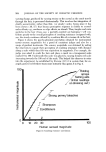
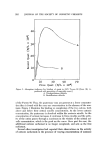
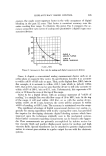
568 JOURNAL OF THE SOCIETY OF COSMETIC CHEMISTS varying charge, produced by varying strains on the crystal as thc comb travels through the hair, is processed electronically. This involves the integration of chiefly second-order, rather than first- (or steady) order, forces since it has been shown (16, 17) that human perception response is chiefly to second- order effects, e.g., nonlinear or edge effects, as stimuli. Thus, tangles and resin particles in the hair (from, say, a partially-combed out hairspray) will con- tribute greatly to the overall perception of combing resistance compared with, say, the steady resistance offered by a uniform film of a viscous oil on the hair. Figure 4 shows the psycho-physical correlation obtained for instrumental versus sensory magnitudes for a panel of consistent judges and also for a range of product treatments. The sensory magnitude was obtained by asking the observers to equate their perception of combing resistance with distance along a scale which they felt was equivalent in magnitude. For example, the judge was asked to comb the hair and pl,ace a mark on a transparent scale marked 0 to 100. Underneath this scale was placed a varying density red scale increasing towards the 100 end of the scale. This helped the observer to enter into the experiment. As established by Stevens (12) it is certain that, for ex- ample, point Z is felt three times more intensely than point X in Fig. 4. 100' 0 0 x lO Holding sprays Setting aids Z•o(nlnitial readings dressing out ) /•ng __• Shampoos Conditioners perms/bleaches 2O 3O Human sensed magnitude 100 Figure 4. Combing resistance correlations
Purchased for the exclusive use of nofirst nolast (unknown)
From: SCC Media Library & Resource Center (library.scconline.org)