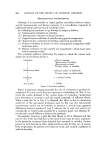
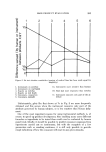
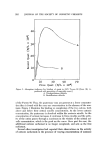
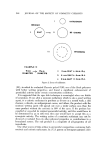
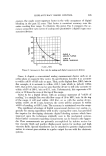
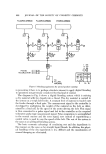
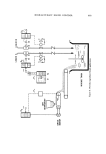
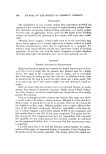
HIGH-ACCURACY BLEND CONTROL 595 essence, the single most important factor in the wide acceptance of digital blending in the past 12 years. That factor is consistent accuracy over the entire working itow range. To illustrate this point, Fig. 2 compares the ac- curacy versus flow rate curves of analog and quantitative (digital) type mea- surement devices. 5.0 4.O 25.0 2.0 o.• io ioo FLOW L/MIN CURVE A ANALOG- % SPAN CURVE B DIGITAL- %READING Figure 2. Accuracy vs. flow rate for analog and digital measurement devices Curve A depicts a conventional analog measurement device such as an orifice plate or magnetic flow meter. Its specifications describe it as accurate to within +0.5% of full scale or span. Thus, at the highest flow, 100 1./min in this example, it is accurate to within -+0.5 1./min which is, indeed, within 0.5%. But at 10 1./min it can be seen that the device is still only accurate to within ---0.5% of 100 1./min or 0.5 1./min. Unfortunately, this represents a 5% error, or 10 times the error at the top of the range. Curve B, for a digital device, with an accuracy statement of "ñ0.5% of reading," is a straight line over this flow range of 10 to 100 1./min. At the top of the range, it will read within ñ0.5 liter, or, as with the analog device, within ñ0.5%. At 10 1./min, however, the meter will be accurate to within ñ0.5% of reading, or 0.05 k/min. The accuracy is maintained over the range. This significant advantage .of digital measurement devices over analog, es- pecially for mixing ingredients with widely varying flow rates, has provided the impetus for developing electronic digital blending systems which have improved upon the techniques originally seen in the mechanical systems. Some further comments regarding measurements can be found in the Appen- dix. Flow measurements are primarily accomplished by turbine meters for low viscosity fluids and positive displacement meters for medium and high viscosity fluids. Special transducers can be attached to positive displacement meters to convert gear rotation to a pulse output for use with the electronic systems.

596 JOURNAL OF THE SOCIETY OF COSMETIC CHEMISTS - I I -
Purchased for the exclusive use of nofirst nolast (unknown)
From: SCC Media Library & Resource Center (library.scconline.org)