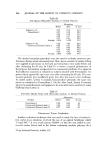
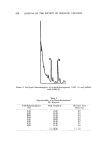
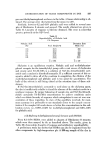
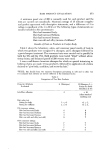
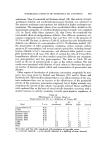
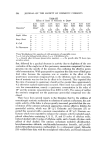
EVALUATION OF SUNSCREEN FORMULATIONS 545 Spectrophotometric Analysis The above evaluations are subiective but the improvement noted with Formulation ! is substantial and real. However, a more quantitative measure was needed of how well sunscreens are retained on the skin. For this purpose, a screening test was developed for efficacy of sunscreen formulations which was based on uv analysis of alcohol extracts taken from skin treated with sun- screen. A constant amount of suntan lotion was spread over a constant area of skin-the anterior forearm was often used, but it was also possible to run the test on the back or leg. A bottle containing a set volume of alcoholic solvent was inverted onto the treated surface and carefully shaken for a given period of time. This action would extract all of the alcohol-soluble material within the inner area of the bottle's mouth. The sample was then analyzed in a Beck- man DU spectrophotometer to determine the absorption peak at 305 ratx which is in the spectral area of maximum burning from the sun's rays. For some of our laboratory testing, subiect's arms were sprayed 20 min with water after suntan formulation had been applied. A spray head similar to those used in garden sprinkle cans was attached to the water faucet. It mea- sured 3.25 in. in diameter and contained 56 holes of 0.0•-in. diameter. Water at 78-80øF. was forced through this head at a rate of 2.5 gal/min. The .arms were placed approximately 10 in. from the spray head. Alcohol extractions were performed before and after this stress situation. Typical performance of the polymer formulation is shown in Table II. In this test, 0.3 ml of loti.on was spread on 16 in. 2 of arm surface. The change in the uv absorption values can be directly translated into per cent loss of sunscreen from the skin, which in the case of the polymer formulation is 33% as contrasted with 85% for the commercial product. An even greater loss (93%) was found in a formulation similar to Formulation i but with no polymer present. Table II Arm Spray With Ultraviolet Analysis of Alcohol Extracts Absorption Product Before After % Loss Formulation i 0.63 0.42 33 Commercial Suntan Lotion A 0.53 0.08 85 Formulation I (no polymer) 0.367 0.025 93 To show the reliabfiity of this test the absorption values representing the average of three extractions before and three extractions after the arm spray test on ten individuals are listed in Table III. Half of the group applied 0.2 ml of Formulation i and the other half applied 0.2 ml of Commercial Lotion A to 16 in? of arm surface. Note that this is less lotion than used on the subiects in Table II.

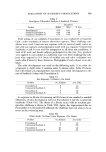
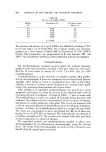
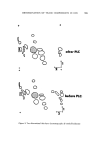
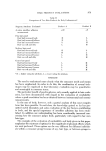
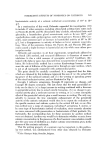
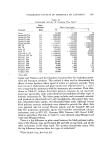
546 JOURNAL OF THE SOCIETY OF COSMETIC CHEMISTS Table III Arm Spray-Ultraviolet Analysis of Alcohol Extracts Absorption Before After % Loss Subiects 1-5, Formulation 1 Average Subjects 6-10, Commercial Suntan Lotion A Average 0.27 0.18 33.3 0.27 0.19 29.6 0.22 0.15 31.8 0.28 0.17 39.3 0.27 0.21 25.0 0.264 0.180 31.8 0.28 0.02 92.8 0.28 0.01 96.4 0.27 0.04 85.2 0.37 0.03 91.9 0.25 0.03 88.0 0.290 0.026 91.0 The alcohol extraction procedure was also used to evaluate sunscreen per- formanee during actual swimming tests. Here, given amounts of suntan lotions were applied to grid areas on the back and extractions were made before and after swimming for 45 min. In Table IV •s shown a typical performance of the polymer formulation compared to two commercial products. It is apparent that sufiieient sunscreen is retained on subjects treated with Formulation 1 to protect them against the sun's rays even after swimming for 45 min. The com- mercial products give insurelent protertion after this much water challenge, As stated earlier, Lotion A contains homomenthyl salieylate, the same sun- screen as contained in Formulation 1. On the other hand, Lotion B contains glyeeryl p-aminobenzoate and appears to be somewhat more sensitive to water challenge than Lotion A. Table IV Forty-five Minute Swim with Ultraviolet Analysis of Alcohol Extracts Absorption Product Before After % Loss Formulation I 0.52 0.30 42 Commercial Suntan Lotion A 0.58 0.15 75 Commercial Suntan Lotion B 0.57 0.08 86 Fluorescent Tracer Evaluation Another evaluation technique that was used to study the loss of suntan lo- tion under stress situations involved the use of an optical brightener called T'nopal SFG.* A very small amount (0.025%) of this dye was added to com- mercial suntan lotions and to the lotions containing aerylate polymer. In a *Geigy Industrial Chemicals, Ardsley, N.Y.
Purchased for the exclusive use of nofirst nolast (unknown)
From: SCC Media Library & Resource Center (library.scconline.org)