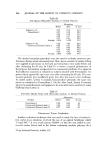
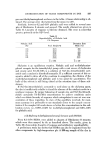
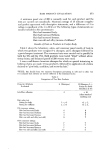
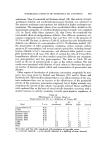
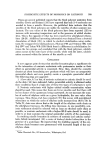
SYNERGISTIC EFFECTS OF NONIONICS ON CATIONICS 587 Table 1V Germicidal Activity or' Nonionic Plus Quat" Ratio Nonionic/ Plate Count (rain) Nonionic Quat 1/2 1 2 None 14,000 1,400 10 Igepal CO 710 2/1 1,000,000 50,000 2,500 Igepal CO 710 5 / 1 1,000,000 1.000,000 1,000,000 Igepal CO 880 5 / 1 1,000,000 780,000 180,0'00 Igepal CO 990 5/1 360,0(•C 13,000 700 Igepal AR 660 5/1 1,C00,000 1,000,000 1,000,000 Brij 35 5/1 1,000,0',I0 1.000,000 1,000,000 Brij 78 5 / 1 1,000,000 1,000,(X)0 1,000,000 Myrj 45 3/1 660,0o0 150,000 8,4o0 Myrj 53 .q / t 1,000,000 1,000,000 25,000 Ethomid C / 15 5 / 1 1,000,000 640,000 320,000 Ethomid HT 60 5/1 1,000,000 700,000 28,000 Pluronic L44 5 / 1 13,000 1,600 30 Pluronic P54 5/1 12,500 360 10 Pluronic P65 5/1 1•,'800 1,100 10 Pluronic L62 5 / 1 26,400 1,400 20 Pluronic P85 5/1 6,000 400 10 Pluronic P105 4/1 64,000 7,200 110 Tergitol XD 4/1 7,300 350 10 Tergito! XH 4/1 26,000 700 20 aFrom (23). Cantor and Winicov used the Chambers test procedure for evaluating germi- cidal and detergent sanitizers. This method is often used in determining the effects of water hardness where speed of action is a primary requisite. Tests were run on S. choleraesius and plate counts were obtained after 1/2, 1, and 2 min, comparing the quaternary with the quaternary plus nonionic. Their data, shown in Table IV, indicate that block polymer nonionics do not inactivate quaternary germicides, while under identical test conditions all other types of nonionic surfactants do. This latter group includes such commonly encount- ered products as ethoxylated octyl and nonylphenols, ethoxylated fatty alco- hols, ethoxylated fatty amides, and ethoxylated fatty acids. Although various block polymer nonionic surfactants were claimed to provide this effect, data were reported only for several Pluronic polyols and for Tergitol* XD and XH. The quaternary germicidal agents used included conventional cationic surfactants, such as BTC 471, Hyamine 3500, Tetrosan 3,4D, Eracol E-607, Beloran, and others. The data, in Table IV, were obtained using 500 ppm hard water and 200 ppm Beloran. There is a big difference in plate count between the block polymer surfac- rants of the Pluronic type and Tergitol XD and XH, on one hand, and all the other surfactants, on the other hand. The question immediately arises, Why the big difference between these two types of surfactants? *Union Carbide Corp., New York, N.Y.

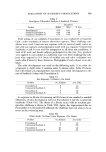
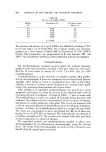
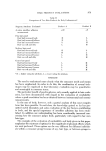
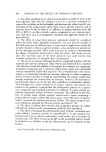
588 JOURNAL OF THE SOCIETY OF COSMETIC CHEMISTS A big difference is seen among the data for Igepal CO©* 710, 880, and 990 at the 5/1 ratio. It should be noted that in this homologous series, as the moles of ethylene oxide on the same hydrophobe are increased, the speed of reaction or killing time decreases. Other data from the same source are shown in Table V. Here a comparison is made using various eationic germicidal compounds at 9,00 ppm, with water of 300 ppm hardness, and the indicated varying amounts of several different nonionic surfaetants. Table V Germicidal Actiwty of Nonionic Plus Quat • Plate counts (rain) Composition Listed ,•/fi 1 Hyamine 3500 alone Plus 2/1 Igepal CO 710 Plus 5/1 Igepal CO 710 Plus 5/1 Pluronic P65 Beloran alone Plus 2/1 Igepal CO 710 Plus 5/1 Igepal CO 710 Plus 5/1 Igepal AR 660 Plus 5/1 Pluronic P65 Eracol E607 alone Plus 2/1 Igepal CO 710 Plus 5/1 Igepal CO 710 Plus 5/1 Pluronic P65 Hyamine 2389 alone Plus 5/1 Igepal CO 710 Plus 5/1 Pluronic P65 10 10 10 12,300 170 50 1,000,000 468,000 103.000 10 10 10 1,550 25 10 84,500 6,000 240 8•0,000 470,000 145,000 1,000,000 880,000 310,000 570 10 10 62,500 5,200 1,700 410,000 195,000 65,000 1,000,000 1,000,000 1,000,000 71,000 3,500 710 2,70,000 108,000 27,000 1,000,000 1,000,000 900,000 520,000 135,000 95,000 "From (23). The low plate count at the lower nonionic quaternary ratio, compared to the high plate count for the high ratio can again be explained by the reduced concentration, due to solubilization of the cationic in the nonionic micelle. It is suggested that the difference between the block polymers and the other types of nonionics can be explained by the application of physical chemistry. There is a big difference between the block polymer surfactants and the other types. It lies in the presence of the ether oxygen atoms in the hydro- phobe of the former. In the ethoxylated fatty alcohol or alkylphenol nonionic surfactants, the hydrophobe consists of a chain of carbon atoms, without any ether linkages. With the block polymer nonionic, the hydrophobe is capable of forming hydrogen bonds with the water molecules, whereas in the other group this property is missing. * GAF Corp., New York, N.Y.
Purchased for the exclusive use of nofirst nolast (unknown)
From: SCC Media Library & Resource Center (library.scconline.org)