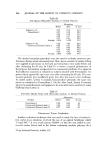
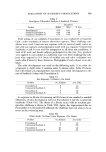
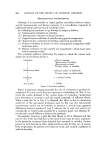
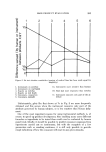
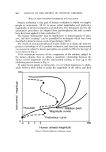
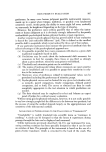
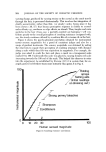
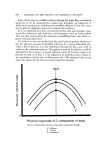
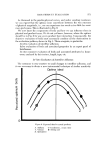
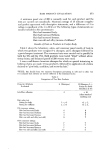
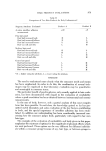
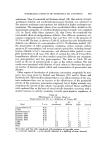
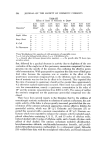
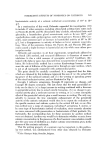
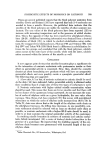
HAlll PRODUCT EVALUATION 575 Table II Comparison of Two }lair Prodnets for Body Enhancement" Property/Attribute Evaluated In vitro, interfiber adhesion measurement Fine hair panel Itair had increased body ttair had increased fullness Hair had increased bounce Hair xvas soft and silky Medium hair panel Hair had increased body Hair had increased fullness Hair had increased boltnee Hair was soft and silky Coarse hair panel Hair had increased body Hair had increased fullness Hair had increased bounce Hair was soft and silky Product A Product B +22 +5 H L II L L H L H It L H L L H L H L H L H L H L H higher rating for attribute, L = lower rating for attribute. SUMMARY The need to understand more clearly what the consumer needs and means has been emphasized. In order to do this, the combination of several tech- niques may be employed so that laboratory evaluation may be quantitative and meaningful in consumer terms. The particular benefit of psycho-physics, only recently applied to hair evalu- ation, has been demonstrated with regard to the evaluation of combability where a good correlation has been obtained between instrumental and sensory measurements. In the case of body, however, only a partial analysis of this most complex term has been possible. Nevertheless, the knowledge gained so far has per- mitred useful laboratory and salon evaluation of the key factors contributing to body, and the special importance of interfiber adhesion has been estab- lished. In addition our understanding has been considerably increased con- cerning how the consumer judges body, particularly with regard to her own hair type. The exmnplcs of the evaluation of cmnbability and body given in this paper e•nphasize the existence of opti•na for the magnitude of physical effects which are •nost preferred. These optima can be very different for different individu- als within a consumer group because of say, hair type, or between groups in

576 jOURNAL OF THE SOCIETY OF COSMETIC CHEMISTS different countries, because of differences in climate, customs, expectations, etc. For these reasons we cannot always anticipate perfect correlation be- tween a laboratory evaluation method and consumer response. These shortcomings are being minimized by maintaining a continual flow of information and understanding between the consumer and the scientist at the laboratory bench. (Received December 22, 1972) (i) (2) (3) (4) (5) (7) (8) (9) (i0) (11) (i2) (13) (14) (15) (16) (17) (i8) l•EFERENCES Sagarin, E., Cosmetics: Science and Technology, Interscience Publishers, New York, 1957, p. 4O9. Sagarin, E., Op. cit., p. 977. Robbins, C., Weathering in human hair, Text. Res. J., 37, 337 (1967). Morgan, C. T., and Stellar, E., Ps[tcho-Ph•lsiolog•l, McGraw-Hill, New York, 1964. Prall, J. K., Evaluation of the effectiveness of cosmetic shampoos, 6th Int. Fed. Soc. Cosmet. Chem. Congr., 1970. Cryer, t . H., Design and analysis of product performance trials in an hairdressing salon, Int. Fed. Soc. Cosmet. Chem. Congr., 1962. Scott-Blair, G. W., The subjective assessment of the consistency of materials in re- lation to physical measurements, J. Soc. Cosmet. Chem., 17, 45, (1966). Scott-Blair, G. W., Physical basis of stickiness, Ibid., 11, 181 (1960). Kobayashi, S., Relations between sensory and physical characteristics for the handle of worsted and woolen fabrics, Sen-i-Gakkaishi, 25, 223 (1962). Basic Principles of Sensory Evaluation, Special Tech. Publ. No. 433, A.S.T.M., Philadelphia, Pa., 1968. Pridmore, W. A., Sensory testing-a statisticJan's approach, J. Soc. Cosmet. Chem., •.•., 211 (1971). Stevens, S. S., Psychol. Rev., 64, 153 (1957). Hays, W. L., Quantification in Ps•lcholog!A Brooks/Cole, Belmont, Calif., 1967. Schwartz, A.M., and Knowles, D.C., Frictional effects in human hair, J. Soc. Cosmet. Chem., 14, 455 (1963). Waggoner, W. C., and Scott, G. V., Instrumental method for the determination of hair raspiness, Ibid., 17, 171 (1966). Von Bekesy, G., Ps•lchol. Rev., 66, i (1959). Rafiiff, F., Mach Bands, Holden-Day, London, 1965. Balsam, M. S., and Sagarin, E., Cosmetics: Science and Technolog•l, Wiley-Intersci- ence, New York, 1972, p. 109.
Purchased for the exclusive use of nofirst nolast (unknown)
From: SCC Media Library & Resource Center (library.scconline.org)