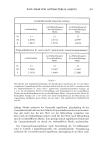
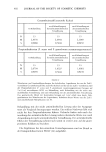
J. Soc. Cosmet. Chem., 29, 449-467 (August 1978) Fractography of human hair G. H. HENDERSON, G. M. KARG andJ. J. O'NEILL Avon Products, Inc., Suffern, NY 10901. Received July 30, 1976. Presented at 9th IFSCC International Congress, June 1976, Boston, Massachusetts. Synopsis Scanning electron microscopy and optical microscopy show that when HUMAN HAIR is extended in water the cuticle usually suffers multiple circumferential FRACTURE with local separation from the cortex before the latter fractures. The cortex fracture is typically smooth and perpendicular to the fiber axis. In the dry state the fracture is more irregular indicating axial splitting of the cortex before or during fracture without prior failure of the cuticle. Except for the cuticle-cortex separation which occurs in wet extension, fracture surfaces do not show a strong tendency to follow cell boundaries. INTRODUCTION Scanning electron microscopy has been applied extensively to the study of human hair topography. Applications have ranged from studies of pathological conditions (1-3) to assessment of the effects of normal weathering and grooming (4) and of cosmetic treat- ments (5, 6). More recently there have been reports of direct observation of the response of hair to mechanical stresses applied by means of apparatus specially designed to manipulate hair in the specimen chamber of the microscope in modes simulating a variety of grooming operations such as brushing and backcombing (7, 8). In this paper we report results of a more conventional study of the topography of hair after tensile strain in different environments and after different pretreatments. We dis- cuss our observations with reference to the known histology and chemistry of hair and the expected response to factors such as hydration and age. MATERIALS AND METHODS Natural brown European hair was obtained from DeMeo Brothers, New York, New York. With the single exception of the study of fracture type versus age, this hair was used throughout. For the latter study, hair samples were obtained from a young woman with long (approximately 50 cm), light brown virgin hair. The hairs were plucked or snipped at a distance not exceeding 1 cm from the scalp. Bleaching with potassium persulfate/hydrogen peroxide was done in alternating 1- and 2-hr intervals to give 3- and 6-hr bleached hair. Fresh solution was introduced at the 449

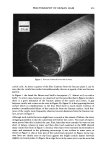
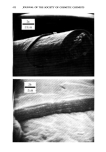
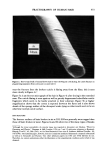
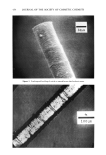
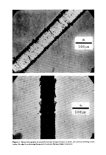
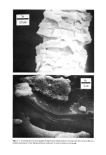
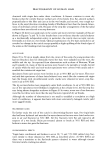
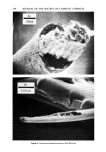
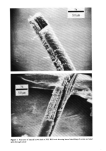
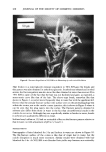
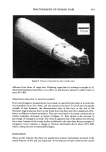
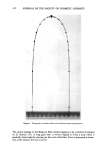
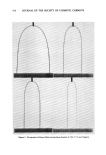
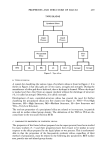
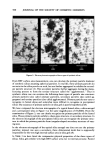
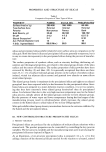
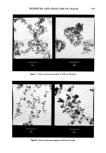
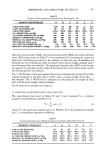
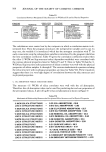
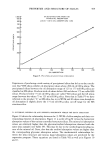
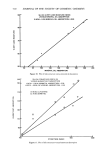
450 JOURNAL OF THE SOCIETY OF COSMETIC CHEMISTS end of each interval. Hairs fractured in solvents were soaked a minimum of 16 hr before Instron testing. Variation in pH was accomplished by addition of acetic acid or ammonium hydroxide. It was noted after 16 hr that the pH of these systems was not af- fected by the hair. Relative humidities other than 50 -+ 1% (room condition) were ob- tained for 20, 71, 79 and 90% by using saturated salt systems (9) in capped jars containing sample hanging racks and a fixed post. Samples to be fractured were equili- brated for a minimum of three days at 21 m iøC in these chambers. A glycerin/water mixture equivalent to a water activity of 50% RH was prepared using 22.5% water and 77.5 % anhydrous glycerin by weight. Stress/strain measurements on hairs were made on a Model TT-B Instron Tester. Hairs were mounted in special holders of stainless steel with chamfered holes and secured with tapered Teflon plugs. The working length was 12.7 mm and most experiments were done at a constant rate of extension of 200%/min. Some determinations were made at one-tenth this speed (20%/min). Hairs run in the humidity chambers were fixed between small screw clamps to provide the desired working length and suspended between a hook on the Instron and the fixed post in the chamber. The hook extended down through a small hole in the cover. The screw clamp subjected the hair to a 2- to 3~g stress during the conditioning period which was ignored since the resulting extension is negligibly small. The hairs were viewed in a Coates and Welter Cwik Scan Model 100-2 Field Emission Scanning Electron Microscope. Prior to viewing, the hairs were sputter coated with gold/palladium in a Denton DV-515 Evaporator equipped with a Model DSM-1 Sput- tering Module. The sputtering was done at 10 mA and 150 millitorr for 1.5 min in in- tervals of 30 sec. For SEM viewing the hairs were mounted perpendicular to the surface of a standard Coates and Welter specimen stub. The length of hair exposed below the fracture varied but was generally of the order of 1 mm. Both sides of the fracture were examined in all cases. The optical microscopy was carried out on hairs immersed in a dish of water on the stage of a Zeiss Universal Photomicroscope. The hairs were mounted on a Hoffmann hose clamp modified to permit use of the screw-driven bearings to stretch the specimen. RESULTS WET FRACTURE The fracture surfaces of virgin hairs broken under water are often quite flat as shown in Figure 1. Here it appears that the fracture started at a small zone on the edge of the fiber and radiated from there in a plane perpendicular to the axis. Such detailed evi- dence of fracture propagation is seldom seen but, in general, the new surface is remarkably devoid of evidence of the cellular and subcellular fibrous structure of hair the fracture pattern is much more similar to the brittle fractures of glass or carbon (10) than to the fracture patterns of other natural fibers such as cotton (11). The cuticle fracture is also planar and perpendicular to the fiber axis and again evidence of cellular structure is lacking there is little sign of delamination or axial slippage of the
Purchased for the exclusive use of nofirst nolast (unknown)
From: SCC Media Library & Resource Center (library.scconline.org)