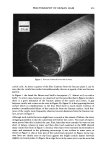
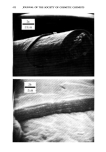
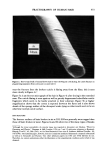
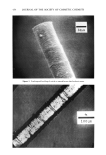
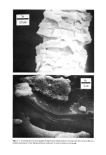
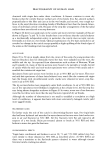
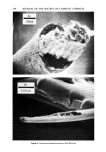
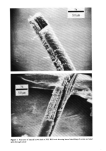
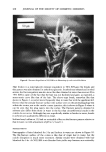
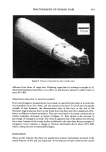
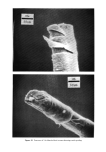
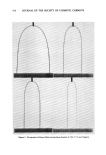
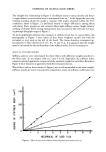
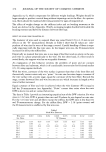
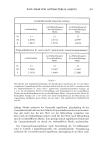
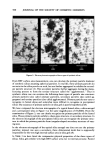
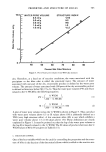
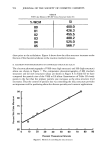
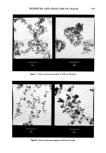
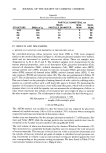
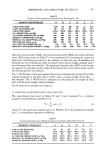
FRACTOGRAPHY OF HUMAN HAIR 465 A similar weakening might have been expected in the case of hair in view of its pronounced swelling in water, but from our data it would appear that the intercellular and interfibrillar material in both wet and dry hair is as strong as the keratinous matter in both the cortex and the cuticle. The cuticle-cortex boundary, however, is a zone of intercellular weakness in the wet state and this weakness is markedly aggravated by oxi- dative bleaching, as shown in Figure 10 cylindrical segments of the entire cuticle have been lost in the process of tensile fracture. This is the only evidence of bleach damage dry breaks of bleached hair appear to be quite similar to those of virgin hair. The weakness of this boundary is also revealed in virgin hair in sleeve fractures (Figure 2) and in the related flaring of the cuticle after its tensile failure, as seen in Figure 4. The multiplicity of the cuticle cracks on wet extension indicates that the junction with the cortex fails only locally, probably as a result of the combined forces of axial shear and radial tension generated by the elastic relaxation of torn cuticle to its unstressed length and radius. The flaring in Figure 4c is about 30% of the fiber diameter as would be expected for relaxation from 70% extension at constant volume (assuming a Poisson ratio of 0.5 throughout). The effect of age on hair fracture is quite different from that of bleach. Where cuticle is present its bond with the cortex seems unchanged, but the cortex in old hair splits and fibrillates much more than in young hair. With reference to virgin hair, we argued above that intact cuticle is involved in the generation of splitting forces on the same argument we would expect that loss of cuticle on old hair should lead to less, not more, splitting on tensile fracture. From the fact that the contrary is observed we conclude that the major effect of aging in the cortex as revealed in fractography is a significant decrease in the inherent cohesiveness of this tissue at the intercellular level. Loss of cuticle in vivo, however, leaves the cortex much more vulnerable to other modes of stress and we do not wish to imply that such loss is of no consequence cosmetically on the contrary, we propose that even in young hair cuticle rupture in the wet state may have significant cosmetic consequences. The evidence of multiple fracture of the cuticle on wet extension (Figures 3 and 4) suggests a mechanism for producing "friz- zies" in midshaft. If the detached cuticle were subsequently eroded away from such fracture sites the cortex would be locally exposed to mechanical and chemical attack. In extreme cases this might lead to a condition dermatologists would diagnose as acquired trichorrhexis nodosa (14). The spongy scales seen in hairs dried in the extended state after wet stretching to cuticle rupture (Figure 4b) are thought to be the remains of cells which have split through the endocuticle layer as proposed by Swift and Bews (15) in reference to similar features on hair which had been subjected to prolonged agitation in water in their cuticle isolation procedure. It seems plausible that if the hair shown in Figure 4 were even mildly scoured in the wet state the scales would slough off and the end result would be a normal-looking hair. This is supported by our observation that after a hair has been broken in water under the optical microscope a considerable amount of scaly, isotropic matter is seen in the bath. It seems reasonable to postulate that such cracking of the swollen endocuticle will occur in hairs under tension since the inclination of the stacked cuticle cells to the fiber axis should give rise to a component of force normal to their surfaces. This sloughing phenomenon should be studied further, especially with reference to the question of whether it occurs at the much lower extensions involved in ordinary grooming operations (such as setting wet hair on rollers) and also whether it occurs

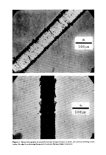
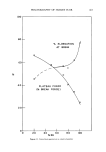
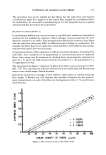
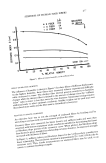
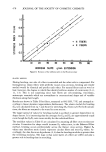
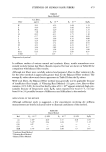
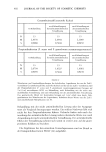
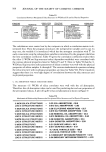
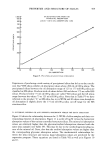
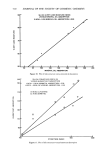
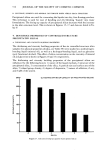
466 JOURNAL OF THE SOCIETY OF COSMETIC CHEMISTS when the entire cycle of extension and relaxation occurs in water. In either case it may make a significant contribution to the gradual loss of cuticle associated with aging. Hair fractures in dry solvents (glycerin, ethanol and ethyl acetate) look like wet frac- tures on cursory examination, but the absence of cuticle cracks and the location of sleeve fracture surfaces in the cortex rather than at the base of the cuticle suggest a se- quence of events different from those of both wet and dry breaks. The absence of noticeable response to pH variation and addition of surfactant indicates that the wet fracture dynamics are not very sensitive to either the charge state of the protein or to reduction of interfacial tension with the environment at the fracture site. Removal of accessible lipids with chloroform/methanol was also without noticeable ef- fect on dry or wet fractures. With reference to Figure 11, the shape of the curves shows that there is not a direct relationship between the plateau-force/break-force ratio and percentage of elongation at break. Nevertheless some interesting features are noted. Compared with the reported decrease in plateau force vs. relative humidity for keratin fibers (16), we find that the plateau-force/break-force ratio decreases more slowly, indicating that a decrease in the break force also occurs with increasing relative humidity. This provides a second, indirect confirmation that wet hair is weaker than dry hair. The percentage of elongation at break is almost constant at 55 to 60% in the 50 to 79% RH range in which jagged fractures are almost invariably obtained in air. We con- clude that, •-cept for highly hydrated hairs, this is the limiting extensibility of the cortex. It is interesting to note in connection with the difference in hair fracture at inter- mediate vs. very high humidities that over 60% of the observed radial swelling of wool by water occurs above 70% RH (17), indicating a change in the effect of water at high humidities. Based on our results, we propose that a similar change in hair properties occurs at high humidities. Over 60% of the change in relative rigidity of wool occurs above 65% relative humidity (18). From our data and that on wool it appears that hydration is the dominant variable affecting both the stress/strain behavior and the fracture mechanics, and that the two are interrelated. It seems appropriate to point out that our data on percentage of elongation at high relative humidities follows a trend very similar to the uptake of water by wool in the same range (19). Based on our own data, hair shows the same behavior up to 90% RH, the highest humidity at which water uptake was determined. SUMMARY Fracture pattern and stress/strain behavior of hair are interrelated through degree of hydration. The different fracture patterns obtained for wet and dry hair are attributed to an inversion in the relative extensibilities of the cuticle and cortex. The boundary of these two tissues is weak in the wet state and this weakness is aggravated by oxidative bleaching. Aging causes a reduction of cohesiveness in the cortex as well as a loss of cuticle a new mechanism, not necessarily involving abrasion, is proposed for cuticle loss. Finally, a new demonstration of the lower tensile strength of wet, relative to dry, hair is presented.
Purchased for the exclusive use of nofirst nolast (unknown)
From: SCC Media Library & Resource Center (library.scconline.org)