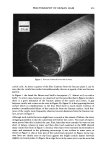
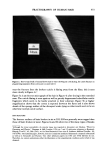
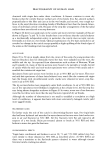
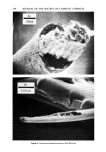
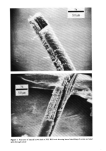
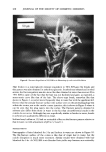
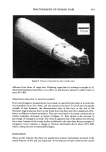
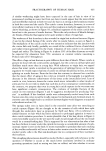
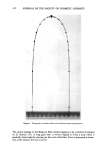
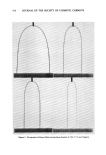
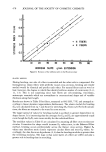
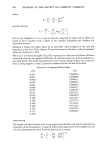
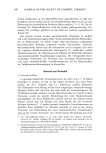
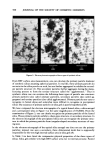
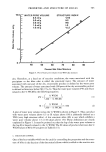
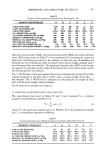
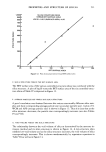
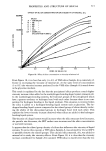
472 JOURNAL OF THE SOCIETY OF COSMETIC CHEMISTS Figure 1. Photograph of a balanced fiber with calculated points superimposed The closest analogy to the Balanced Fiber method appears to be a method developed by D. Sinclair (16). A long glass fiber is twisted slightly to form a loop which is gradually drawn tight by moving one free end of the fiber. Force is measured as a func- tion of the distance the end is moved.

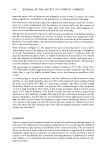
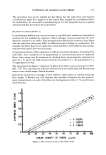
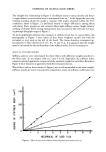
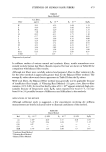
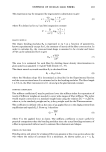
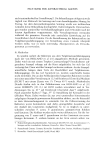
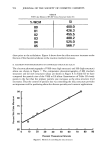
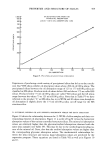
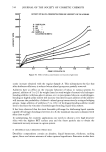
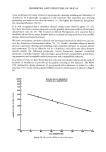
STIFFNESS OF HUMAN HAIR FIBERS 473 The procedure may not be suitable for hair fibers, but the same force and reaction considerations apply for a segment of the looped fiber as apply for our balanced fiber. In confirmation, we succeeded in transforming eq 5 in the Appendix into an equation identical with that derived for the looped fiber. RELATION TO LINEAR DENSITY (L) In developing a stiffness test a test of accuracy is requi•ed since satisfactory materials or methods are not available for reference. Fibers of larger cross-sectional area (A) were therefore assumed to be stiffer. This assumption has deficiencies, however, since fibers with the same area values may differ in stiffness because of shape or composition. For example, flat fibers bend more easily than cylindrical fibers. Nevertheless, this assump- tion provided a good, first test of accuracy. Actual measurement of fiber diameters is difficult and linear densities, determined for each fiber, were considered to be proportional to cross-sectional areas of unaltered fibers. Area values may be estimated by dividing these measurements, expressed as g/cm, by 1.31 g/cm a, the bulk density found for wool fibers (17, 18) and assumed (11, 19) appropriate for hair. The data plotted in Figure 2 represent 24 fibers from three sources measured at 60% RH, 75øF. The only basis for selection of fibers from two individuals and Korean hair was to cover a broad range of linear densities. Each point represents an average of four stiffness values taken at random along the fiber length. A Bartlett test (20) indicates that standard deviations for the point-to- point measurements on each of the fibers are homogeneous with a 3.7% pooled stan- dard deviation. 1.0 0.8 0.6 0.4 0.2 ../.•• • H FIBERS L FIBERS . •/o- ß K FIBERSIII / I I I I I I0 20 30 40 50 60 70 80 90 I00 LINEAR DENSITY OF FIBERS /a.g/crn Figure 2. Effect of linear density on the stiffness index
Purchased for the exclusive use of nofirst nolast (unknown)
From: SCC Media Library & Resource Center (library.scconline.org)