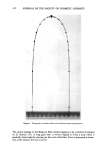
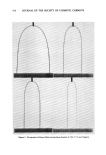
484 JOURNAL OF THE SOCIETY OF COSMETIC CHEMISTS I/R = TD/2 and, from eq 3, EB I = TD2/8. Combining the equations to eliminate EB I, R = D/4. Strain e is equal to r/R, where r is the radius of the fiber, and hence e = 4r/D. Since the elastic modulus is the ratio of stress to strain, the maximum stress cr = e EB. Substituting 4r/D for e and the value of Eu from eq 3 and since I = wr4/4, we have for the maximum fiber stress 2 TD cr- (10) Theoretically and empirically, D is proportional to A or r 2 and consequently the maximum stress is inversely proportional to r. Thus, thin fibers undergo greater stresses than thick fibers and require more care in handling during measurements. The stiffness index value and the maximum bending moment are affected by changes in the applied force T. Since TD 2 = 8 En I = a constant, a change from T to kT changes D to D/X/•. The maximum bending moment M = TD/2. When T is changed to kT, D changes to D/X/-• and, to maintain the equality 2M = TD, the maximum bending mo- ment changes to M X/•. CONTACT OF FIBER WITH WIRE Acceptable stiffness measurements require that contact between fiber and wire be minimal, theoretically a point contact. For a given bending force and fiber stiffness, this places a limit on wire diameter that may be used. As shown above, the radius of curvature of the bent fiber R = D/4. For equal radius of curvature of wire and bent fiber, R must equal the wire radius or half its diameter. Replacing R with W/2 gives 2W = D. Accordingly, for "point" contact, wire diameter should be less than half the distance D. At larger wire sizes, contact between fiber and wire assumes an arc shape. REFERENCES (1) (2) (3) (4) (5) (6) (7) (8) (9) (10) (11) P. W. Carlene, The relation between fiber and yarn flexural rigidity in continuous filament viscose yarns, J. Text. Inst., 41, T159 (1950). P. W. Carlene, The measurement of the bending modulus of monofils, J. Text. Inst., 38, T38 (1947). J. C. Guthrie, D. H. Morton and P. H. Oliver, An investigation into bending and torsional rigidities of some fibers, J. Text. Inst., 45, T912 (1954). R. M. Khayatt and N.H. Chamberlain, The bending modulus of animal fibers, J. Text. Inst., 39, T185 (1948). N. E. King, Comparison of Young's modulus for bending and extension of single mohair and kemp fibers, Text. Res. J., 37,204 (1967). W. E. Morton and J. W. S. Hearle, "Physical Properties of Textile Fibers," Butterworth and Co., Ltd., London, England, 1962, p 376-383. K. R. Sen, The elastic properties of single jute filaments, J. Text. Inst., 39, T339 (1948). C. R. Robbins and G. V. Scott, Prediction of hair assembly characteristics from single fiber properties, submitted for publication, August 1977. P.S. Hough,J. E. Huey and W. S. Tolgyesi, Hair body, J. Soc. Cosmet. Chem., 27, 571 (1976). E. M. Karrholm and B. Schroder, Bending modulus of fibers measured with the resonance frequency method, Text. Res. J., 23,207 (1953). W. S. Simpson, A comparison of methods of measurement of Young's modulus for keratin fibers, J. Text. Inst., 56, T675 (1965).

STIFFNESS OF HUMAN HAIR FIBERS 485 (12) R. Meredith and J. W. S. Hearle, "Physical Methods of Investigating Textiles," Interscience Publishers, Inc., New York, New York, 1959, p 235. (13) T.W. Mitchell and M. Feughelman, The bending of wool fibers, Text. Res. J., 35, 311 (1965). (14) J. W. Ballou and J. C. Smith, Dynamic measurements of polymer physical properties, J. Appl. Phys., 20, 493 (1949). (15) G. V. Scott and C. R. Robbins, A convenient method for measuring fiber stiffness, Text. Res. J., 39, 975 (1969). (16) D. Sinclair, A bending method for measurement of the tensile strength and Young's modulus of glass fibers, J. Appl. Phys., 21,380 (1950). (17) P. Larose, The density of wool in hydrocarbons, Text. Res. J., 34, 80 (1964). (18) P. Alexander, R. F. Hudson and C. Earland, "Wool," Chapman and Hall Ltd., London, England, 1963, pp 88-89. (19) M. Chaikin and N.H. Chamberlain, The propagation of longitudinal stress pulses in textile fibers, J. Text. Inst., 46, T44 (1955). (20) W.J. Dixon and F. J. Massey, "Introduction to Statistical Analysis," McGraw-Hill Book Co., Inc., New York, New York, 1957, p 179. (21) P. Grosberg and D. Plate, Capstan friction for polymer monofilaments with rigidity, J. Text. Inst., 60, 268 (1969). (22) I.M. Stuart, Capstan equation for strings with rigidity, Brit. J. Appl. Phys., 12,559 (1961). (23) J. H. Nachtigal, private communication. (24) B. Worsnop and H. Flint, "Advanced Practical Physics for Students," Methuen and Co., Ltd., London, England, 1941, p 86. (25) D. Murray, "Differential Equations," Longmans Green and Co., New York, New York, 1936, p 52. (26) W. Michels, "The International Dictionary of Physics and Electronics," D. Van Nostrand Co., Inc., New York, New York, 1956.
Purchased for the exclusive use of nofirst nolast (unknown)
From: SCC Media Library & Resource Center (library.scconline.org)