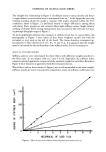
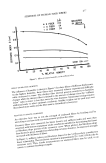
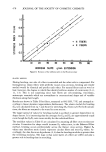
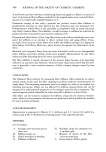
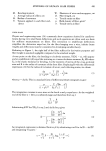
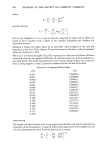
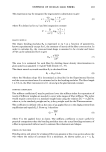
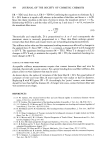
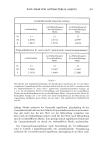
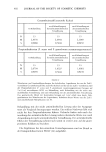
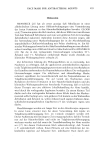
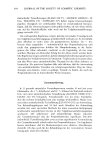
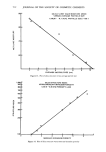
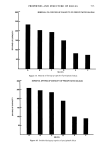
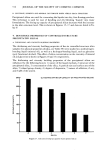
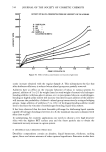
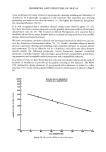
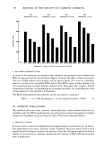
470 JOURNAL OF THE SOCIETY OF COSMETIC CHEMISTS rings had to be very carefully made round, in one plane and small, 1 to 2 cm in diameter. Both beam and loop methods required precise measurement of very small deflections and forces. A dynamic procedure using short lengths of fibers as vibrating reeds (3, 6, 10, 11, 14) seemed experimentally more attractive, but we preferred a static or quasi-static (10) method for relating to hair behavior. No other methods re- viewed offered better prospects for routine screening of hair treatment effects. Changes in fiber strength are conveniently monitored by conventional tensile measure- ments which presumably serve as indirect measures of fiber stiffness. Controversy exists, however, as to the equivalence of elastic moduli calculated from stretching and from bending keratin fibers (3-5, 11). Unlike stretching, fiber bending involves both extension and compression with greatest strains near peripheral points of the fiber cross section. As a consequence, if fiber strength is affected chiefly in outer portions of a fiber, treatment effects may be detected more readily by stiffness than by tensile measurements. Aside from means for estimating stiffness, a question remains as to the extent to which hair fiber stiffness can be altered by practicable hair treatments. Few current hair products of the nondamaging variety can be expected to produce more than superficial effects on stiffness. With a convenient measuring means available, however, perhaps this can be changed. Essential working details of a simple method for measuring hair fiber stiffness were first disclosed in a very brief communication (15). The present paper describes the com- plete method giving information which includes a theoretical basis for equations, ex- perimental data obtained on hair fibers and how these data relate to other measured properties of the same fibers. For easier reading, theoretical equations are derived in the Appendix with appropriate equations brought forward where needed in the text. The Appendix also contains a glossary of symbols used in this paper. EXPERIMENTAL MATERIALS AND METHODS Hair fibers used were from a 15-year-old Caucasian female (H), a 12-year-old Cau- casian female (L) and from purchased South Korean hail: (A. Klugman Inc., New York, New York). Unless otherwise specified, the fibers were equilibrated and measured in a room maintained at 60% RH, 75øF. STIFFNESS DETERMINATION (D) The procedure used for determining stiffness is as follows: weights are attached to each end of a fiber by threading the end through a short length of plastic tubing and insert- ing a tapered metal pin in the tubing to wedge the fiber. The weights of pin plus tubing on each fiber end are equal and known exactly. The fiber is carefully draped over a wire hook and a separately hung guide bar is brought into light contact with the fiber legs to hold the fiber plane 'perpendicular to the optical axis of a horizontal cathetometer. The distance between tile two vertical legs is measured several times by moving the distal end upwards, slidfng the fiber to different contact points on the hook. The average distance in centimeters is'expressed as the stiffness index (D) for that fiber.

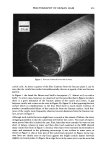
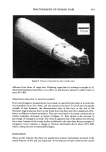
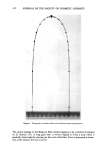
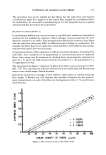
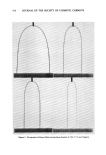
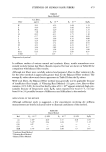
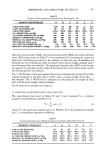
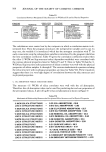
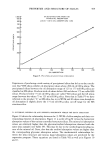
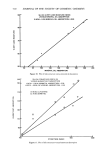
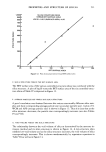
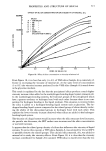
STIFFNESS OF HUMAN HAIR FIBERS 471 For most human hair fibers, a recommended weight of pin and tubing is 0.1 g with a hook wire diameter of 0.75 mm. LINEAR DENSITY DETERMINATION (L) The fiber is measured for length to the nearest millimeter and is weighed to the nearest 0.01 mg using a Roller Smith © 3-mg Precision Balance (Federal Pacific Electric Co., Newark, New Jersey). Results are conveniently expressed as micrograms per cm (L) of fiber. TENSILE DETERMINATION (H) A fiber of 5-cm gauge length is extended at a rate of 0.1 in./min using an Instron © Model TM with Tension Cell A set at 10 g full scale. From the linear portion of the charted trace, the Hookean or elastic slope is estimated as g per mm extension (H) of the 5-cm fiber. RESULTS AND DISCUSSION Although fiber stiffness is important for overall hair performance, no convenient method for measurement of single fibers appeared to be available. Several approaches were tried in an effort to develop an empirical procedure which might be applied for evaluating hair treatment effects. Instron measurement of the work required to draw large hair loops taut between pegs was encouraging but suggested the simpler method described in this paper. A fiber, weighted on each end, is draped over a fine wire and the distance (D) between the vertical legs is measured. The test proved useful on an empirical basis and became more acceptable with development of theory, outlined in the Appendix. The test is referred to below as the "Balanced Fiber" method and the distance between legs as the "Stiffness Index." FIBER SHAPE A fiber was hung in the usual way and photographed. Before theory was developed, at- tempts were made to shape-fit enlargements with simple curves that might empirically characterize the hanging fiber. Our lack of success here is readily explained by the com- plexity of the theoretical equation for fiber shape (Appendix, eq 5). The equation was tested by measuring the enlargement for a D value and calculating values of y at assigned x values. The points coincide with the fiber shape as shown in Figure 1, confirming the theoretical treatment. In another photo, not shown, a pronounced short-length bend just above the vertical part of the fiber had apparently no effect on the otherwise smooth inverted-U shape. A technique of comparing theoretical and photographed fiber shapes may be useful for examining individual fibers for eccentricities. For this purpose, calculations have been simplified by providing computed factors (AppendixmFiber Shape). The distance from the hook to any point along the fiber may also be calculated by applying similar computations to eq 6, Appendix.
Purchased for the exclusive use of nofirst nolast (unknown)
From: SCC Media Library & Resource Center (library.scconline.org)