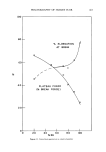
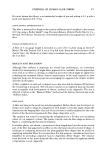
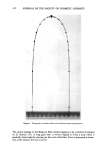
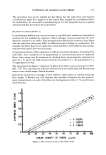
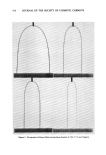
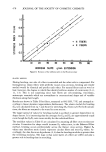
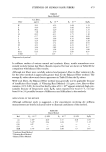
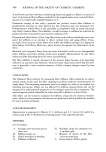
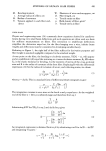
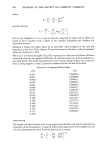
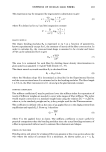
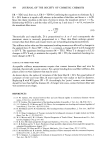
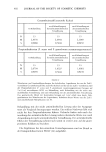
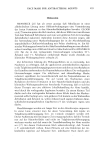
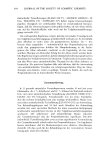
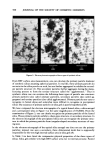
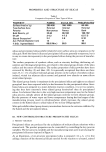
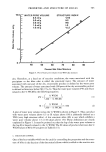
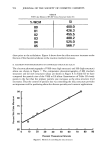
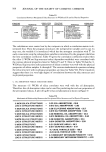
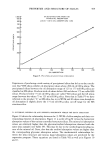
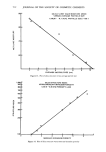
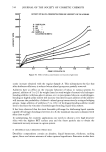
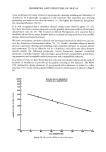
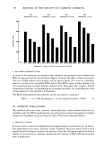
478 JOURNAL OF THE SOCIETY OF COSMETIC CHEMISTS x la.I 1.0 0.8 0.6 - 0.2 I0 20 30 40 50 60 70 80 HOOKEAN SLOPE g/rnrn EXTENSION Figure 6. Relation of the stiffness index to the Hookean slope ELASTIC MODULI During bending, one side of a fiber is extended and the other side is compressed. For homogeneous elastic fibers with perfectly round cross sections, bending and tensile moduli would be identical and predict each other. For natural fibers such as wool or hair, however, the degree to which this identity holds is a matter of controversy (2-6, 11, 13). This is not surprising since hair fibers are oil-containing, viscoelastic, anisotropic materials which are nonuniform in cross-sectional shape and of variable thickness along their length. Results are shown in Table II for fibers, measured at 60% RH, 75øF, and arranged ac- cording to linear densities (approximate thicknesses). The elastic moduli for bending (En) are calculated from eq 7 and those for stretching (Es) from eq 8. For both calcula- tions, the fibers are assumed to be round in cross section. The larger spread of values for bending moduli is ascribed to greater dependence on shape factors. It is interesting that the averages for EB and Es are approximately equal even though the EB/Es ratio varies widely for the individual fibers. The modulus values in Table II are calculated by assuming all fiber cross sections are circular. Correction for shape would increase Eu values since, in the Balanced Fiber method, bending occurs preferentially across the fiattest cross section. Higher Eu values may therefore more closely represent circular fibers and truer Eu values. Ac- cordingly, the data favors an hypothesis (4, 6) that the bending modulus is greater than the stretching modulus. The logic is that outer layers of a fiber are stiffer and play a greater role in bending than in stretching.

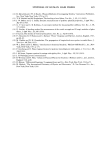
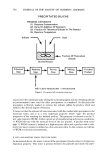
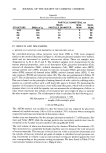
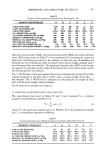
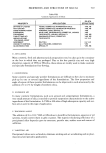
STIFFNESS OF HUMAN HAIR FIBERS 479 Table II Elastic Moduli a Lin. Dens. Fiber /zg/cm EB' 10 -•ø Es' 10 -•ø EB/Es K 99.5 4.23 3.68 1.15 L 94.9 3.54 3.82 0.93 K 89.2 4.29 3.43 1.25 L 71.8 4.25 3.83 1.11 H 69.2 4.11 3.75 1.10 L 67.7 3.35 3.96 0.85 L 54.6 3.60 4.12 0.88 L 52.9 4.69 3.98 1.18 H 52.6 3.74 4.03 0.93 H 42.3 3.23 4.21 0.77 L 34.4 2.89 4.33 0.67 H 31.3 3.58 3.59 1.00 Aver. 63.4 3.79 3.89 0.97 % SD -- 13.9 6.7 -- aExpressed as dynes/cm 2. In stiffness studies of various natural and synthetic fibers, textile researchers occa- sionally include human hair fibers. Results reported for hair are shown in Table III for comparison with balanced fiber results. Although test fibers were carefully selected and prepared, fiber-to-fiber variation in EB for the other methods is appreciably greater than for the Balanced Fiber method. The average Es values show much better agreement in Table III than the EB values. With wool fibers, the Balanced Fiber method may generally not be applicable because of insufficient fiber length. A Vibrating Reed Method (! !) gave a low, fiber-to-fiber variation (12% S.D.) for wool but the EB value of 8 X 10 •ø appears relatively high, pre- sumably because of frequencies used. EB/Es ratios reported for wool (3-5, ! 1) vary from 0.4 to 3.4, possibly because of differences and difficulties in the methods. APPLICATIONS OF THE METHOD Although additional study is suggested, a few experiments involving dry stiffness measurements are briefly indicated below to illustrate usefulness of the method. Table III Elastic Moduli Ref. E8 ' 10 -•ø % S.D. Es ß 10 -•ø % S.D. En/Es (4) 1.95 • 40.9 3.57 16.8 0.55 (11) 5.35 b 22.4 3.68 7.7 1.45 (10) 4.9 b .... (19) -- -- 3.60 -- -- S&R 3.79 c 13.9 3.89 6.7 0.97 Cantilever Beam Method. •Vibrating Reed Method. Balanced Fiber Method.
Purchased for the exclusive use of nofirst nolast (unknown)
From: SCC Media Library & Resource Center (library.scconline.org)