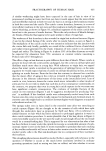
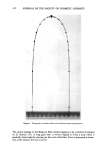
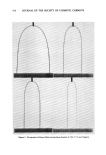
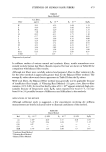
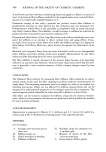
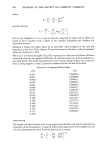
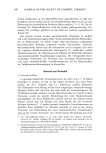
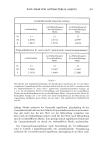
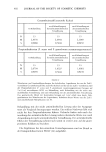
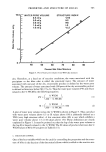
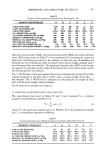
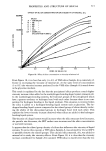
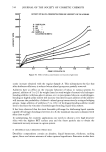
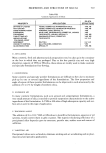
482 JOURNAL OF THE SOCIETY OF COSMETIC CHEMISTS where and the constant -D D X/•+ 1 C - + logo -- For us, the integration of eq 4 was an exercise requiring 40 steps and no effort was made to find a shorter route. Copies of the detailed integration are available for interested persons. Equation 5 defines the shape taken by an ideal fiber when weighted at the ends and hung from a fine wire. Only distance D must be known to calculate y values at assigned values ofx from zero to D/2. When eq 5 is divided through by D, y/D is expressed as a function ofx/D and y/D has a numerical value at each assigned x/D value. A computer print-out of these quantities is provided below. For any D measurements, x and y values along the fiber are readily ob- tained. Using negative x values, points are obtained for the left half of the fiber. Factors •r Computing FiberShape x/D -y/D 0.001 0.000002 0.002 0.000008 0.0025 0.000012 0.004 0.000032 0.005 0.000050 0.008 0.000127 0.010 0.000199 0.025 0.001232 0.050 0.004878 0.100 0.019335 0.200 0.079170 0.300 0.194416 0.400 0.423225 0.450 0.664291 0.475 0.908362 O.5O0 FIBER LENGTH The length z of fiber from the wire to any point along the fiber may also be expressed as a function of the D parameter. Using the differential expression for the length of an arc (25) and substituting the value for dy/dx from eq 4, we obtain az_ 1- (• D2/j dx

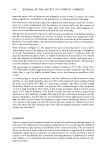
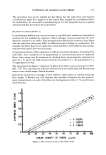
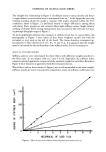
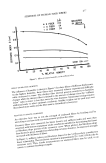
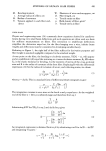
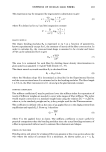
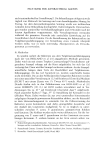
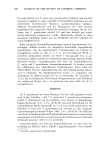
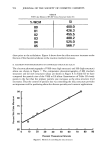
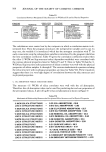
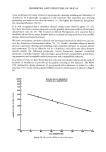
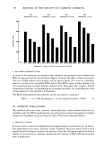
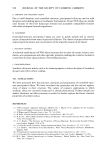
STIFFNESS OF HUMAN HAIR FIBERS 483 This expression may be integrated by trigonometric substitution to give -D I+F z - 1og•- + C' 4X/• 1-F where F is defined as for eq 5 and the integration constant D X/•-+ 1 C' - 1og• -- (6) ELASTIC MODULI The elastic beriding modulus EB is expressed in eq 3 as a function of parameters, known experimentally except for I, the moment of inertia of the fiber cross section. In order to calculate EB, the cross-sectional shape is assumed to be circular and hence A2/4•r can be substituted for I to give •rT D 2 EB -- (7) 2A • The area A is estimated for each fiber by dividing linear density determinations in g/cm units by an assumed 1.31 g/cm 3 bulk density (11, 19). The elastic stretch or tensile modulus Es is calculated from Es = H g 1/A A (8) where the Hookean slope H is determined as described in the Experimental Section and the cross-sectional area A is estimated as for the bending modulus. The fiber length 1 is 5.0 cm, the fiber extension A is 0.1 cm and g is the gravitational constant. STIFFNESS COEFFICIENT The stiffness coefficient G may be preferred over the stiffness index for expression of results if different weights are needed to cover wide ranges of fiber stiffness. The index would require correction to a standard weight basis using the relation D• • = w•D•2/w• where w• is the standard g weight and w• is the g weight used for the D measurement. The coefficient is defined (26) as the ratio of an applied force to the displacement from equilibrium and equals EB I. From eq 3 therefore TD • G - (9) 8 where T is the applied force in dynes. The stiffness coefficient is more useful for practical comparisons than the bending modulus since the actual bending resistance of a fiber is represented without need to estimate fiber diameters and shapes. FORCES ON THE FIBER Bending stress and strain for a balanced fiber are greatest at the cross section above the wire where the radius of curvature R is a minimum. As shown earlier, at x = o, EB
Purchased for the exclusive use of nofirst nolast (unknown)
From: SCC Media Library & Resource Center (library.scconline.org)