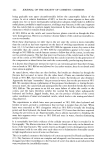
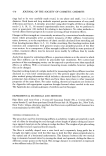
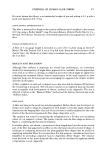
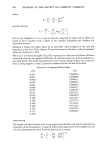
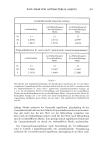
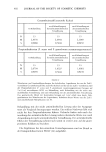
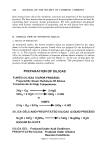
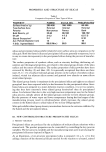
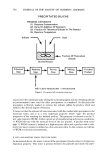
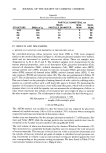
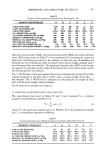
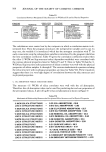
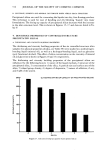
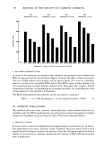
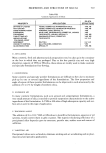
PROPERTIES AND STRUCTURE OF SILICAS 501 Table I Comparative Properties of Three Types of Silicas PROPERTY FUMED SILICA GEL PRECIPITATED Surface Area (m:/g) 200-400 300-1000 60-300 Type Surface Area External Internal External Porosity Non-porous Porous Both Bulk Density, g/I 32-64 96-160 160-192 5% pH 3-4.2 4-7.5 6.5-7.5 Silanol Groups/nm 2 2-4 4-8 8-10 Ave. Particle Diameter (nm) 14 -- 18 % SiO 2 (Ignited Basis) 99.8 (Min.) 99.5 98.0 silicas and precipitated silicas exhibit relatively lower surface areas in comparison to the silica gels. Both the fumed silicas and precipitated silica are generally nonporous, but it is easy to create microporosity in the precipitated silicas during the process of manufac- ture. The surface properties of synthetic silicas, such as viscosity building, thickening, ad- sorption and rheological properties, are related to the silanol group density of the silica surface and the extent of hydration. The surface properties of silica powders have been reviewed by Hockey (9) and Hair (10). It is generally recognized that there are three types (9, 11-13) of surface hydroxyl groups present on the surface of synthetic silicas: isolated, vicinal (on adjacent silicon atoms) and geminal (two silanols on same silicon atom) silanol groups. The silanol group density is maximum in the precipitated silicas and eight to ten silanol group/nm 2 have been reported widely in the literature for the precipitated silicas. Since fumed silicas are prepared in a water-deficient reaction condition, it is not too surpris- ing that they have extremely lower silanol group density/nm 2 than do precipitated silicas. It is believed that due to the very high reaction temperature used in the fumed silica process, initially almost all the silanol groups condense to form siloxane groups. But the presence of water vapor and lower temperature during the final stages of the manufacturing process result in rehydroxylation which increases the silanol group content in the fumed silicas to a final value of two to four OH group/nm •. Silica gels exhibit silanol group density intermediate between the extreme exhibited by the fumed and the precipitated silicas. III. NEW CONTROLLED-STRUCTURE PRECIPITATED SILICAS A. PROCESS VARIABLES Precipitated silicas are produced by the acidulation of sodium silicate solutions with a mineral acid. The product properties can be controlled by controlling the key process variables. The key process variables and the manufacturing steps used in producing the precipitated silicas are depicted in Figure 4. As an illustration, a low-structure precipitated silica is prepared (14 a, b, c) by first adding a fraction of the theoretical silicate needed for the reaction to a heated, stirred

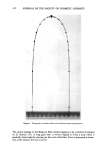
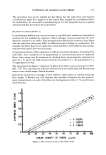
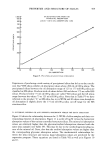
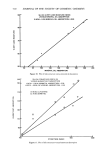
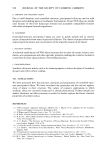
502 JOURNAL OF THE SOCIETY OF COSMETIC CHEMISTS PRECIPITATED SILICAS PROCESS VARIABLES (3) Reactant Concentration (2) Rates Of Addition Of Reactants (3) Fraction Of Theoretical Silicate In The Reactor (4) Reaction Temperature Silicate Acid Stirred Reactor Fraction Of Theoretical Silicate Filtration Step Washing Step Drying • Milling Step Step WET CAKE MOISTURE =STRUCTURE Figure 4. Precipitated silica manufacturing steps Finished Product reactor and then simultaneously adding the acidulating agent and the remaining silicate at predetermined rates until the silica precipitation is completed. At this point the precipitate is filtered, washed to remove the sodium sulfate by-product, dried and milled to the desired degree of fineness. It turns out that the amount of water associated with the washed silica precipitate is the structural water, and it is a very important property which "tags" the product properties of the resulting dry finished product. This property is referred to as the % wet cake moisture (WCM). Under a given set of manufacturing and process conditions, % WCM will vary with the structure level of the dry product. A product with a very high % WCM content is defined as a high-structure silica and a product with a rela- tively low water content is defined as a low-structure silica. In this context, we will use % WCM or structure synonymously. B. WET CAKE MOISTURE VERSUS STRUCTURE INDEX As mentioned above, the water content of the precipitated product prior to drying is an important property. This water is present between the particles and inside the pard-
Purchased for the exclusive use of nofirst nolast (unknown)
From: SCC Media Library & Resource Center (library.scconline.org)