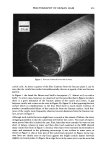
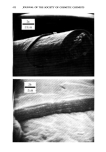
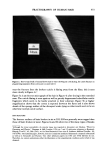
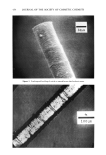
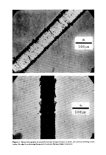
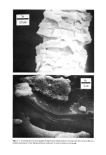
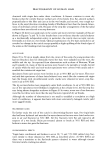
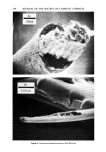
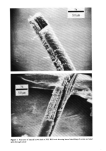
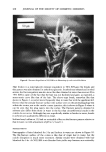
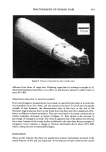
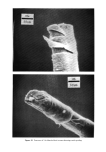
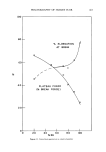
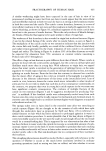
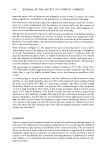
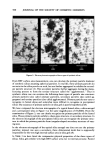
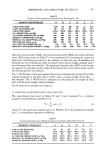
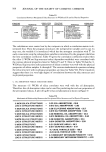
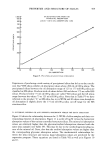
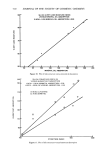
FRACTOGRAPHY OF HUMAN HAIR 451 25m Figure 1. Fracture of natural brown hair in water cuticle cells. At about a quarter of the fiber diameter from the fracture plane it can be seen that the cuticle has cracked circumferentially this too is typical of the wet fracture pattern. In Figure 1 the break fits Brown and Swift's description (7) "almost as if cut with a knife." In a few cases, however, we observed wet fractures like that in Figure 2a where there is a gross mismatch of the fracture planes of the cuticle and cortex. A gap between cuticle and cortex can be seen in Figure 2b. Figure 2c is the opposing fracture surface which is complementary to the first. Here there is much clearer evidence of another circumferential failure of the cuticle far from the fracture surface. Such frac- tures of the cuticle were frequently observed several diameters from the fracture sur- face, as seen in Figure 3. Although such cuticle fractures might have occurred at the instant of failure, the more intriguing possibility is that the cuticle fails well before the cortex. Two types of experi- ment proved that this is indeed the case. First, hairs that were extended in water to just short of failure, relaxed in water and then dried and examined in the SEM showed many cracks like those in Figure 3. Second, when hairs were extended incrementally in water and examined in the polarizing microscope it was evident in some cases, as shown in Figure 4, that at least part of the cuticle had ruptured. In Figure 4a the rup- ture lines are clearly seen in top focus against the bright corticle matter between slightly uncrossed polars. In Figure 4b at edge focus in the same view it can be seen that

452 JOURNAL OF THE SOCIETY OF COSMETIC CHEMISTS 2Slam
Purchased for the exclusive use of nofirst nolast (unknown)
From: SCC Media Library & Resource Center (library.scconline.org)