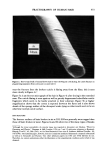
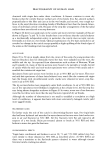
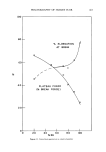
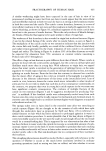
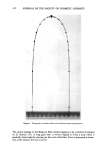
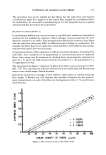
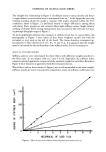
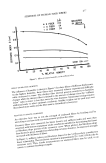
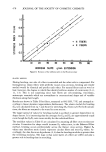
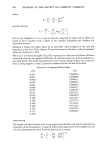
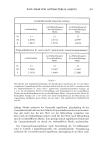
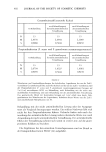
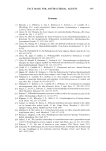
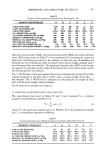
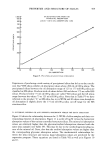
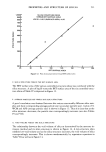
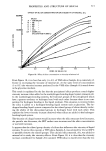
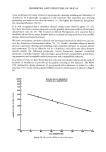
FRACTOGRAPHY OF HUMAN HAIR 463 IOO 8O 60' 40 20. % ELONGATION PLATEAU FORCE • 20 40 60 80 I00 %RH Figure 11. Stress/strain parameters vs. relative humidity

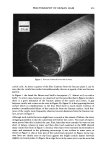
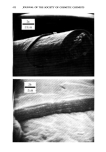
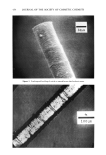
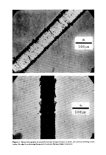
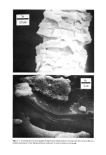
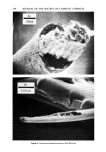
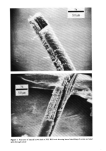
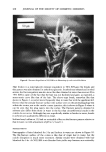
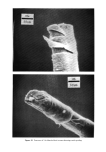
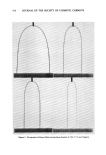
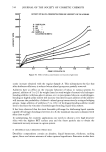
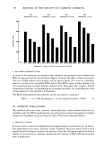
464 JOURNAL OF THE SOCIETY OF COSMETIC CHEMISTS being gradually torn apart circumferentially before the catastrophic failure of the cortex. In air at relative humidities of 80% or less the cortex appears to have split axially into two or more mechanically independent subunits which failed in different radial planes, probably in rapid sequence, yielding a step fracture in this case it appears that the cuticle fails in a pattern largely determined by that of the underlying corticle elements to which it remains firmly attached. At 90% RH in air the cuticle and cortex fracture planes coincide as though the fiber were homogeneous. There is no evidence of prior failure of the cuticle as invariably oc- curs in wet breaks. From these observations we infer that in the wet state the cortex is more extensible than the cuticle as has been reported on the basis of swelling experiments on animal hair (12, 13), but that in air at less than 90% RH the opposite is true dry cortex is less extensible than dry cuticle. At 90% RH the extensibilities appear to be equal. Al- though at 50% RH the cuticle fracture seems to follow that of the cortex, its role may not be entirely passive. The fact that prior wet fracture of the cuticle leads to fiat frac- ture of the cortex at 50% RH indicates that the cuticle is involved in the generation of the compressive or shear forces that crack the cortex axially, producing step fractures. It is known that if hairs are stressed in water to an extension greater than their elonga- tion at break in 50% RH air and allowed to dry under tension, they do not break until more stress is applied. As stated above, when they are then broken, fiat breaks are obtained as though the fracture had occurred in water. On the other hand, if hairs are extended almost to break at 50% RH, then hydrated and broken in water, fiat breaks are also obtained. Apparently the hairs "remember" the pre-stress in water, but not the pre-stress at 50% RH. We interpret this as confirmation of the proposed mechanism, i.e. during the pre- stress in water, the cuticle fails and subsequently the cotex therefore breaks fiat even in 50% RH air. The pre-stress in air did not cause failure of either the cuticle or the cortex, and the hairs therefore exhibit the normal fiat break when subsequently hydrated and broken. Jagged breaks, then, are the product of failure of the cortex under conditions of intact and attached cuticle, which leads to the tearing and shred- ding observed. The experiments in which hairs were pre-stressed at 50% RH, then hydrated and broken in water, provide a confirmation that wet hair is weaker than dry hair. When hairs were extended to 58% elongation (which at 50% RH is virtually the breaking point) and then hydrated, the break force is at least 15% lower than the force required during the pre-stress in air. Experimentally, this is almost equivalent to breaking the same hair segment twice--once at 50% RH and once in water, thereby eliminating sample variation. It is remarkable how little evidence of the cellular structure of hair is revealed in its fractography. The fibrous structure of the cortex is clearly seen only on the lateral sur- faces of dry step fractures. The cuticle cleaves as though it were a homogeneous sleeve its imbricated cells do not slide over each other nor is delamination detectable except in high magnification views of some wet fractures. This is in marked contrast to the behavior of cotton as reported by Hearle and Sparrow (11). Dry fractures of cotton are complex and elongated wet fractures are even more elongated and their resemblance to the fracture of a yarn was taken as an indication that water weakens the interfibrillar matter.
Purchased for the exclusive use of nofirst nolast (unknown)
From: SCC Media Library & Resource Center (library.scconline.org)