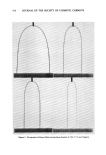
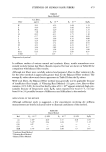
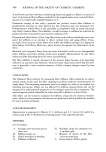
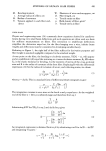
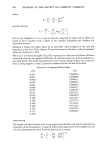
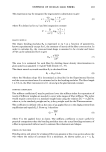
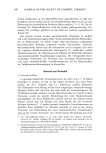
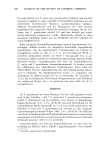
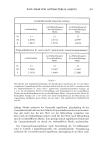
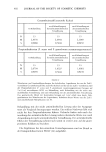
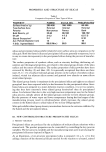
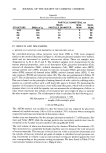
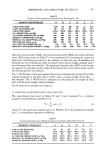
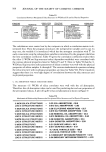
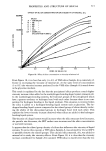
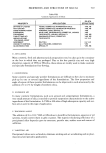
476 JOURNAL OF THE SOCIETY OF COSMETIC CHEMISTS Appendix eq 9), which compensate for different weight loadings. Weights should be large enough to produce vertical hang without imparting a set to the fiber. As a precau- tion, fibers should be examined after measurement for signs of imparted set. The effect of weight change on the stiffness index and on bending moments at the hook are derived in the Appendix. Briefly, increasing weights fourfold will double the bending moment and halve the distance between fiber legs. EFFECT OF HOOK WIRE DIAMETER (W) The diameter of wire used tq suspend fibers was varied from 0.19 to 3.16 mm to test effects on the "D" measurement. Results in Table I show that D values are inde- pendent of wire size for most of the range covered. Careful handling of fibers is espe- cially important with the fine wire sizes. At the largest wire size, the D measurement increases for all but the stiffest fiber. Empirically we learned that wire size is too large if the fiber tends to orient on the sup- port wire in a plane perpendicular to the wire. On the other hand, if a fiber tends to swivel freely, the support wire has an acceptable diameter. An explanation of this behavior involves the problem of point and arc contacts between fiber and substrate, which is of considerable interest also for frictional studies (21, 22) using capstan methods. With fine wires, curvature of the wire surface is greater than that of the bent fiber and theoretically contact exists only at a "point." As wire size becomes larger, curvature of the wire surface will, at some stage, equal the curvature of the bent fiber. Beyond this stage, contact between fiber and wire becomes an arc which increases in length as wire size is further increased. Equal curvature of fiber and wire is achieved when the wire diameter (W) is equal to half the D measurement (see Appendix). "Point" contact thus exists when the ratio D/W is above two and arc contact below two. The data in Table I provide an interesting empirical test of the D/W criterion. For wire sizes to 1.62 mm, D/W is greater than two and D values do not depend on wire size. For the 3.16-ram wire and all fibers except the stiffest, the D/W ratio is less than two and D measurements change. For the stiffest fiber, D/W = 2.18 (point contact) and the D measurement is unaffected by this wire size. Table I Hook Wire Diameter Wire (cm) 0.019 0.024 0.031 0.038 0.076 0.128 0.162 0.316 Lin. Dens. "D" Distance 46.9•g/cm 0.35 0.35 0.34 0.34 0.33 0.33 0.33 0.45 51.1 0.39 ..... 0.39 0.47 56.7 0.41 0.41 0.41 0.40 0.41 0.41 0.39 0.48 58.0 0.44 ..... 0.44 0.51 63.6 0.48 ..... 0.46 0.52 69.0 0.50 ..... 0.51 0.54 89.8 0.61 ..... 0.60 0.62 89.3 0.68 ..... 0.69 0.69

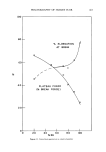
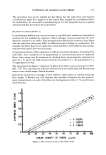
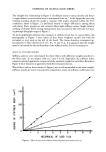
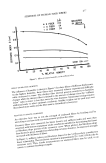
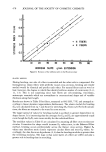
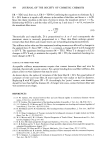
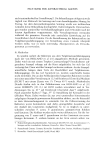
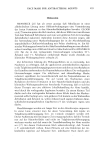
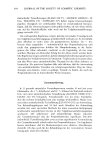
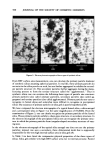
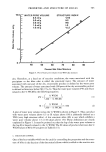
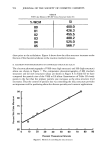
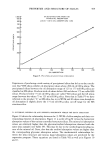
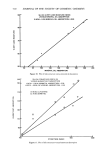
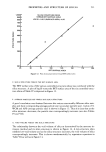
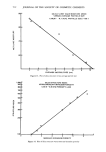
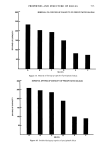
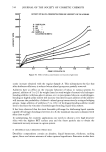
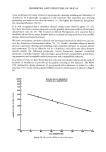
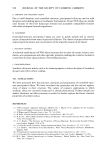
1.0 0.B 0.6 0.4 477 STIFFNESS OF HUMAN HAIR FIBERS L._.•.D. MEASURED ß K FIBER 102 IN W,.•• z• H FIBER 54 o H FIBER 34 IO HOOK DIA. '•-- ZO 30 40 50 60 70 80 % RELATIVE HUMIDITY Figure 5. Effect of relative humidity on the stiffness index 90 100 EFFECT OF RELATIVE HUMIDITY influence of humidity is shown in Figure 5 for three fibers of The ' ß ß t fibers were measured without experimen"stiffnessdifficuthicknthedifferent changes while the thinnest fiber is limited in the amount of change index" value in water is less than twice the wire diameter. immersiwetrequusedtestingbesincecan additional study to select optimum conditions. Smaller weights since fibers bend more easily and the fiber mass is diminished by buoyancy- RELATION TO ELASTIC EXTENSION An objective here was to test the strength of unaltered stretching to see how well one measurement predicts the Fourteen fibers were measured for linear density and the stretched with Instron equipment under conditions suitable or Hookean slope portion of the extension curve. When data showed a good, straight-line relationship to linear densitiesslolinestrethewereandHooktheAsindexdetermforplotted,other.byandbendibyfibersstiffness expec increased with thickness of fibers. In Figure 6, stiffness indices and the show linear relationship- The prediction = the mensions used. Thus, tensile measurementdi-toforusedsatisI4abemay0.0151fibersDfibers14forunalteredapproximaonisslopesequationHookean an extent, to estimate bending strengths.
Purchased for the exclusive use of nofirst nolast (unknown)
From: SCC Media Library & Resource Center (library.scconline.org)