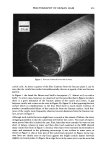
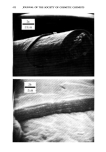
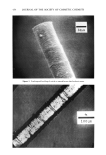
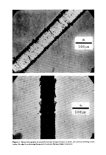
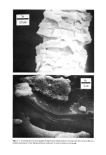
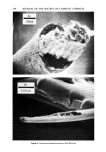
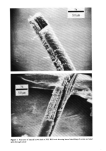
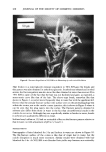
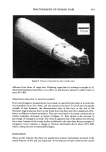
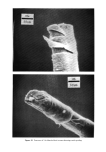
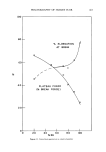
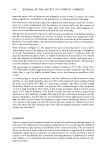
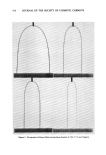
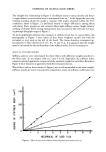
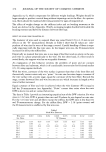
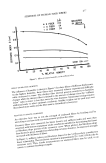
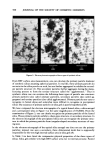
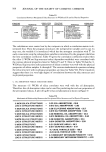
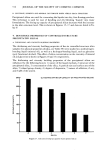
FRACTOGRAPHY OF HUMAN HAIR 457 observed with virgin hair under these conditions. A feature common to most dry breaks is that the corticle fracture surfaces are of two kinds: first, flat, smooth surfaces perpendicular to the fiber axis just as in the wet breaks and second, very rough sur- faces in the axial direction revealing details of fibrillation finer than the lateral dimen- sions of individual corticle cells. Because of the step-like arrangement of the flat radial surfaces these are referred to as step fractures. In Figure 6b there is an axial crack in the cuticle and more extreme examples of this are shown in Figures 7a and 7b. In dry breaks there is no evidence that the cuticle behaves as a mechanically independent entity in particular, the cuticle does not split circum- ferentially as it does in a wet break. Optical examination of a few hairs extended in air revealed no change in the cuticle except possibly a slight uplifting of the distal edges of the scales as the breaking strain was approached. AGE OF HAIR Hairs 45 to 50 cm in length, taken from the crown of the scalp of a young woman who had not bleached, dyed or chemically waved her hair, were sampled near the root, the middle and the tip. As expected from observations such as those of Bottoms, Wyatt and Comaish (4), many of the tip sections were found to be partially or totally devoid of cuticle while the mid- and root-section specimens were covered with cuticle and re- sembled the commercial virgin hair. Specimens from each section were broken in air at 50% RH and in water. The root- and mid-hair specimens of these hairs behaved very much like the commercial virgin hair flat breaks with circumferential cuticle cracks were obtained in water, step frac- tures in air at 50% RH. The tip sections broke more irregularly under both conditions. In air at 50% RH two out of five specimens were fibrillated completely at the cellular level, the flat step fea- ture being absent altogether as shown in Figure 8. In water, seven out of ten fractures were flat, but three were more like the step fractures typical of dry air breaks. Although the number of observations is too small to establish a correlation at a high level of confidence, it appears that hairs with more extensively damaged cuticle yield more jagged breaks. PRE-STRESSED HAIRS To further study the role of the cuticle in determining fracture type, five virgin hairs that had been hydrated and stretched in water almost to fracture were dried under ten- sion in air and fractured at 50% RH. All five fractures were fiat and typical in all respects of a wet break. Hairs pre-stressed almost to break at 50% RH and then broken in water also gave fiat fractures. ENVIRONMENTAL EFFECTS Virgin hairs conditioned and broken in air at 20, 71 and 79% RH yielded step frac- tures similar to those obtained at 50% RH, as described above. At 90% RH in air there was a transition to the flat-break pattern obtained in water although circum- ferential cuticle cracking was absent.

458 JOURNAL OF THE SOCIETY OF COSMETIC CHEMISTS • 201•m 6b 1001•m I . Figure 6. Fractures of natural brown hair at 50% RH in air
Purchased for the exclusive use of nofirst nolast (unknown)
From: SCC Media Library & Resource Center (library.scconline.org)