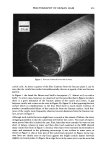
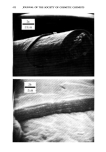
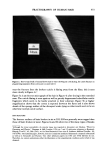
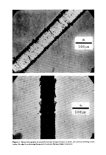
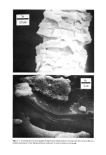
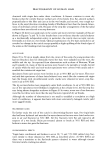
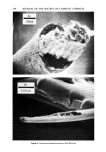
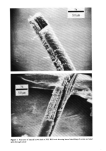
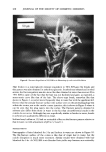
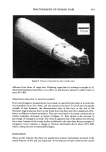
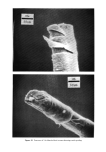
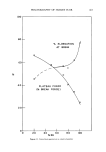
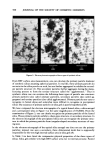
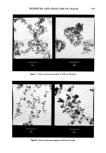
FRACTOGRAPHY OF HUMAN HAIR 453 50tam Figure 2. Sleeve-type break of natural brown hair in water showing (a) cortical plug, (b) cuticle fracture on plug showing separation from cortex and (c) cuticle sleeve near the fracture lines the broken cuticle is flaring away from the fiber this is seen more clearly in Figure 4c.• Figure 5a is an electron micrograph of the hair in Figure 4c after drying in the extended state. The cuticle flaring is seen again as well as grossly degenerated subcellular cuticle fragments which seem to be barely attached to their substrate. Figure 5b at higher magnification shows that the cortex is exposed between the flares and it also shows details of the spongy surface of the disrupted scales lying on what would seem to be an otherwise normal cuticle surface. DRY FRACTURE The fracture surfaces of hairs broken in air at 50% RH are generally more ragged than those of hairs broken in water. Figures 6a and 6b show two of the many types of breaks 1Although the lower extensibility of cuticular tissue was reported in Alexander and Hudson, "Wool, Its Chemistry and Physics," Chapman & Hall, London, 1954, pp 7 and 12 with prior reference to Reumuth, Klepzig, Textil-Z., 45,288 (1942), we find that Reumuth in turn cites E. Lehmann, Melliand Textilber., 22, 145 (1941). The Lehmann paper, however, does not contain the attributed illustration contained in Reumuth as well as in Alexander and Hudson. Two other Lehmann papers (in 1943 and 1944) likewise do not. Therefore, we cannot authenticate either the illustration or the experimental conditions under which it was obtained.

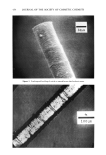
454 JOURNAL OF THE SOCIETY OF COSMETIC CHEMISTS Figure 3. Cracking and buckling of cuticle on natural brown hair broken in water 4a 100l•m
Purchased for the exclusive use of nofirst nolast (unknown)
From: SCC Media Library & Resource Center (library.scconline.org)