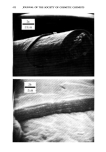
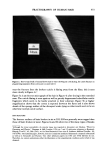
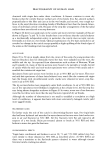
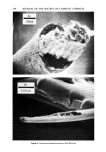
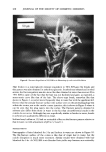
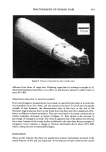
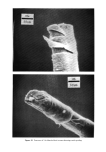
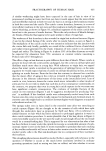
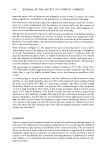
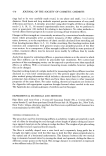
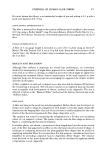
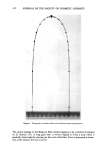
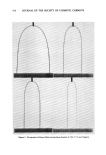
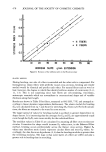
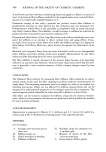
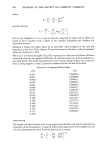
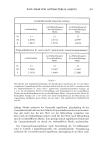
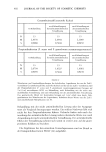
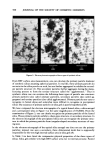
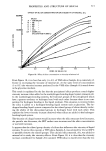
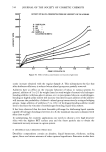
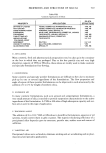
460 JOURNAL OF THE SOCIETY OF COSMETIC CHEMISTS $Om •,, '•' ... .. . . • .•.. ...%• .... . • k '? :.• Figure 8. Fracture of aged hair at 50% RH in air illustrating tip-end cortical fibrillation Hair broken in a water/glycerin mixture equivalent to 50% RH gave flat breaks and this pattern was also obtained in anhydrous glycerin. In anhydrous ethanol and in ethyl acetate the fracture pattern was also more like that obtained in water than in air at 20 to 79% RH in spite of the fact that the hair was not hydrated and gave, as expected, a stress-strain curve like that of dry hair. The sleeve-type break, somewhat like that shown in Figure 2, occurred more frequently than in water but with the significant dif- ference that the annular fracture surface (the surface seen on the protruding plug) was within the cortex, not at the cuticle-cortex junction this is shown in Figure 9 where it can be seen that the plug tapers into the cortex. The fracture patterns obtained in solvents also differ from those in water in the fact that circumferential cracks in the cuticle do not occur. Although they are superficially similar to breaks in water, breaks in solvents are qualitatively different in detail. Sodium lauryl sulfate at 3% had no noticeable effect on the fracture pattern relative to that in water, nor did adjustment ofpH to 3, 9 and 11. PRETREATMENTS Fractographs of hairs bleached for 3 hr and broken in water are shown in Figure 10. The flat-fracture surface of the cortex is like that of virgin hair in water, but the cuticle disruption is much more extensive. Similar results were obtained with hair bleached for 6 hr. At 50% RH in air bleached hair yields step fractures not noticeably

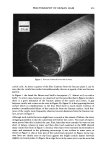
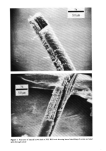
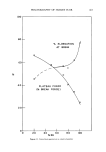
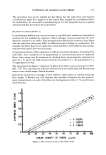
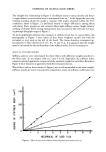
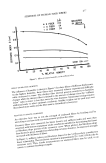
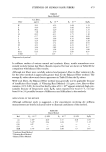
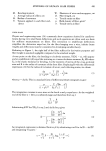
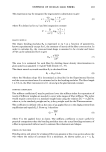
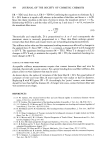
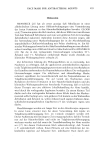
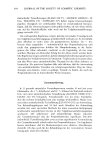
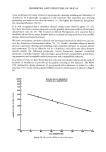
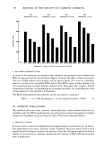
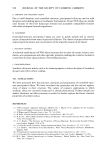
FRACTOGRAPHY OF HUMAN HAIR 461 50tm "4 lbigure 9. Fracture of natural brown hair in ethyl acetate different from those of virgin hair. Defatting virgin hair by soaking overnight in 2:1 chloroform/methanol had little or no effect on the fracture pattern in either water or air at 50% RH. STRESS/STRAIN BEHAVIOR VS. RELATIVE HUMIDITY Force and elongation measurements were made on natural brown hairs at several rela- tive humidities from 20 to 90%, and also immersed in water. To avoid introducing the variable of hair diameter, the dimensionless ratio of the force at the end of the Hookean region (plateau force) to the break force has been used for comparison of be- havior at different relative humidities. This ratio was found to decrease continuously as relative humidity increased, as shown in Figure 11. Also shown is the increase in percentage of elongation at break. The trend is opposite that of the plateau force/break force ratio. Instead of the steady decline exhibited by the ratio data, the percentage-of- elongation trend indicates a change in fracture mechanism above about 80% RH, where a sharp increase in extensibility begins. DISCUSSION These studies indicate that there are qualitatively distinct mechanisms involved in the tensile fracture of wet and dry virgin hair. In wet fracture we have observed the cuticle
Purchased for the exclusive use of nofirst nolast (unknown)
From: SCC Media Library & Resource Center (library.scconline.org)