MECHANICAL SPECTRA OF SKIN 171 Potts and Breuer (12) have recently investigated the low-strain stress relaxation of excised hamster skin and observed three characteristic relaxation processes, with time constants of approximately 2, 50 and 350 secs. For each relaxation, the intensity (i.e., the magnitude of the relaxation modulus measured at the peak height), but not the time constant, varied with relative humidity. It is the purpose of this investigation to study the thermal and relative humidity dependencies of these three relaxation processes, in order to gain insight into the macromolecular processes responsible for each of them. METHODS The experimental techniques have been published in detail elsewhere (12). For the purposes of this report only a brief summary of methods will be given. SAMPLE PREPARATION Adult (age 6 to 8 months) male and female hamsters were sacrificed immediately prior to experimentation. The animals were shaved and the skin removed from the back. A strip of skin 10 by 0.5 cm was cut parallel to the spine. The sample was immediately mounted inside a controlled atmosphere chamber on a tensile testing device (Instron © ) and equilibrated several hours at zero-strain under the appropriate conditions of temperature and relative humidity. This procedure was necessary in order to obtain reproducible results. STRESS RELAXATION The sample was stretched to constant percent elongation (0.6%), in a constant period of time (0.6 sec). Force data were measured over a time period of 2000 sec. at intervals of increasing duration. The data were collected and stored on a floppy disk for subsequent computer analysis. DATA REDUCTION The relaxation spectrum can be approximated as the derivative of force with respect to the logarithm of time (13). --d F(t) H(r) - -- (1) dlnt where H(r) is the relaxation modulus, F(t) is the force per unit cross-sectional area, t is the time and ß is the relaxation time constant. The relaxation data were analyzed by first smoothing the raw data and then performing an analytical differentiation (12). The relaxation modulus [H(r)] was then plotted vs logarithmic time to yield a relaxation spectrum. At each condition of temperature and relative humidity at least three separate spectra were obtained. In each spectrum the values of H(r) and LOG•0 ß associated with each peak varied by no more than plus or minus 15% and plus or minus 0.15, respectively. These spectra were then combined in a point-by-point average to yield the final spectrum. The intensity and time constant of each relaxation peak were then obtained by inspection of the final spectrum.

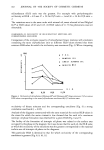
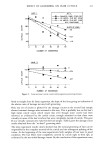
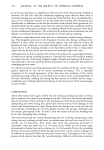
172 JOURNAL OF THE SOCIETY OF COSMETIC CHEMISTS RESULTS Figure 1 shows the relaxation spectra of excised hamster skin at two temperatures but constant relative humidity (90 plus or minus 5%), percent elongation (0.6%) and stretching time (0.6 sec.). [The data obtained at 21øC were reported previously (12).] These results indicate that the intensity of each peak is insensitive to changes in temperature. The time constant for peak A (r^) does not appear to vary with temperature while both rB and rc shift to lower times with increasing temperature. I I I I = A 4 - , 0_, 0 1 2 3 4 Log•o T (sec.) Figure 1. The relaxation spectrum of skin obtained at 90% relative humidity and 45øC (upper) or 21øC (lower). The three peaks are labelled A, B and C in order of increasing time constants.
Purchased for the exclusive use of nofirst nolast (unknown)
From: SCC Media Library & Resource Center (library.scconline.org)