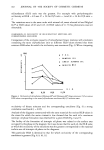
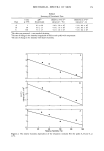
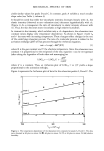
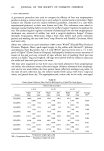
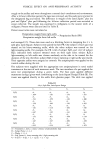
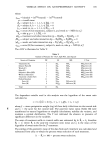
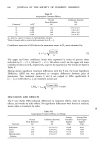
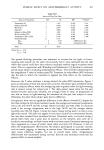
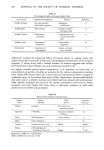
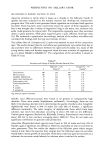
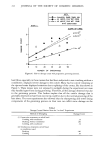
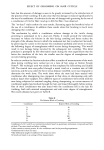
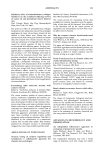
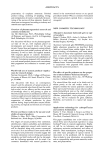
MECHANICAL SPECTRA OF SKIN 173 Table I Summary of Viscoelastic Data 'r (sec) AH *a (dI/dT) at 95% rh a'b Peak at 25øC (Kcal/mole) (dyne/cm 2 ß øK) (dI/d(rh)) at 21øC •'• (dyne/cm 2. %) A 2 0.2 _ 0.8 -0.8 _ 2.0 x 10³ B 50 9.4 - 2.5 -0.4 _ 1.6 x 10³ C 350 7.5 _+ 1.7 -0.2 .+ 1.0 X 10 3 --2.4_+ 0.4x 10³ --3.8- 0.4x 10³ --3.4_+0.4x 10³ •The values are presented _+ one standard deviation. bThe rate of change in the intensity (magnitude of H(r) at each peak) with temperature. CThe rate of change in the intensity with relative humidity. 3 • • 2_ ß ß _ 1 0 4 x •E 2 0 1 - 0 20 40 60 80 100 Relative Humidity (%) Figure 2. The relative humidity dependence of the relaxation modulus H(r) for peaks A, B and C, at 21øC.

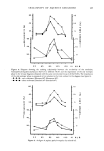
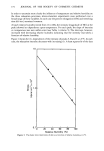
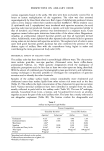
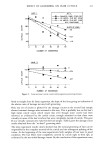
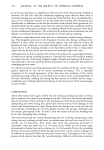
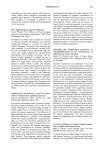
174 .JOURNAL OF THE SOCIETY OF COSMETIC CHEMISTS In order to ascertain more clearly the influence of temperature and relative humidity on the three relaxation processes, stress-relaxation experiments were performed over a broad range of these variables. In each case the percent elongation (0.6%) and stretching time (0.6 sec.) remained constant. At each relative humidity tested from 23 to 90%, the intensity (magnitude of H(r) at the peak) showed no dependence upon temperature. For each peak, the slope of intensity vs. temperature was zero within error (see Table 1 column 5). The intercept, however, increased with decreasing relative humidity indicating that the intensity was solely a function of relative humidity. Figure 2 shows the r.h. dependence of the intensity of peaks A, B and C at 21øC. In each case, the relaxation intensity decreases with increasing r.h. A least squares fit of the data 10 I i i I 0.1 • I • ] 0 20 40 60 80 1 O0 Relative Humidity (%) Figure 3. The elastic (zero-time) stress of skin as a function of relative humidity at 21øC.
Purchased for the exclusive use of nofirst nolast (unknown)
From: SCC Media Library & Resource Center (library.scconline.org)