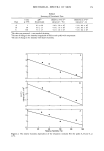
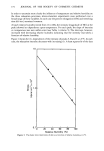
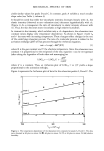
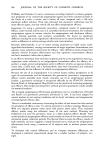
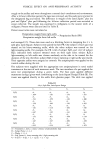
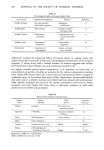
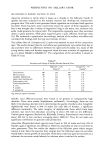
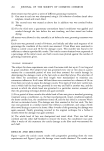
VEHICLE EFFECT ON ANTIoPERSPIRANT ACTIVITY 183 snugly to the axillae and worn throughout a normal day's conditions and environment. After a 10-hour collection period, the tape was removed, and the pads were returned to the designated bag and sealed. The difference in weight of the tared Ziploc © plus dry pad and Ziploc © plus pad following the 10-hour collection period was recorded as sweat collected. The weight was expressed in milligrams to the nearest tenth of a milligram. Pretest sweat data are listed in Table II. Pretest sweat ratios were calculated as Perspiration weight from right axilla Perspiration weight from left axilla -- Perspiration Ratio (PR) and averaged (15). These data were used as a blocking factor in designing the 4 x 4, split plot, Latin Square. Subjects were paired by their PR. One subject of each pair was treated on his heavy-sweating axilla, while the other subject was treated on his light-sweating axilla. For example, the PR 1.636 of subject B4D 2 and 1.422 of subject B4D • indicated both subjects sweated more on their right sides. subject B4D2's light-sweating or left axilla was chosen randomly as the side to be treated for the duration of the test therefore, subject B4D•'s heavy-sweating or right axilla was treated. Their opposite axillae were assigned as controls. No antiperspirant was applied to the control axillae during the test. The subjects were supplied with the appropriate test antiperspirants in tared sealed containers at the start of each treatment week. The two members of a pair applied the same test antiperspirant during a given week. The four pairs applied different treatments during a given week conforming to the Latin Square Design (Table III). The cream was applied directly to the axilla from glassine paper. The stick was applied Table III 4 by 4, Split Plot, Latin Square Design C• C2 C3 C4 B•Ds As A2 A• A 4 -.395* -.783 -.379 -.457 B2D s A2 A 3 A 4 A s -.543 --.959 --.384 +.006 B3Ds A3 A4 As A2 --.359 --.045 --.283 +.035 B4D s A 4 A• A• A 3 --.301 +.316 --.064 --.566 B•D: A• A• A 3 A 4 +.407 --.295 --.361 --.664 B2D2 A2 A 3 A 4 As --.252 --.812 --.658 +.118 B3D • A3 A 4 A• A• --.467 --.637 --.809 --.658 B4D 2 A 4 A• A2 A 3 +.015 +.554 --.497 +.079 A = Treatments: 1, stick 2, cream 3, lotion 4, hydroalcoholic base B = Subject Pairs, 1, 2, 3, 4 C = Weeks, 1, 2, 3, 4 D = Side Treated: 1, heavy-sweating side 2, light-sweating side *z = In if/x-) = In ([Ys + Y, + Y,l/[xs + x• + x,])

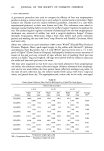
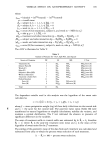
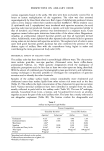
184 JOURNAL OF THE SOCIETY OF COSMETIC CHEMISTS manually. The lotion and hydroalcoholic solution were applied with tared cotton swabs. All antiperspirants were applied to the 2• x 4• inch delineated axillary area. This area is outlined by the hairy portion of the axillae where apocrine and eccrine sweating occur. A measured amount of test antiperspirant was applied daily to the treated axilla for a two-day period to accomodate the axilla to the antiperspirant no sweat was collected. On each of the next three days, antiperspirant was applied to the treated axilla. An elapsed one-minute drying time was allowed before taping the tared pads to the axilla. A tared pad also was taped snugly to the control axilla. The subjects proceeded with their daily routines. At the end of the 10-hour collection period, they removed the tape and sealed the pads in the designated bags. The pads and test antiperspirant containers were collected by the investigators to be weighed for daily sweat weights and amount of antiperspirant applied. Post-test sweat collection data for a sample subject pair are listed in Table IV. Table IV Post-test Sweat Collection Data Sample Day 1 Day 2 Day 3 Right Left Right Left Right Left Treatments* (mg) (mg) (mg) (mg) (mg) (mg) z** Subject B2D• A• 168.2 143.3 67.0 73.9 102.0 117.9 +O.OO6 A2 103.1 286.8 63.4 78.6 94.4 83.8 -- 0.543 A 3 125.2 195.6 204.4 771.6 64.1 59.5 -- 0.959 A 4 479.0 884.5 427.6 483.0 79.5 80.1 --0.384 Subject B2D2 A• 90.6 93.6 163.1 109.9 67.7 82.1 + 0.118 A 2 310.5 71.0 58.6 76.3 126.0 237.5 -- 0.252 A 3 100.0 27.2 380.0 136.7 102.1 94.9 --0.812 A 4 216.0 95.3 509.7 213.7 447.8 298.5 -- 0.658 *A•, stick A2, cream A 3, lotion A4, hydroalcoholic solution. **z = In (•/•) = In ([y• + Y2 + Y,I Ix, + x2 + x,]) Nine-day recovery periods, in which no sweat was collected nor antiperspirant applied, alternated with the four treatment weeks. 3. STATISTICAL TREATMENT OF RESULTS Post-test sweat collection data were evaluated statistically using the geometric mean of treatment results of a 4 x 4, split plot, Latin Square design (16, 17), illustrated in Table III. The letters D• and D 2 represent the heavy-sweating sides and light-sweating sides treated, respectively. The columns represent the four treatment weeks the rows represent subject pairs and the blocks indicate the treatments. The statistical model describing this treatment design is indicated in Table III. Zjkmp = •'• -}- •gj -}- •k -}- '•m '4- T•jk m '4- {•p -}- (•g•)jp -}- (•)kp -}- ('•)rnp -}- •jkmp
Purchased for the exclusive use of nofirst nolast (unknown)
From: SCC Media Library & Resource Center (library.scconline.org)