202 JOURNAL OF THE SOCIETY OF COSMETIC CHEMISTS (2oh) (21) (22a) (22b) (23) M. Kirk-Smith, D. Booth, Effect of androstenone on choice of location in others' presence, ibid, pp. 397-400. N. Shehadeh, A. Kligman, The bacteria responsible for apocrine odor, part II, J. oflnv. Derm., 41, 1-5 (1963). J. Leyden, K. McGinley, E. Holzle, J. Labows, A. Kligman, The microbiology of the human axilla and its relationship to axillary odor, J. Invest. Derm., 77,413-416 (1981). P.J.H. Jackman, (personal communication) in Microbiology of Human Skin, 2nd ed., W. C. Noble (Lloyd-Luke LTD., London, 1981) p. 94. M. G.J. Beets, E. T. Theimer, "Odor similarity between structurally related odorants," in Ciba Foundation Symposium on Taste and Smell Vertebrates, G. E. W. Wolstenholme andJ. Knight, Eds. (J & A Churchill, London, 1970), pp. 313-323. (24) S. Bird, D. B. Gower, The validation and use of a radioimmunoassay for 5c•-androst-16-en-3-one in human axillary collections, J. Ster. Biochem., 14, 213-219 (1981). (25) J. N. Labows, G. Preti, E. Hoelzle, J. Leyden, A. Kligman, Steroid analysis of human apocrine secretion, Steroids, 3, 249-258 (1979). (26) D. B. Gower, M. R. Hancock and L. H. Bannister, Biochemical Studies on the boar pheromones, in Biochemistry of Taste and Olfaction, R. Cagan and M. Kate, Eds. (Academic Press, N.Y., 1981) pp. 7-31. (27) J. C. Do, E. Kitatsuji, E. Yoshii, Study on the components of musk. I. Ether soluble components, Chem. Pharm. Bull, 23 (3), 629-635 (1975). (28) H. Reed, O. Melrose, R. L. S. Patterson, Androgen steroids as an aid to the detection of oestrus in pig artificial insemination, Brit. Vet. J., 130, 61-67 (1974). (29) B. S. Goodrich, E. R. Hesterman, K. E. Murray, R. Mykytowycz, G. Stanley, G. Sugowdz, Identification of behaviorally significant volatile compounds in the anal gland of the rabbit, Oryctolagus cuniculus, J. Chem. Ecol., 4 ( 5 ), 581-594 (1978). (30) Z. Valenta, A. Khaleque, The structure of castoramine, Tetrahedron Letters, 12, 1-5 (1959). (31) J. Adams, A. Garcia, C. S. Foote, Some chemical constituents of the secretion from the Temporal Gland of the African Elephant, J. Chem. Ecol., 4, 17-25 (1978). (32) G. Anderson, A. Brundin, K. Anderson, Volatile compounds from the interdigital gland of reindeer (Rangifer t. tarandus L.), J. ofChem. Ecol., 5 (3), 321-333 (1978). (33) A. Brundin, G. Anderson, K. Anderson, T. Mossing, L. Kallquist, Short chain aliphatic acid in the interdigital gland secretion in reindeer (Rangifer tarandus L.), and their discrimination by reindeer, J. Chem. Ecol., 4, 613-622 (1978). (34) D. Miiller-Schwarze, C. Miiller-Schwarze, A. G. Singer, R. M. Silverstein, Mammalian pheromone: identification of active component in the subauricular scent of the male pronghorn, Science, 183, 860-861 (1976). (35) G. Anderson, K. Anderson, A. Brundin, C. Rappe, Volatile compounds from the tarsal scent gland of reindeer (Rangifer tarandus),J. Chem. Ecol., 1 (2), 275-281 (1975). (36) G. Epple, N. F. Golob, A. B. Smith, Odor communication in the Tamarin Saguinus fuscicollis (Callitridridae): behavioral and chemical studies, in Chemical Ecology.' Odor Communication in Animals, F.J. Ritter, ed. (North-Holland Biomedical Press, 1979)pp. 117-130. (37) D. H. McBumey, J. M. Levine, P. H. Cabanaugh, Psychophysical and social ratings of human body odor, Personality--Soc. Psych. Bull., 3, 135-138 (1977). (38) J. Amoore, Specific anosmia and the concept of primary odors, Chemical Senses and Flavor, 2, 267-281 (1977). (39) S. Puhvel, R. Reisner, M. Sakamoto, Analysis of lipid composition of isolated human sebaceous gland homogenates after incubation with cutaneous bacteria: thin-layer chromatography, J. Inv. Derre., 64, 406-410 (1975). (40) M. Julesz, New advances in the field of androgenic steroidogenesis of the human skin, Acta Med. Acad. Sci. Hungat, 25,273-285 (1968). (41) B. W. L. Brooksbank, Labelling of steroids in axillary sweat after administration of 3H- AS-Pregnenolone and •4C-Progesterone to a healthy man, Experentia, 26, 1012-1014 (1970). (42) B. W. L. Brooksbank, R. Brown, J. A. Gustafusson, The detection of 5c•-Androst-16-en-3c•-ol in human male axillary sweat, Experentia, 30, 864-865 (1974). (43) R. Claus, W. Alsing, Occurrence of 5c•-Androst-16-en-3-one, a boar pheromone, in man and its relationship to testosterone,J. Endocr., 68, 483 (1976). (44) J. N. Labows, Human odors--what can they tell us?, Perfumer and Flavorist, 4, 12-17 (1979). (45) F. Ayorinde, J. W. Wheeler, C. Wemmer, J. Murtaugh, Volatile components of the occipital gland secretion of the Bactrian camel,J. Chem. Ecol., 8, 177-183 (1982).

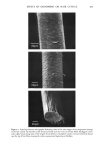
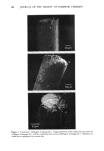
j. Soc. Cosmet. Chem., 33,203-215 (July 1982) The effect of grooming on the hair cuticle SUSAN E. KELLY and V.N.E. ROBINSON, School of Textile Technology, University of New South [Vales, P.O. Box 1, Kensington NS[V, 2033, Australia Received July 20, 1981. Synopsis A study has been carried out on the effects of normal grooming on the cuticle of human hair. The grooming processes studied included shampooing, wet combing, wet brushing, and towel drying. The experiments were performed on tresses of hair and also included "on-head" studies. The results were assessed using scanning electron microscopy techniques. The data indicate that all of the damage normally observed can be entirely due to the grooming process. Sharnpooing and towel drying were shown to inflict some damage, but the process of wet combing or brushing greatly increased the damage. Brushing was shown to be more damaging than combing. The use of a conditioner was shown to significantly decrease this damage by reducing the friction forces generated in the hair during combing. INTRODUCTION Human hair consists of three main components: the cuticle, the cortex, and the medulla (1). Figure 1 shows transverse cross-sections of human hair which clearly illustrate the three components. The cuticle, which comprises the outermost layer, forms a protective sheath around the cortex. When the hair first emerges from the follicle the cuticle consists of between six and ten overlapping scales (1). These are clearly visible in Figure 1. As the hair grows away from the scalp it is subjected to various outside influences which can have a damaging effect on the cuticle. The scales, which are at first smooth and rounded, become rough and jagged as pieces are eroded away. If the hair is allowed to grow long enough and is sufficiently exposed to these degradative processes, then eventually complete removal of the cuticle layer will occur, leaving the cortex of the hair exposed (2-5). The unprotected cortex will then split and break very easily, which can lead to the appearance of split ends and often render the hair *'unmanageable." The progressive stages of damage to the cuticle are illustrated by the scanning electron micrographs of hair from root to tip given in Figure 2. The gradual erosion of cuticle scales has been attributed to various factors including aging, exposure to sunlight, handling, and the grooming processes to which hair is subjected which include shampooing, drying, brushing, and combing (1-6). Hair can also be damaged chemically by the application of treatments such as bleaching, coloring, and permanent waving which modify the hair (7), and it is likely that these treatments leave the hair more susceptible to further damage. 203
Purchased for the exclusive use of nofirst nolast (unknown)
From: SCC Media Library & Resource Center (library.scconline.org)