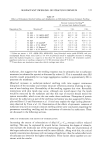
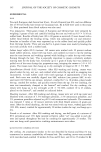
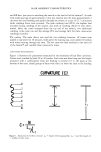
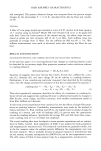
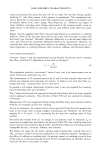
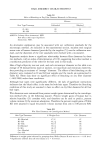
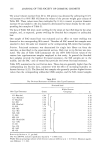
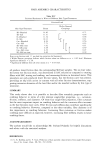
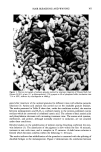
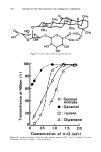
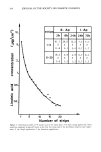
HAIR ASSEMBLY CHARACTERISTICS 151 ments encountered the easier the hair will be to comb. For the best fitting models,. involving C 2, only three percent of the variance is unexplained. This unexplained vari- ance is likely due to error and to other fiber properties not included in the model, such as cohesive effects of oil, static charge, fiber ellipticity, etc. However, the impact of these variables, including static charge (mentioned in the original model), must be small relative to the effects of curvature, friction, and stiffness under these test condi- tions. Bogaty (14) has suggested that fiber cross-sectional ellipticity is important to combing behavior. Three of the four hair types used in this study were Caucasian in origin and the fourth type Oriental. Therefore, although differences in cross-sectional shapes did exist, they were not the maximum differences likely to be encountered. However, we conclude that other than having some influence on stiffness, fiber ellipticity •per se is of lesser importance to combing behavior than curvature, stiffness, and frictional effects. SINGLE-FIBER MEASUREMENTS Curvature. Figure 1 and the experimental section describe the scheme used to measure hair fiber curvature (C). Expression (4) was used to calculate C. N c - (4) (Lc/LT) This expression provides a minimum C value of zero, and is an improvement over an earlier estimation involving Lc/L T (15). The measurement of N required practice for O and Cau hair samples where the curl pattern was irregular and sometimes not distinct. It helps to view each hair fiber as a simple sine wave, counting from crest to crest for N. In general a curl height (amplitude) of greater than 2 mm was required for counting thus microcrimps were not considered. The C values for Oriental hair approach a bimodal distribution while the kinky samples tend to approach normality. Thus the data of Table VII were not analyzed by Analysis of Variance. Measurement of C was complicated where strong interfiber forces were operative such as with the oil treatment and for wet combing. For the oil treatment, the cohesive forces were so great for O and Cau hair samples that hairs in the tresses were virtually straight, eliminating curl. Therefore, for these hair samples N = O and C = O, accounting for the very low combing loads of these systems. For kinky hair treated with oil, no change in curl pattern could be measured. L c in tresses and in single hairs was found to be the same (Table VII), but combing loads were much lower for oil treatments than for SAC. Nevertheless these two treatments provide comparable friction, curvature, stiffness, and diameter. We believe the reason for the lower combing loads of kinky hair, treated with oil vs SAC, are due to cohesive forces not employed in our correlation equation. Analogous to the effects of stiffness on combing load, the primary impact on combing occurs in front of the comb as it advances through the hair. Fewer entanglements are therefore encoun- tered and the hair is thus easier to comb.

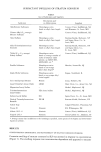
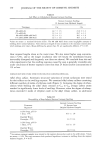
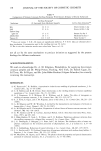
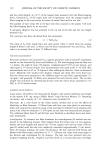
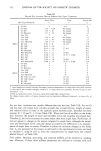
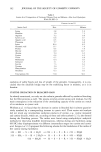
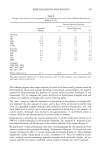
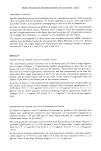
152 JOURNAL OF THE SOCIETY OF COSMETIC CHEMISTS Table VII Dry and Wet Curvature Data on Different Hair Types/Treatments Single Fiber Tress Round Off Hair Type/Treatment C C C DRY WET " O-Oil * 0.0 0 O-SAC 1.55 + 0.60 No change 1.6 O-SLS 1.59 ñ .81 No change 1.6 O-Bleached 1.47 ñ .95 No change 1.5 Cau-Oil * 0.0 0 Cau- SAC 2.50 --- . 61 No change 2.5 Cau-SLS 2.74 q- .84 No change 2.7 Cau-Bleached 2.58 ñ 1.5 No change 2.6 KI-Oil 17.81 --- .8 18.32-• 17.8 KI-SAC 18.02 q- .62 -- 18.0 KI-SLS 18.10 ñ .66 17.36-• 18.1 KI-Bleached 18. l 1 ñ .74 -- 18.1 KII-Bleached 16.32 ñ 1.1 16.08-• 16.3 KII-SLS 16.08 ñ 2.2 16.55 q- 0.88:• 16.1 KII-SAC 15.82 ñ 1.4 -- 15.8 KII-Oil 15.96 + 1.8 16.08-• 16.0 •' KII-Bleach/Oil 15.88 ñ 1.6 16.43 ñ 0.48•: 15.9 r' O-SAC * 0 0 O-SLS * 0 0 O-Bleached * 0 0 Cau-SAC * 0 0 Cau- SLS * 0 0 Cau- Bleached * 0 0 KI-SAC (no rinse) -- 14.41.• 14.4 KI-SAC (rinse) -- 14.035 14.0 KI-SLS -- 14.78-• 14.8 KI-Bleached -- 14.38-• 14.4 * Visual inspection revealed obvious discrepancy between measurement in single fiber and actual curvature in tress which was virtually straight therefore C in single fibers not measured. In tress N goes to zero therefore C = O. -• Only L c measured in tress. N and Lr taken from single-fiber measurement. No change means only Lc of tresses measured and no significant difference between Lc in tress vs L c of fibers. For wet hair, curvature was visually different than dry hair (see Table VII). For wet O and Cau hair, the tresses were virtually straight due to high friction, weight of water, and cohesive forces of water in the capillary spaces between hairs. Therefore for these systems N = O and C = O (see Table VII). Water had less of an effect on the kinky hair however, the weight of water and interfiber forces did lengthen the relaxed hair. Therefore L c had to be estimated in tresses rather than from single hairs. For KI hair, N did not appear to change in the tresses compared to single hairs, although the ampli- tude and wavelength of the curls did change as noted by the differences in L c measure- ments of single hairs vs tresses. Therefore to adjust for curvature changes in wet kinky hair, L c was measured in the tresses, as indicated in the experimental section, and used to calculate C using N and L T from dry measurements on single hairs (see column labeled Tress C of Table VII). Fiber stiffness. Bending, stretching, and torsional stiffness are all involved in combing hair. However, if these three stiffness parameters are collinear or correlate with each
Purchased for the exclusive use of nofirst nolast (unknown)
From: SCC Media Library & Resource Center (library.scconline.org)