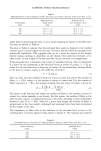
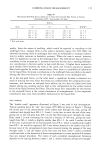
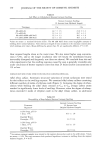
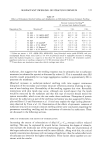
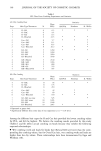
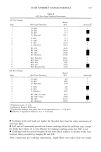
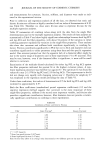
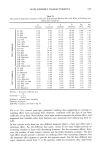
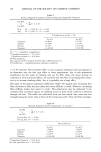
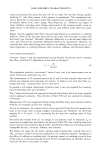
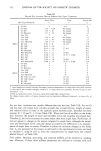
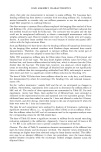
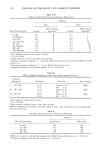
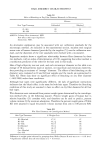
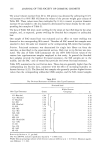
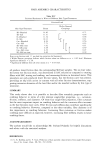
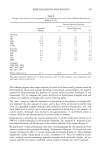
HAIR ASSEMBLY CHARACTERISTICS 15 3 other, then only one measurement is necessary to assess stiffness. For Caucasian hair, bending stiffness has been shown to correlate with stretching stiffness (16). It therefore seemed reasonable to consider only one stiffness parameter to test the relationship of single fiber properties to combing behavior. Our first attempt to measure fiber stiffness employed the hanging fiber method of Scott and Robbins (16). A few exploratory measurements with KI and KII hair indicated that this method would not work for kinky hair. The curvature was too great and the hair could not be straightened sufficiently to obtain a meaningful measurement with the weights ordinarily used. Heavier weights were tried, but the results were still unsatis- factory. A cantilever beam method was not tried because of similar anticipated diffi- culties with the high-curvature fibers. Scott and Robbins (16) have shown that the bending stiffness of human hair determined by the hanging fiber method correlates with Hookean slopes estimated from tensile measurements. Therefore, this approach to estimate stiffness from the initial part of load-extension curves was adopted to assess hair fiber stiffness. Table VIII summarizes stiffness data for fibers taken from tresses of SLS-treated and bleached hair of all hair types. The data shows highest stiffness values for O hair, the thickest hair, and lowest stiffness values for kinky hair, which is thinner than the O but thicker than the Cau hair. The kinky hair, however, was steam-set, which might de- crease its stretching resistance. Although all bleached hair samples are not significantly lower in stiffness than the corresponding unbleached hair (SLS), each sample is numeri- cally lower and there is a significant overall stiffness reduction by bleaching (17). The data of Table VIII also show lower stiffness values for wet vs dry hair, a well known fact demonstrated by others for stretching (18), bending (16), and torsional measure- ments (19). For the "surface treatments," namely SAC and the oil, we anticipated no changes in stiffness. Nevertheless, experiments were conducted to determine the stiffness effects of SAC and oil. The results of these experiments are summarized in Table IX. For each experiment, twenty hair fibers, from another lot of Oriental hair, were extended as indicated in the experimental section and separated into two equivalent groups. These calibrated hairs were then soaked in water for 1 hour and allowed to relax for 24 hours, then treated, and after drying, restretched except in the case of experiment II when the hairs were rewet for 1 hour and restretched. The data for each experiment were analyzed by Analysis of Covariance, indicating no significant treatment effects, i.e., no significant effect of SAC or oil on stiffness. There- fore the stiffness values for SAC and oil treatments used in the regression analysis were the corresponding values for the SLS-treated hair. The data of Table IX shows a significant increase in stiffness for the second stretching evaluation compared to the calibration. Apparently 1 hour in water and 24 hours at 60 q- 5% RH is not sufficient time to permit complete relaxation of the hair. Diameter. The data of Table X summarizes diameter measurements of the different hair types by linear density and microscopic methods. The diameter values determined by microscopy are higher than those obtained using the linear density method. This differ- ence may be an inherent difference in these two procedures, since the linear density method assumes circularity while the microscopic method averages diameter across the elliptical fibers.

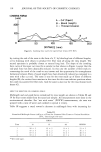
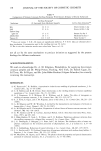
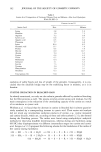
154 JOURNAL OF THE SOCIETY OF COSMETIC CHEMISTS Table VIII Stiffness of Hair Fibers From Load Extension Experiments Hair Type/Treatment Stiffness I Dry 2 Wet 3 Waller Duncan gm/mm groupings 4 gm/mm Waller Duncan groupings 5 O-SLS 23.1 O-Bleached 22.1 Cau-SLS 18.5 Cau-Bleached 17.8 KI-SLS 14.1 KI- Bleached 12.8 KII-SLS 14.1 KII- Bleached 14.0 13.0 * 11.o [ lO.9 10.3 [ 9.0 8.1 7.9 • Each stiffness number is a mean from 15 fibers. 2 55 to 65% RH. 3 Fibers soaked for 1 hour in tap water, then stretched. 4 Minimum significant difference = 2.92 from Waller Duncan ratio test using Proc ANOVA of SAS Institute (11). 5 Minimum significant difference = 1.31 from Waller Duncan K ratio test. * Significantly different from all other means at the tx = 0.05 level. Table IX Effects of Surface Treatments on Hair Fiber Stiffness gm/mm Extension • Treatment Experiment Calibration Treatment Anacova Result I Dry 2 SAC 2 l. 76 Control 22.76 NSD 21.77 SAC 22.27 II Wet 3 SAC 12.01 Control 13.45 NSD 11.77 SAC 13.53 III Dry Oil 18.09 Control 21.83 NSD 18.02 Oil 21.51 • Each number is a mean from 10 fibers. 2 55 to 65% RH. 3 Fibers soaked in aleionized water 1 hour, then stretched. Between calibration and treatment, fibers were soaked in water 1 hour and allowed to dry overnight before treating and retesting. Table X Dry Fiber Diameters via Linear Density and Microscopy Microns Hair Type/Treatment Linear Density Microscopy O-SLS 86* 89* Cau-SLS 71' 80* KI-SLS 761 84 I KII-SLS 75 84 Differences in diameters indicated by groupings from Waller Duncan K ratio test at o• = 0.05 level. * Significantly different from all other means at tx = 0.05 level.
Purchased for the exclusive use of nofirst nolast (unknown)
From: SCC Media Library & Resource Center (library.scconline.org)