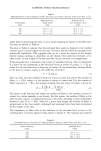
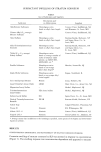
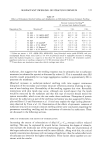
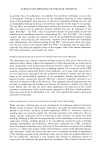
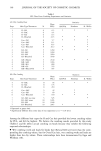
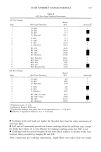
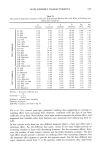
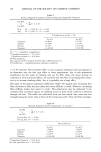
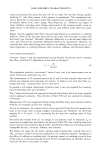
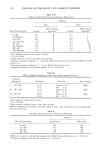
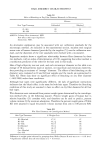
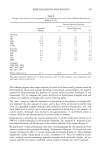
HAIR ASSEMBLY CHARACTERISTICS 15 7 Table XIV Frictional Resistance in Water of Different Hair Types/Treatments Frictional Load Waller Duncan• Hair Type/Treatment Grams Groupings KI- Bleached 14.85 * 0.71 KI- SLS 11.51 •g 0.64 O-Bleached 11.34 0.64 O-SLS 10.31 0.61 Cau- Bleached 8.56 I I 0.5610.530.50.47 Cau- SLS 7.73 KI-SAC-rinse 7.02 O- SAC-ri nse 6.58 I 0.49 Cau-SAC-rinse 6.19 KI-SAC-no rinse 4.60 0.39 Root to tip friction with 1.1 gm load (no correction for buoyancy). •: Waller Duncan groupings indicate which friction values are different at o• = 0.05 level. Minimum significant difference = 2.18. * Significantly different from all other means at o• = 0.05 level. all produce lower friction than the corresponding SLS hair samples. The no rinse value, the lowest wet friction result, was determined in SAC solution as compared to treating fibers with SAC rinsing and soaking, and measuring friction in deionized water. This procedure not only produced lower friction values, but the friction curve was altered, providing no slip stick action in contrast with all other friction determinations, sug- gesting extensive alteration of the hair fiber and/or the mandrel surfaces by this type of treatment. SUMMARY This study shows that it is possible to describe fiber assembly properties such as combing behavior in terms of a few relevant single-fiber properties, i.e., curvature, friction, stiffness, and diameter. Of these four single-fiber properties, fiber curvature has the most important impact on combing behavior and the curvature effect increases as the hair becomes more curly. Fiber friction and stiffness also contribute significantly to combing behavior. However, compared to the other variables, fiber diameter is of less importance to combing behavior. Increasing fiber curvature or friction makes combing more difficult as expected however, increasing fiber stiffness results in lower combing forces. ACKNOWLEDGMENT The authors would like to acknowledge Mr. Richard Polanski for helpful discussions and advice with the statistical analyses. REFERENCES (1) C. R. Robbins and G. V. Scott, Prediction of hair assembly characteristics from single fiber proper- ties,.]. Soc. Cosmet. Chem., 29, 783-792 (1978).

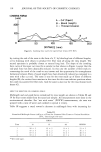
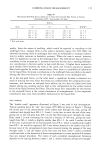
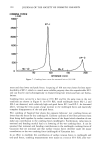
158 JOURNAL OF THE SOCIETY OF COSMETIC CHEMISTS (2) (3) (4) (5) (6) (7) (8) (9) (10) 11) 12) 13) 14) 15) (16) (17) (18) (19) (20) (21) (22) DeMeo Brothers, 135 Fifth Avenue, New York, NY. M. L. Garcia and J. Diaz, Combability measurements on human hair, J. Soc. Cosmet. Chem., 27, 379-398 (1976). G. V. Scott and C. R. Robbins, Effects of surfactant solutions on hair fiber friction, J. Soc. Cosmet. Chem., 31, 179-200 (1980). Federal Pacific Electric Co., Newark, NJ. C. R. Robbins, Chemical and Physical Behavior of Human Hair (Van Nostrand Reinhold Co., New York, 1979), pp 173-174. Ethicon Inc., Somerville, NJ. G. Barnett, The Swelling of Hair in Aqueous Solutions and Mixed Solvents, M. S. thesis, Polytechnic Institute of Brooklyn (June 1952). P. B. Sram, R. F. Katy, and H. J. White, Jr., The swelling of human hair in water and water vapor, Textile Res. J. 22, 448-465 (1952). J. A. Epps and L. J. Wolfram, Combing differences between caucasian and black hair, J. Soc. Cosmet. Chem., 34, 213-214 (1983). SAS User's Guide Statistics (SAS Institute Inc., Cary, North Carolina), 1982 Edition, pp 1-110. G. W. Shedecor and W. G. Cochran, Statistical methods, 6th ed. (Iowa State University Press, Ames, Iowa), p 398. N. E. Yin, R. H. Kissinger, W. S. Tolgyesi, and E. M. Cottington, The effect of fiber diameter on the cosmetic aspects of hair, J. Soc. Cosmet. Chem., 28, 139-150 (1977). H. Bogaty, Letter to the editor, J. Soc. Cosmet. Chem., 28, 610-611 (1977). C. R. Robbins and R. J. Crawford, A method to evaluate hair body, J. Soc. Cosmet. Chem., 35, (1984). G. V. Scott and C. R. Robbins, Stiffness of human hair fibers, J. Soc. Cosmet. Chem., 29, 469-485 (1978). C. R. Robbins, Chemical aspects of bleaching human hair, J. Soc. Cosmet. Chem., 22, 339-348 ( 1971). J. Menka. rt, L.J. Wolfram, and I. Mao, Caucasian hair, Negro hair and wool: Similarities and differences, J. Soc. Cosmet. Chem., 17, 769-787 (1966). H. Bogaty, Torsional properties of hair in relation to permanent waving and setting, J. Soc. Cosmet. Chem., 18, 575-589 (1967). E. I. Valko and G. Barnett, A study of the swelling of hair in mixed aqueous solvents, J. Soc. Cosmet. Chem., 3, 108-117 (1952). N. Chamberlain and J. B. Speakman, Hysteresis phenomena in the adsorption of water by human hair, Zeitschriftfur Elektrochemie, 37, 374-375 (1931). G. King, Frictional properties of wool and nylon fibers, J. Textile Inst., 41, Tl35-144 (1950).
Purchased for the exclusive use of nofirst nolast (unknown)
From: SCC Media Library & Resource Center (library.scconline.org)