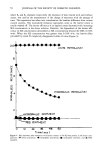
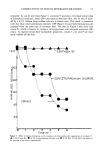
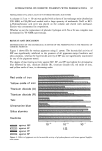
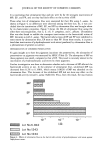
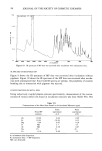
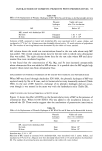
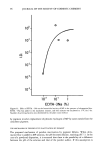
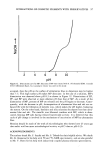
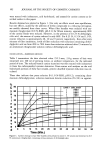
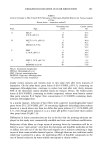
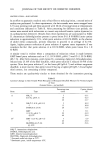
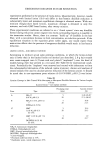
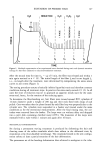
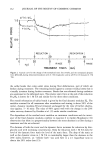
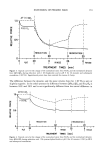
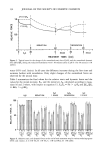
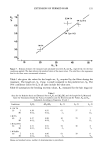
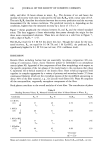
74 JOURNAL OF THE SOCIETY OF COSMETIC CHEMISTS EFFECT OF DETERGENT TYPE ON BARRIER EFFECTS One anionic, one cationic, and one nonionic detergent were chosen to evaluate the effects of detergents on barrier cream effects, at a concentration well above the CMC (14-15). Five hundredths percent NaCi was added to the donor solution as the conducting medium to study the effects of detergents. Cream D, which has moderate barrier functionality, was used as the sample cream. The data in Figure 6 indicate that the anionic surfactant (SLS) is the most effective one of all three detergents evaluated in eliminating the barrier function of cream D from the skin surface. By comparison, the nonionic surfactant (Tween 80) was found to be a poor detergent. The results in Figure 6 also point out that even cream D, which is not a very effective barrier, can adhere to the skin surface, providing a barrier in an aqueous environment as long as no detergents are present. The effects of detergents on the barrier efficiency of ointment V (the best barrier cream among the five creams evaluated Figure 5) were also studied. Results similar to those observed earlier for cream D were obtained except for the indistinguish- able detergency between the two ionic surfactants in the first hour (Figure 7). Subse- quently, ointment V appeared to wash off in lumps instead of being gradually removed by diffusion, as shown by the stepwise drops in the resistance profile. CONCLUSIONS An electroconductivity method was developed to provide an easy and reproducible in vitro technique to study skin resistance as well as the effects of barrier cream formula- tions on the electrical permitivity of excised skin during exposure to detergents. It was found that hydrocarbon base (white petrolatum and ointment V) provided the greatest barrier effect when exposed to a drastic aqueous environment containing detergents. The in vitro electroconductivity technique developed here can be applied to measure skin resistance as affected by various cream formulations or ingredients in the formula- tion. REFERENCES (1) G. E. Osborne and R. J. Gerraughty, Protective barriers for the skin, J. Soc. Cosmet. Chem., 12, 271-279 (1961). (2) G. P. Serban, S. M. Henry, V. F. Cotty, and A.D. Marcus, In vivo evaluation of skin lotions by electrical capacitance: I. The effect of several lotions on the progression of damage and healing after repeated insult with sodium lauryl sulfate. J. Soc. Cosmet. Chem., 32, 407-419 (1983). (3) H. Y. Ando, A. Escobar, R. L. Schnarre, and E. T. Sugita, Skin potential changes in the guinea pig due to the depilation and the repeated application of polyethylene glycol and retinoic acid. J. Soc. Cosmet. Chem., 34, 159-169 (1983). (4) G. P. Serban, S. M. Henry, V. F. Cotty, and A.D. Marcus, In vivo evaluation of skin lotions by electrical capacitance: II. Evaluation of moisturized skin using an improved dry electrode, J. Soc. Cosmet. Chem., 32, 421-435 (1983). (5) H. Tagami, M. Ohi, K. Iwatsuki, et al., Evaluation of the skin surface hydradon in vivo by electrical measurement, J. Invest. Dermatol., 75, 500-507 (1980). (6) K. E. Malten and J. den Arend, Topical toxicity of various concentrations of DMSO recorded with impedence measurements and water vapor loss measurements, Contact Dermatitis, 4, 80-92 (1978). (7) P. H. Dugard and R. J. Scheuplein, Effects of ionic surfactants on the permeability of human epi- dermis: An electrometric study, J. Invest. Dermatol., 60, 263-269 (1973). (8) J. E. Wahlberg, Impairment of skin barrier function by depilatories. J. Invest. Dermatol., 59, 160-161 (1972).

CONDUCTIVITY OF SKIN IN DETERGENT SOLUTIONS 75 (9) USP XX, The United States Pharmacopeia/The National Formulary, NF XV, United States Pharmaco- peial Convention, Inc., Md. (1980). (10) J. C. Liu, E. L. Tan, C. C. Chiang, K. Tojo, and Y. W. Chien, Mechanistical analysis of release kinetics for lipophilic drug from matrix-type drug delivery devices, Drug Devel. Ind. Pharm., 11, 1373-1390 (1985). (11) Y. C. Chien, P. R. Keshary, Y. C. Huang, and P. P. Sarpotdar, Comparative controlled skin per- meation of nitroglycerin for marketed transdermal delivery systems, J. Pharm. Sci., 72, 968-970 (1983). (12) H. H. Willard, L. L. Merritt, Jr., andJ. A. Dean, InstrumentalMethods of Analysis, 5th ed. (D. Van Nostrand Company, New York, 1974), pp. 740-766. (13) D. A. Skoog, and D. M. West, Principles oflnstrumentalAnalysis, (Holt, Rinehart & Winston, Inc., New York, 1971), pp. 502-504. (14) M. R. Vidal-Paruta and L. D. King, Critical micelle concentration of nonionic surfactants in water and carbon tetrachloride, J. Pharm. Sci., 53, 1217-1220 (1964). (15) S. G. Bjaastad, N. A. Hall, and A. L. Thakkar, Comparison of the solubilizing capacities of ionic and nonionic surfactants for camphor, J. Pharm. Sci., 54, 1529-1531 (1965).
Purchased for the exclusive use of nofirst nolast (unknown)
From: SCC Media Library & Resource Center (library.scconline.org)