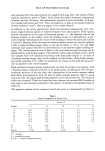
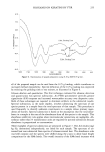
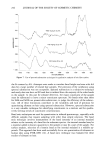
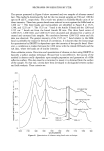
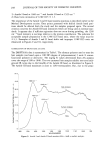
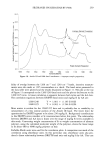
J. Soc. Cosmet. Chem., 38, 209-221 (July/August 1987) The effect of solvents on the ultraviolet absorbance of sunscreens LOUISE E. AGRAPIDIS-PALOYMPIS and ROBERT A. NASH, St. John's University, Jamaica, NY 11439, and NADIM A. SHAATH,* Research & Development Laboratory, Felton Worldwide Inc., Brooklyn, NY 1123 7. Received March 25, 1987. Synopsis The efficacy of sunscreens is often influenced by the solvents in which they are dissolved. In this regard, the ultraviolet (UV) absorption spectra of 13 UVA and UVB sunscreen chemicals were determined in 12 solvents of varying polarity and cosmetic interest. Changes in both the wavelength of maximum absorbance (K max) and molar absorptivity (½) were observed for many of the sunscreen-solvent systems studied. Observed hypsochromic and bathochromic shifts in K max for a number of sunscreen chemicals were related to their structure and polarity. Polar solvents shifted the K max of polar sunscreens to shorter wavelengths (hypsochromic) and shifted less polar sunscreens to longer wavelengths (bathochromic). Ortho-substituted sunscreen chemicals, such as salicylates and anthranilates experienced a minimum or no UV absorbance shift. With the exception of PABA, most sunscreens showed increased absorbance in both polar and non-polar solvents and decreased absorbance in semi-polar solvents, such as hexylene glycol and C•2-C•5 alcohols benzoate. The results of this study should aid the cosmetic chemist in selecting appropriate solvents and vehicles for sunscreen chemicals. INTRODUCTION In 1960, Riegelman and Penna (1) were the first to observe marked changes in the UV absorbance of p-aminobenzoic acid (PABA) and several less important UV absorbers in five different solvents (water, alcohol USP, polyethylene glycol 400, isopropyl palmi- rate, and mineral oil). The authors concluded that a sunscreen's effectiveness could be influenced by the solvent in which it is dissolved. Twelve years later, Groves, using a thin-film spectrophotometer, confirmed the previous findings for a small number of sunscreen chemicals in polyethylene glycol 400, isopropyl palmitate, and mineral oil (2). Shifts in the spectral absorbance of PABA in water and isopropyl alcohol were also reported by Cumpelik (3). More recently, Klein and Doshi have shown that the UV absorbance of several important sunscreen chemicals, alone and in combination with * Address all correspondence to: Dr. Nadim A. Shaath, Technical Director, Felton Worldwide, Inc., 599 Johnson Ave., Brooklyn, New York, 11237-USA. 209

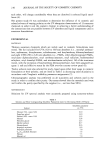
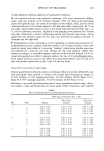
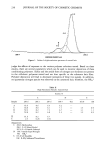
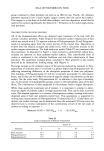
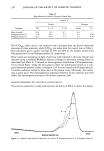
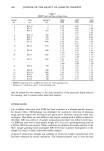
210 JOURNAL OF THE SOCIETY OF COSMETIC CHEMISTS each other, will change considerably when they are dissolved in selected liquid emol- lients (4). The present study (5) was undertaken to determine the influence of 12 cosmetic and related solvents of varying polarity on the UV absorption characteristics of 13 sunscreen chemicals in order to aid the cosmetic chemist in achieving a better understanding of the interactions that are possible between UV absorbers and liquid components used in sunscreen formulations. EXPERIMENTAL MATERIALS Thirteen sunscreen chemicals which are widely used in cosmetic formulations were tested. The list included five UVA (320 to 360 nm) absorbers (i.e., menthyl anthrani- late, oxybenzone, dioxybenzone, sulisobenzone, and butylmethoxy dibenzoylmethane) and eight UVB (290 to 320 nm) absorbers (i.e., PABA, ethyl dihydroxypropyl PABA, octylcyano diphenylacrylate, octyl methoxycinnamate, octyl salicylate, homomenthyl salicylate, octyl dimethyl PABA, and triethanolamine salicylate). All of the sunscreens tested, with the exception of butylmethoxy dibenzoylmethane, have been assigned Cat- egory 1: safe and effective status by the FDA over-the-counter review panel (6). Twelve solvents were also selected for study, based upon either their usage in cosmetic formulation or their polarity, and are listed in Table I in decreasing order of polarity in accordance with Vaughan's solubility parameter assignments (7). Chromatographic analysis was performed on all sunscreens and solvents used in the study in order to confirm their purity. Our assays showed that the materials used were well within the purity specified by the supplier (i.e., not less than 98%). METHODOLOGY Solutions for UV spectral analysis were accurately prepared using sunscreen-solvent Table I Solvents and Their Corresponding Solubility Parameters Listed in Decreasing Order of Polarity Solubility parameter Solvent at 25øC Ethanol 70%-water 30% 16.0 Propylene glycol 14.0 Ethanol 90%-water 10% 13.9 Ethanol 12.8 Hexylene glycol 12.3 Methyl carbitol 10.7 Ethoxyethanol 10.6 Isopropyl myristate 8.0 Isopropyl palmitate 7.8 C•2-C•5 alcohols benzoate 7.6 Hexane 7.3 Mineral oil 7.0
Purchased for the exclusive use of nofirst nolast (unknown)
From: SCC Media Library & Resource Center (library.scconline.org)