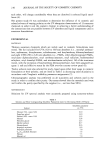
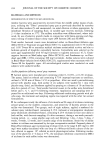
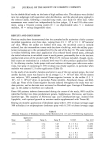
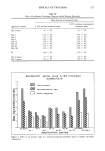
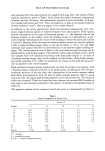
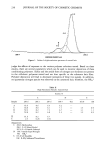
224 JOURNAL OF THE SOCIETY OF COSMETIC CHEMISTS MATERIALS AND METHODS DETERMINATION OF EFFECT ON SKIN MICROFLORA Aerobic bacteria were quantitatively recovered from the middle axillae region of sub- jects, utilizing the "Thran" pressurized spray gun as previously described by ourselves (4) and other workers (5) and enumerated, via serial dilution or where appropriate, by membrane filtration of sampling fluid, in suitable agar recovery medium, following 2-4 days incubation at 37øC. The axillary microflora were differentiated, where indi- cated, by use of selective growth media in conjunction with Gram-staining and diag- nostic testing of isolated major colony types (API Systems 20E and STAPH). Total aerobic bacterial counts were determined either on Brain-Heart-Infusion agar (Difco 0418) or Trypticase soy agar (Oxoid CM 131), supplemented with 0.3% lecithin and 1.0% Tween 80 to neutralize residual triclosan antimicrobial activity and also to facilitate growth of lipophilic coryneform bacteria. Coryneforms were selected on the same agar supplemented with 50 mg/l furoxone to suppress micrococci (6,7), Gram- negative bacteria on MacConkey agar (Difco 0075019), and Pseudomonas sp. on Pseu- dosel agar (BBL 11554) containing 300 mg/l cetrimide. Axillae isolates were cultured in Brain-Heart-Infusion broth (Oxoid CM 225), supplemented when necessary with 1% Tween 80 for lipophilic types. All microbiological studies were conducted on male subjects with unshaved axillae. Axillae population following aerosol spray treatment. ß Aerosol sprays were manufactured containing either 0, 0.05%, or 0.2% triclosan. The sprays, based on ethanol and containing 0.75% isopropyl-myristate as emollient, utilized a 50:50 mix of Freon 11/12 as propellant. After one week's preconditioning period with placebo soap, both axillae of six subjects were washed for 1 min with placebo soap, dried, and deodorant applied by spraying at a distance of 10 cm from the skin for a period of 3 sec. Total aerobic bacterial counts in the axillae were determined before and 1, 4, 7, and 9 h following treatment. Application and sampling were re- peated for an additional two days. Following additional conditioning periods with pla- cebo soap, the treatment and sampling regime was repeated with the other two aerosol formulations. ß In a subsequent study the influence of six months ad lib usage of triclosan-containing aerosol sprays on the number, composition, and sensitivity of bacteria present in the axillae was determined. Two groups, each of eight subjects, applied a marketed de- odorant spray (alcohol-based, containing 0.15% triclosan) or antiperspirant deodorant spray (aluminum chlorhydrate-based, containing 0.25% triclosan) at least once daily to both axillae, with bacteria sampling 4 h after treatment, during a one-week precondi- tioning period, i.e., using placebo soap only and following 1 day, 2 days, 5 days, 2 weeks, 4 weeks, 12 weeks, and 6 months usage of the deodorants. Sensitivity of axillae isolates to triclosan was examined by the agar incorporation method: Prepared plates of Brain-Heart-Infusion agar incorporating triclosan levels in the range 0. 001 mg/1 to 200 mg/1 were surface-inoculated with one drop of a 48-hour-old broth culture of the iso- late, diluted to approx. 10 7 cells/ml in sterile physiological saline. Following incuba- tion of the plates for 2-4 days at 37øC, the minimum inhibitory concentration (MIC) of triclosan for each axillae isolate was determined.

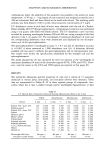
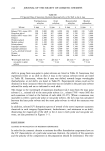
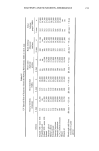
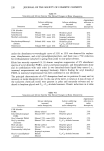
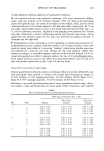
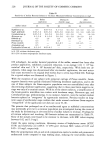
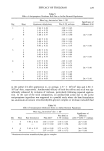
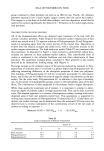
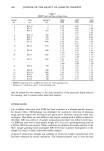
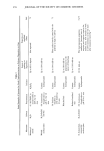
EFFICACY OF TRICLOSAN 225 Axillae population following application of antiperspirant deodorants. ß o/w emulsion roll-ons were produced containing 15% active aluminium chlorhy- drate, with and without 0.2% triclosan included. After one week's preconditioning period with placebo soap, the axillae of ten subjects were washed, dried, and the roll-on with and without 0.2% triclosan applied to left and right axilla, respectively, for 15 sec per axilla. Total aerobic bacteria counts in the axillae were determined before and 1, 4, 6, and 8 h following treatment. Application and sampling were repeated for a further four days. Following a second conditioning period with placebo soap alone, roll-on application was repeated, again over five days, but with the test products reversed, to eliminate any left-right bias. ß Antiperspirant sticks containing as active ingredient an aluminium-zirconium tet- rachlorohydrex-glycine complex, with and without 0.3% triclosan included, were eval- uated on twenty male subjects. A seven-day "washout" period using placebo soap alone was followed by a four-day test week. During the test week panelists' axillae were washed according to a controlled regimen, and test sticks with and without 0.3% tri- closan were applied once daily to opposite axilla at the rate of 0.4 g/axilla/application. Total aerobic bacteria counts in the axillae were determined before, and 4 h and 24 h after test product application on day 1 and 4 of the test week. OLFACTORY EVALUATION OF SKIN ODORS General guidelines for olfactory studies on deodorant efficacy have been defined (8), and such procedures were utilized to evaluate two aerosol spray formulations (Spray A: 0.15% triclosan, 0.75% isopropyl-myristate, 39.10% ethanol, 60.0% Freon 11/12. Spray B: 0.75% isopropyl-myristate, 39.25% ethanol, 60.0% Freon 11/12). Following a one-week preconditioning period using unperfumed placebo soap, thirty- two subjects, male and female (from an initial panel of fifty volunteers), were selected Table I Effect of Deodorant Sprays on Axillae Bacterial Populations Mean log•0 bacteriaJcm 2 skin _+ SD Plus 0.05% Plus 0.2% Day Hour Ethanol triclosan triclosan 1 2.82 -+ 0.54 2.62 _+ 0.78 1.83 -+ 0.68 4 3.36 -+ 0.22 3.09 -+ 0.50 2.07 -+ 0.83 7 3.58 -+ 0.26 3.46 -+ 0.31 2.40 -+ 0.56 9 4.09 -+ 0.08 3.64 _+ 0.46 2.55 -+ 0.66 1 2.77 -+ 0.37 2.40 _+ 0.36 1.61 -+ 0.50 4 2.98 -+ 0.23 2.85 _+ 0.53 1.94 -+ 0.66 7 3.59 -+ 0.22 3.25 -+ 0.39 2.56 -+ 0.65 9 4.09 -+ 0.20 3.65 -+ 0.25 2.82 -+ 0.68 1 3.28 _+ 0.65 2.90 + 0.23 1.96 + 0.29 4 3.57 + 0.69 3.26 + 0.36 2.40 + 0.46 7 4.05 + 0.32 3.53 + 0.40 2.93 + 0.56 9 4.13 + 0.48 3.83 --- 0.41 3.31 + 0.57
Purchased for the exclusive use of nofirst nolast (unknown)
From: SCC Media Library & Resource Center (library.scconline.org)