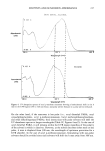
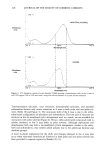
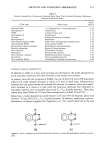
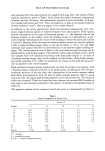
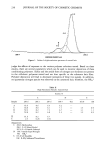
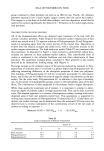
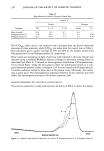
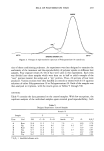
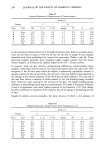
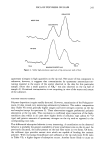
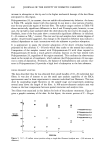
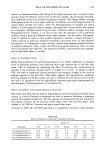
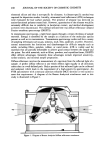
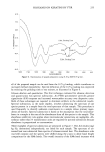
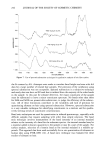
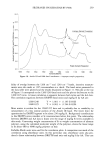
SILOXANES ON KERATINS BY FTIR 249 This attachment fits into the normal sample compartment of the FTIR. Light from the interferometer is reflected by the fiat mirrors, M1 and M2, onto an ellipsoidal mirror, M3. This mirror focuses the light onto the sample, which is placed in a metal cup at M4. The light is diffusely reflected from the sample, and a portion of the reflected light is collected by a second ellipsoidal mirror, M5. The light is refocused on the flat mirrors, M6 and M7, and then onto the detector. Access to the sample is from the top of the attachment, by sliding the ellipsoidal mirrors out of the way. The metal sample cup is removable for filling, and the sample cup height is adjustable for maximizing signal output. A suitable background or reference must be selected. Finely ground KBr or KCI powders are commonly used as diluents and should then be selected as the background. A review article by Griffiths and Fuller (5) provides a summary of the theory, instru- mentation required, and application examples for diffuse reflectance spectrometry. Commercial attachments for these techniques became available in 1979. Since that time, a variety of applications have been investigated. No reference in the literature was found for the use of DRIFTS with keratin fibers. In addition, the majority of papers contained qualitative information on spectral changes rather than quantitative data. A literature search concerning use of infrared spectroscopy for the analysis of keratin fibers resulted in few articles. Those papers available are generally concerned with the study of oxidized keratins showing band shifts and generation of new bands character- istic of the process. Two examples of the early work are Weston (6) and Alter and Bit-Alkhas (7) all use KBr pellet techniques. Baddiel (8) reports the use of multiple internal reflectance to study the surface structure of human hair directly rather than by grinding to form a KBr pellet. Using this technique, he shows interesting shifts in protein bands of the cuticle layer as compared to the internal cortical material. Low and Severdia (9) report the use of FTIR-photothermal beam deflection spectroscopy to char- acterize the spectrum of a single human hair in a non-destructive manner. Most re- cently, Strassburger and Breuer (10) used FTIR with a high-pressure diamond anvil cell to quantitatively measure oxidation damage to human hair. They present data on disul- fide bond cleavage by bleaching and thioglycollate waving as well as generation of sulfonate and thiosulfonate groups. The objective of the effort documented in this paper was the generation of a quantita- tive, siloxane-specific, surface analysis technique for the detection of siloxanes on hair fibers. Quantitative methods for siloxane detection are required to aid in the under- standing of the mechanism of siloxane fluid deposition. EXPERIMENTAL MATERIALS The KBr powder was purchased from Barnes Analytical. No attempt was made to keep the powder anhydrous. The KBr was ground for one minute prior to use as a back- ground reference for DRIFTS. Virgin European, natural brown hair from DeMeo Brothers, Inc. was purchased. The silicones used were trimethylsilylamodimethicones, amine-functional siloxanes, as il- lustrated in Figure 2, and derivatives of the amine functionality. The polymer con-

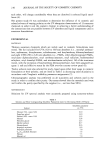
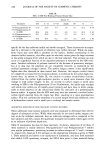
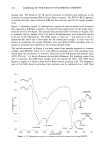
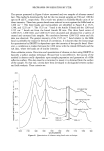
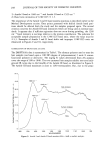
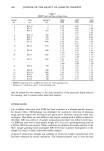
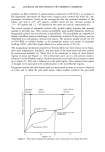
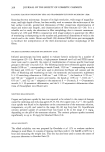
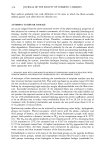
250 JOURNAL OF THE SOCIETY OF COSMETIC CHEMISTS CH 3- Si - 0 i - I OH3 LcH3 Si - Si - OH 3 I OH 3 y NH CH2-CH2-NH 2 Figure 2. Trimethylsilylamodimethicone (CTFA name). rained 100 siloxane repeating units (degree of polymerization, DP) with a 2 mole % amine functionality. The silicones were applied to the hair as 0.25 wt% diluted emul- sions. A 200-g treatment bath was used for each 12-g tress. Each hair tress was allowed to dry naturally before test clippings were collected. The entire tress length (30 cm) was used in preparing samples to provide a uniform, representative sample. INSTRUMENTATION Spectra were obtained from a Nicolet Model SX spectrometer. The spectrometer is equipped with an air-bearing Michelson interferometer, a water-cooled high-intensity globar source, and a liquid nitrogen-cooled mercury cadmium telluride detector. Spectra were collected at 2 cm-• resolution and with co-addition of 300 one-second scans. The diffuse reflectance attachment was purchased from Barnes Analytical, Stamford, Conn. The accessory is called the "Collector" Model 0030-003 and mounts in the sample compartment of the FTIR. The WIG-L-BUG grinder/mixer Model 3110B was also purchased from Barnes Analytical. The WIG-L-BUG is a vial-and-pestle device that reciprocates at 3200 rpm and is commonly used by spectroscopists for solid sam- pling and by dentists for preparation of amalgams. The sample is placed in a (2.5 cm x 1.3 cm) stainless steel vial that includes a 0.6-cm diameter stainless steel ball. TEST PROCEDURE Prepare the FTIR for operation and set-up the diffuse reflectance accessory. Grind about 0.3-0.5 g KBr powder for one minute in the WIG-L-BUG. Fill the DRIFTS macro- cup with KBr powder, level, and place in the accessory. Purge the FTIR for 5-10 minutes, maximize the signal output, and collect 300 scans as background. Repeat as necessary to eliminate CO2 and water vapor contributions. Cut hair fibers to a length of 0.25-0.50 cm. Use solvent-washed scissors and clean paper to prevent sample contam- ination. Weigh 0.20 - 0.005 g KBr powder (non-ground) and 0.05 - 0.005g cut hair fibers into a clean WIG-L-BUG vial containing the stainless steel ball. Clean the vial by rinsing with distilled water, wipe dry with a towel, rinse with methylene chlo- ride, and blow dry. Grind the KBr/hair mixture for one minute. Add all of this mixture to the DRIFTS macro-cup with the aid of a clean metal spatula. Place the sample in the
Purchased for the exclusive use of nofirst nolast (unknown)
From: SCC Media Library & Resource Center (library.scconline.org)