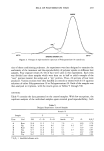
HAIR DAMAGE 271 (liquid retention) (10), alkali solubility (9), and sorption of metal ions (9) as well as polymers (34). For bleached hair, liquid retention was found to be about 42-43% in the pH range 3-5, with increases of up to 52% in the pH region of 5-7.5.(10). For untreated hair, an increase in swelling above 31% is observed at pH values above 9. The phenomenon of increased swelling and its pH dependence for bleached hair has been explained by the charge-rearrangement mechanism postulated for oxidized wool by Thomson and O'Donnel (42). According to this mechanism, strongly acidic cysteic acid residues displace carboxylic groups from their salt links with ionized basic groups. The carboxyl groups remain essentially unionized at pH 4 and below, due to the increase in negative charge density following the formation of cysteic acid residues. Above pH 5, the displaced carboxylic groups begin to titrate, bringing about an increase in swelling. In addition, it has also been proposed that the oxidative destruction of the melanin granules might result in the formation of discrete voids within the fiber structure which contribute to the swelling characteristics (t0). Moisture absorption (regain) parallels the trends recorded in swelling measurements and increases with the extent of bleaching over a wide range of humidities, 17-94%. At 61% RH regain increases from 13.5% for intact hair to 14.8% for bleached fibers (t0). The wet strength of keratin fibers is determined to a great extent by the concentration of disulfide bonds which form crosslinks. On the other hand, the strength of dry fibers is not appreciably influenced by the density of covalent crosslinks and depends largely on Van der Waals forces and ionic interactions between the peptide chains. Conse- quently, for bleached hair, in which the disulfide bonds have undergone oxidative scis- sion by hydrogen peroxide or peracetic acid, a steady decrease in wet strength (yield stress, stress at breakpoint, and 20% index) with increased time of bleaching is ob- served (t0). For example, the yield and stress at break decrease from t. lg/den to .99 g/den and from 1.9 g/den to 1.4 g/den, respectively, for hair bleached with H202 at pH 10 for 60 min. The reduction in fiber strength is accompanied by an increase in the extension to break by a few percent, from 51.5-53.5% to 57.5-59.5%. The modulus, ultimate strength, and breaking extension of dry fibers are virtually unaffected by the same treatments. Since the hydration of bleached hair is strongly pH-dependent, it is also reflected in the mechanical performance of wet fibers. Bleached hair exhibits a region of maximum mechanical stability between pH 3 and 5, where the displaced carboxylic groups are undissociated and those ionized are bound in salt links. Above pH 5 the ionization of free carboxyl groups occurs, leading to increased fiber hydration and reduction in fiber strength (10). Another parameter deduced from stress-strain relations, the hysteresis ratio at constant temperature, was found to be independent of the number of bleaching treatments, but the absolute value of W2o decreases by as much as 35% with increasing bleaching (11). Bleaching raises the temperature of the second-order phase transition from 46øC to 56øC. An increase in the transition temperature was also reported for H202-oxidized hair in TMA measurements (21). Similar trends are evident from dynamic mechanical measurements (6). The torsional modulus of bleached hair, at 65% RH, was (1.05 --- 0.005) ß 10 TM pascals and does not differ from that determined for intact hair ((1.02 ___ 0.09) ß 10 TM pascals). For wet hair, the decrease in rigidity ratio (the ratio of wet to dry torsional modulae) from 0.26 ---

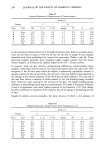
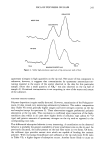
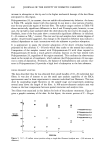
272 JOURNAL OF THE SOCIETY OF COSMETIC CHEMISTS 0.01 for intact hair to 0.14 ___ 0.01 for bleached hair is pronounced. The logarithmic decrement, on the other hand, was virtually unaffected by bleaching and changed from 0.40 ___ 0.05 for intact hair to 0.44 ___ 0.03 for bleached fibers. WAVING In cosmetic practice, the waving of hair is usually accomplished by the fission of disul- fide bonds by reaction with mercaptans. The reagant most frequently used for this purpose is thioglycolic acid (0.6-0.8 M at pH 9.1-9.5). The rate of reaction is diffu- sion-controlled under alkaline conditions, and full penetration into hair usually requires 15-20 min (41). According to aminoacid analysis, the concentration of half-cystine residues in TGA-reduced hair may decrease by as much as 40% (from 156.4 --- 4.5 mol/1000 mol total amino acids analyzed to 95.8 --- 0.1 mol/1000 mol total amino acids analyzed) (39,43). This is accompanied by an increase in concentration of free thiol groups from 2.46 Ixmol/mg to 506.5 Ixmol/mg (39). Thiol groups can be easily oxidized by atmospheric oxygen, and thus the stabilization of reduced hair properties usually involves the blocking of thiol groups by reaction with iodoacetic acid or cross- linking with dihalogenoalkanes (diiodomethane, dibromoethane, or dibromohexane) (11,21). In a permanent-waving procedure, disulfide crosslinks are rebuilt by the use of a suitable oxidizing agent such as sodium bromate, hydrogen peroxide, etc. The neu- tralization (oxidation) step reinstates most of the original disulfide bridges, with con- comitant reduction of the number of thiol groups. The mechanical properties of reduced, reduced-blocked, reduced-crosslinked, and per- manent-waved (reduced and reoxidized) hair were studied by measurement of stress- strain relations and calculation of hysteresis ratios (11). In general, for reduced and blocked or crosslinked hair, a considerable decrease in W20 and a small increase in H20 , as compared to untreated hair, is observed (W20 and H20 changed from 350 to 149-316 and from 0.524 to 0.558-0.624, respectively, at 25øC, depending on the choice of mercaptan. Considerable differences in H20 between treated and untreated hair occur at temperatures below the transition temperature. W20 and 820 of hair reduced with either thioglycolic acid, phenyl mercaptan, or ethyl mercaptan, and subsequently blocked with iodoacetic acid, were similar. Benzyl mercaptan caused a larger reduction in W20 and also effected an appreciable change in H20 at various temperatures. Reduc- tion and blocking also decreased the transition temperature from 46øC to 38-43øC, depending on the mercaptan. Reduction and crosslinking provided mixed results, pro- ducing an increase in transition point to 48øC for treatments involving diiodomethane and dibromohexane and a decrease to 4 IøC for crosslinking with dibromoethane. A study of dry reduced hair using the oscillating beam method showed a small decrease in E' from (4.1 --- 0.66) ß 10 • pascals to (3.5 + 0.2) ß 10 • pascals and no change in E" (13). In the case of hair treated with a waving lotion, which involves reduction followed by reoxidation, no difference in either E' or E" was detected, suggesting that the system has returned to its original mechanical state even though its internal and external configuration may have changed. Similar conclusions can be drawn from tor- sional modulus determinations in air at 65% RH, which also demonstrated no signifi- cant change from (1.02 --- 0.09) ß 10 TM pascals for waved hair (6). On the other hand, rigidity ratios in water and 0. IN HCI were found to be dramatically reduced from 0.26
Purchased for the exclusive use of nofirst nolast (unknown)
From: SCC Media Library & Resource Center (library.scconline.org)