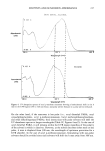
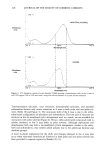
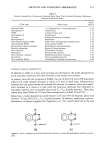
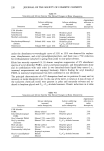
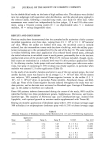
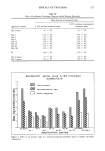
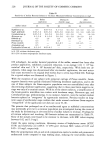
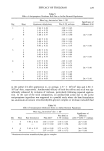
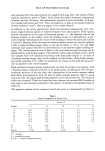
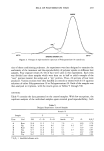
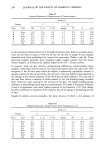
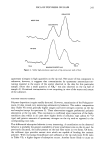
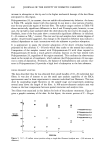
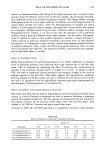
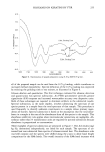
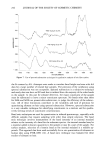
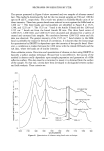
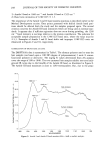
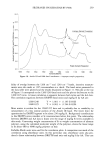
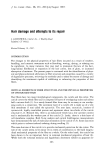
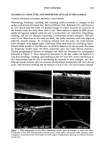
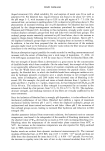
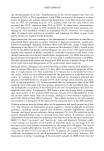
HAIR DAMAGE 269 CHANGES IN STRUCTURE AND PROPERTIES OF HAIR AFTER DAMAGE PHYSICAL HANDLING (CLEANSING, BRUSHING, AND COMBING) Weathering, brushing, combing, and cleansing results primarily in changes to the surface architecture of human hair. Swift and Brown (36), Robinson (37), and Garcia et al. (27) determined that there is a gradual change in surface structure as a function of the distance from the scalp (from root to tip). Their analysis is based on SEM micro- graphs of long-hair samples subjected only to normal hair care treatments of brushing, combing, and use of a shampoo containing a conventional anionic detergent. The por- tions of the fiber close to the scalp are sleek, the scales imbricate with free edges of relatively smooth contour. At increasing distance from the scalp, the scales become more damaged, with jagged edges, sometimes lifted away from the underlying layers. Scratch marks parallel to the fiber axis can often be observed. At the tip ends, the scales are frequently eroded away, the fibers sometimes split into many fibrous elements. Typical morphological features of damaged hair fibers are illustrated by micrographs presented in Figure 2. These destructive alterations to the hair surface are believed to arise from brushing, combing, and handling in the wet state (36). Some contribution to this deterioration may be due to weathering by exposure to rain, sunlight, and dirt, although results indicate that wet abrasion accompanying shampooing and towel drying alone, with minimal combing and no exposure to sun or rain, can cause similar damage. 1188 5KV X800 10Pm [4014 Figure 2. SEM micrographs of hair fibers illustrating various types of damage: a) intact hair fiber b) fragment of hair fiber with partially removed cuticle, lifted scales, and scratch mark exposing cortex c) fragment of hair fiber with eroded scales and early stages of longitudinal splitting into fibrous elements d) split end.

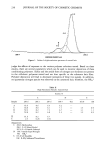
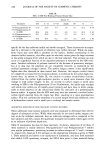
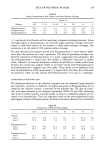
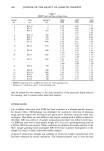
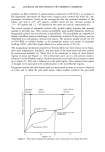
270 JOURNAL OF THE SOCIETY OF COSMETIC CHEMISTS Rubbing of dry fibers results in cuticle loss near the fiber tips, although it does not produce the same degree of scale damage. SEM examination of tangled hair has demon- strated that when hairs become twisted around each other, grooves can form in the cuticle surface, and in some cases cuticle can be removed. In dynamic combing experi- ments, abrasion and deformation of the fibers has been shown to cause stripping of cuticle and fracturing of the fibers. It appears that the types of fracture that result from this treatment yield longitudinal splitting. The average rate at which the scale margins recede down the fiber by combing is about 0.5 •m/2000 comb strokes. Structural deformation of hair fibers under various conditions of mechanical stress were studied by SEM (26). Hair samples were clamped between the crosshead and load cell of an Instron tensile tester and extended at various rates until fracture occurred. Five main types of fracture, related to the degree of internal damage as a result of weathering, were observed. These were: (1) clean transverse fracture in the case of less weathered hair samples (2) clean transverse fracture with some disturbance of culticle (3) part of the fracture is transverse but the remainder tails off with segments of cortex pulled off (also, the damage to cuticle is more severe in the form of lifting as well as longitudinal and circumferential splitting) and (4, 5) fracture ragged with cortex separating into fibrillar elements (such a fracture pattern was observed in the case of severely weathered hair (26)). Negroid hair is especially prone to damage during grooming procedures because of a high frequency of kinks along the fiber axis and its ribbonlike cross-sectional shape (38). Such a unique fiber configuration leads to extensive entanglements which increase the forces applied during combing. The fracture behavior of negroid hair was studied by tensile-fatigue measurements and SEM (38). These studies revealed that frequent twists with random reversals in direction and pronounced flattening in the region of twist lead to stress concentrations during tensile deformation. Fiber failure at low extensions is due to the initiation of cracks at numerous weak points near the twists. SEM showed the predominance of step fractures and a large proportion of fibrillated ends which reflect poor cohesion between cortical cells. In contrast, undamaged caucasian hair usually produced smooth transverse fractures. BLEACHING Although the purpose of bleaching is to eliminate or lighten the natural hair color by the reaction of an oxidizing agent with the melanin pigment, side reactions signifi- cantly affect the properties of the keratin fibers. It is well established that hydrogen peroxide in conventional bleaching and oxidative hair dye formulations (alkaline media at pH 10 and above) leads to oxidative cleavage of disulfide bonds and the formation of cysteic acid as the end product (29). According to aminoacid analysis, extensive bleaching can reduce the content of half-cystine residues from 13.9% to 5%, which corresponds to approximately a 64% reduction in the disulphide bond linkages of the protein molecules (10,39). Bleaching also reduces the concentration of free sulfhydryl groups (for example, from 2.46 •mol/mg to 0.3 •mol/mg (39)). Qualitatively similar results were reported by Robbins et M. (40) and Wolfram (41). The oxidative scission of disulfide bonds results in decreasing the crosslink density of the protein and provides additional anionic sites in the form of cysteic acid residues. Both reduction in covalent crosslink density and an increase in hydrophilicity contribute to the increase in swelling
Purchased for the exclusive use of nofirst nolast (unknown)
From: SCC Media Library & Resource Center (library.scconline.org)