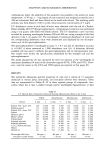
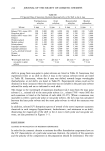
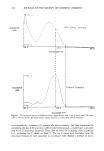
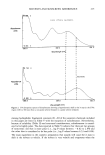
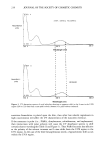
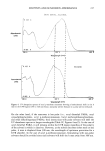
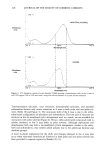
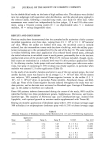
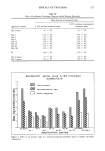
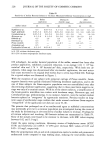
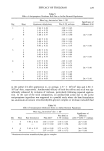
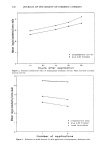
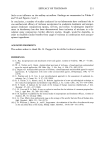
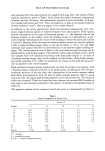
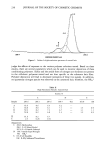
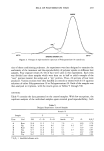
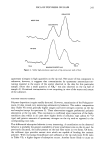
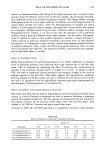
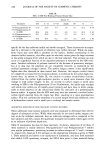
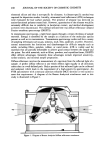
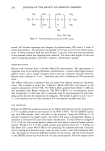
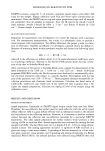
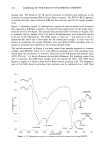
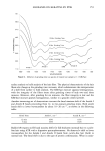
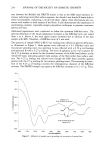
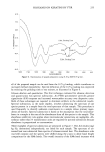
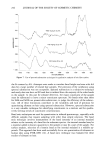
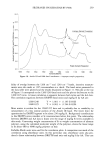
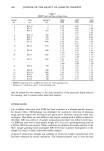
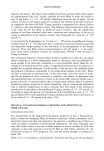
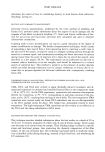
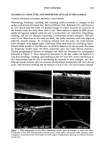
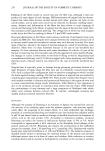
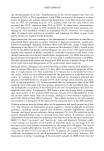
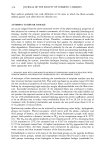
SILOXANES ON KERATINS BY FTIR 255 81.9 • 1 Min. Gnndlng T!me • /• ß / 2 Min. Gnndlng Time 1850 1750 1650 1550 1450 1350 1250 1150 1050 950 WAVENUMBERS Figure 6. Optimization of sample preparation using 0.20 g KBr/0.05 g hair. all of the prepared sample can be used from the 0.25 g loading, which contributes to increased method repeatability. Spectral definition of the 0.25 g loading was improved by reducing the grinding time to one minute, as illustrated in Figure 6. Siloxane detection and quantitation. The first technique evaluated for siloxane detection and quantitation was spectral subtraction. An FTIR spectrometer provides greater signal/noise (S/N) response and increased wavenumber accuracy over dispersive units. Both of these advantages are required to eliminate artifacts in the subtracted results. Spectral subtraction, as the name implies, involves subtracting the spectrum of one species present in a sample from the total spectrum of that sample. This procedure is used frequently to identify unknown constituents in a sample whose primary ingre- dients are known. Spectral subtraction is based on the assumption that the total absor- bance in a sample is the sum of the absorbances from all the species in the sample. This absorbance additivity rule applies when intermolecular interactions are negligible. Ab- sorbance rather than % transmittance units are required for spectral subtraction because absorbance is proportional to concentration. Three examples of spectral subtraction are presented in Figure 7. The AA results (mg/ kg Si), determined independently, are listed for each sample. The spectrum of un- treated hair was subtracted from spectra of siloxane-treated hair. The absorbance scale was held constant and the spectra were shifted along the y-axis to allow band height comparisons for the SiMe bands. The overall intensity of the SiMe band increases with

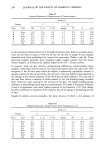
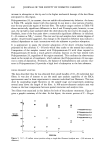
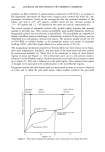
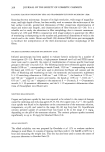
256 JOURNAL OF THE SOCIETY OF COSMETIC CHEMISTS .148 .119 .091 uJ .063 z o • .034 .006 - .021 - .050 • i i i / i i i I i 1850 1750 1650 1550 1450 1350 1250 1150 1050 950 WAVENUMBERS Figure 7. Use of spectral subtraction techniques for qualitative analysis of hair fiber surface. the Si content by AA. Attempts were made to correlate band height and area with AA data for a large number of treated hair samples. The precision of the correlation using spectral subtraction was not acceptable. Spectral subtraction is a subjective technique and rarely does one have an IR band that is isolated from the majority of the other bands in the sample. In this case for siloxane detection, the major constituent of the sample must be subtracted to leave a minor constituent spectrum. No bands other than those for SiMe and SiOSi are present after subtraction, to judge the efficiency of the subtrac- tion. All of these limitations contribute to the variability and lack of precision for quantitating siloxane on hair using spectral subtraction. However, spectral subtraction is a very valuable technique for identifying constituents in a mixture and for qualita- tively viewing trends of constituent concentrations. Band ratio techniques are used for quantitation in infrared spectroscopy, especially with difficult samples that require sampling with other than simple solutions. The band ratio technique involves measurement of the band intensity of an internal standard relative to the intensity of a band for the unknown species. An internal standard may be a material added in known quantities to the sample or may be a part of the sample. For surface analysis, selection of a keratin band as the internal standard is a reliable ap- proach. This approach has been used successfully for in vivo quantitation of siloxanes on human skin using FTIR-ATR (12). A band ratio technique was evaluated for these studies of siloxane on hair.
Purchased for the exclusive use of nofirst nolast (unknown)
From: SCC Media Library & Resource Center (library.scconline.org)