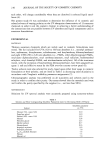
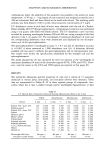
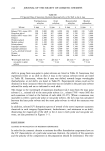
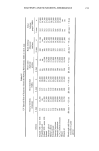
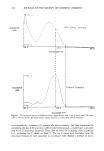
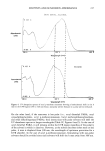
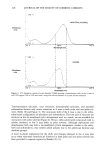
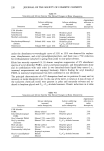
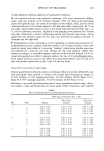
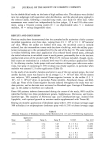
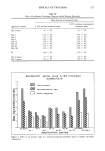
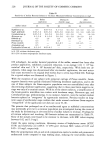
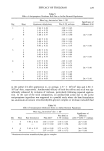
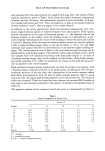
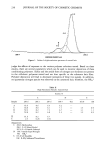
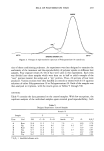
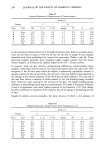
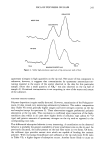
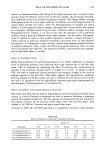
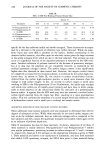
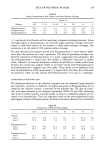
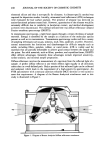
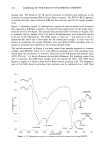
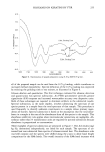
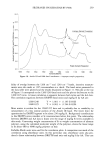
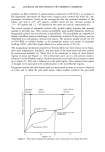
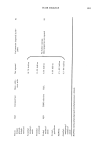
ESCA OF POLYMERS ON HAIR 235 were obtained from the center portion of a single 8-inch-long tress. The results of these replicate analyses are given in Table I which shows the surface elemental compositions in atomic percent. As shown, the measurement precision is quite acceptable, with rela- tive standard deviations near 10%. Thus, heterogenity, at least at the spatial resolution of these analyses (2 mm2), does not appear to be a major obstacle. In addition to the survey spectra from which the elemental compositions were com- puted, high-resolution spectra of selected elements were also acquired. These spectra provide information on the types of functional groups, i.e., the chemical state of the elements present on the surface, since the binding energy of a photoelectron is per- turbed slightly depending on the nature of the bonding in which the particular nucleus is involved. Bonding which decreases the electron density around the nucleus produces a shift to higher binding energy. Thus, in the case of carbon, C- O, C- O, and CO0 (carboxyl) type groups shift the Cls photoelectrons to successively higher binding en- ergies. The contributions of each of these to the total observed peak envelope can be determined by peak-fitting analysis. The observed carbon peak envelopes of the control hair samples were well reproduced by fitting with three peaks (Figure 1). In order of increasing binding energy, they can be assigned to hydrocarbon, alcohol/ether groups, and amide carbonyls (2,5). Table II summarizes the results of this peak-fitting proce- dure as applied to the control samples. High-resolution nitrogen spectra revealed only one form of nitrogen to be present, with a binding energy consistent with that of an amide group. In agreement with the pro- teinaceous structure of the hair fiber, the concentration of the amide carbonyl carbon peak shows good agreement with the level of amide nitrogen detected. This is a good indication that the carbon peak-fitting parameters used were satisfactory. Two forms of sulfur were observed. These two forms have been observed in previous ESCA studies on hair surfaces and have been attributed to the presence of sulfonate and disulfide forms of sulfur (3). The replicate analyses of the untreated control hair serve as a benchmark by which to Table I Surface Composition of Control Hair Atomic % Sample C O N S Si A 78.6 11.8 6.2 2.3 1.0 B 76.0 13.4 6.2 2.6 1.0 C 78.1 11.5 7.1 2.4 0.9 D 74.7 13.9 6.7 2.5 1.1 E 74.8 14.3 5.3 2.1 2.4 F 78.0 11.8 6.8 2.9 0.3 X 76.7 12.8 6.4 2.5 S 1.8 1.2 0.6 0.3 R.S.D. 2.3% 9.4% 9.4% 12% X = average. S = standard deviation. R.S.D. = relative standard deviation.

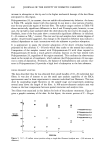
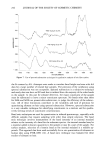
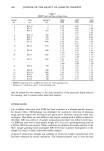
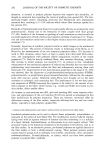
236 JOURNAL OF THE SOCIETY OF COSMETIC CHEMISTS 299.4 BINDING ENERGY {eV) 279.4 Figure 1. Carbon Is high-resolution spectrum of control hair. judge the effects of exposure to the various polymer solutions tested. Based on these results, there are several parameters which can be used to monitor deposition of these conditioning polymers. Sulfur and the amide form of nitrogen are elements not present in the cellulosic polymers tested and are thus specific to the substrate hair fiber. Polymer deposition will lead to decreased intensities of these two signals. In addition, no quaternary nitrogen species was observed on the untreated hair therefore, the NR 4 + Table II High Resolution Results: Control Hair Atomic % C N S Sample 284.6 286.1 287.6 399.7 402 163.8 168 A 63.6 8.6 6.5 6.2 -- C 64.0 8.0 6.1 7.1 -- 1.5 0.9 D 59.2 8.2 7.3 6.7 -- 1.1 1.1 E 59.8 8.2 6.8 5.3 -- 1.2 0,9 X 61.6 8.2 6.7 S 2.5 0.26 0.51 Assignments: C 284.6 Hydrocarbon 286.1 C-O Ether/Alcohol 287.6 C = O Amide Carbonyl N 399.7 Amide-Type Nitrogen 402 NR4 + S 163.8 S-S Disulfide 168 R-SO 3 Sulfonate/Thiosulfonate
Purchased for the exclusive use of nofirst nolast (unknown)
From: SCC Media Library & Resource Center (library.scconline.org)