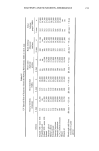
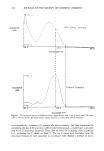
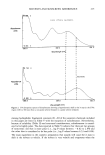
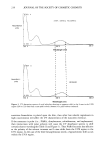
HAIR DAMAGE 275 the thermal properties of hair. Transformations in the solvent-exposed hair were not observed in DTA or TGA experiments, while TMA was found to be sensitive to alter- ations. In general, the solvents reduced the temperature of the first transverse penetra- tion (at 59øC for untreated hair) by 15øC. Diethyl ether was the only solvent that increased the 256øC expansion from 54% to 102%. In stress-strain measurements, 10-15% reduction in work to 25% extension was observed for water solutions con- taining 45-55% methanol, ethanol, or n-propanol (54,55). However, the weakening effect of alcohol-water mixtures is reversible, and resoaking the fibers in pure water nearly restores the original tensile properties. Supercontraction (the term referring to the phenomenon of contraction of stretched or unstretched fibers subjected to certain chemical or physical treatments), usually per- formed by prolonged treatment of keratin fibers with 8M LiBr, causes a longitudinal shortening of the fibers (10-30%). An increase in fiber diameter (100%), as well as loss of the X-ray diffraction pattern and birefringence (2), also occurs. The supercontracted samples were reported to behave similarly to crosslinked samples in that some of the thermal transitions were shifted towards higher temperatures (21). Helix disruption can also be produced by exposure of hair (11) or wool (56) to perfluorooctanoic acid (PFO). The data obtained with human hair treated with PFO indicate a marked change of slope of the yield region and disappearance of the second-order phase transition. Although anionic detergents such as sodium dodecyl sulfate interact with globular pro- teins or keratin fibers such as wool (57), they affect the mechanical properties of hair only to a slight extent (13). This is believed to be mainly due to the protective role of the cuticle, which acts as a diffusion barrier for the penetration of surfactants into the cortex. In contrast to this, fibers with cuticle removed by mechanical abrasion and saturated with SDS showed an increase of 35 % in the average elastic modulus and about 50% in the loss modulus (13). It was postulated that the hydrophilic head of the SDS molecule reacts with polar side-chain groups, particularly in the microfibril areas, and the hydrophobic tail portion of the molecule sticks into the amorphous and more hy- drophobic-like cortex. Consequently, SDS forms a quasi-salt bridge which is stronger than those present in the untreated fiber and also, because of its hydrophobicity in the tail section, drives water from the structure, leading to lower moisture regains at a given RH. Both of these effects increase E'. The marked increase in the loss modulus was ascribed to a disruption of the matrix by the non-polar parts of the SDS molecule. Chlorine solutions have an adverse effect on the appearance and tactile properties of hair (17). The literature on chlorination of wool suggests a variety of degradative reaction pathways, including cystine rupture and oxidation, tyrosine degradation, peptide cleavage, and loss of protein substance during treatment (58-63). The reduction in the protein crosslink density leads to softening of the fiber surface. A systematic study of chlorination of hair was made by measuring inter-fiber friction by the twist method and SEM (17). Both "tip-to-root" and "root-to-tip" static and kinematic frictional coeffi- cients increase as a function of the number of treatment cycles (in the range of 0-60 one-hour cycles) and chlorine concentration (in the range of 0-60 ppm). The rate of damage is considerably higher at low pH. At low pH the "tip-to-root" frictional coeffi- cient may rise from 0.181 to as high as 0. 347. In general, the changes in the frictional coefficient were greater in the case of measurements in the "root-to-tip" direction. The examination of surface morphology of friction-tested samples by SEM reveals that the

276 JOURNAL OF THE SOCIETY OF COSMETIC CHEMISTS fiber surfaces gradually lose scale definition in the areas in which the fibers actually rubbed against each other after the chlorine test. ATTEMPTS TO REPAIR DAMAGE As can be judged from the above-presented review of the physicochemical properties of hair subjected to a variety of cosmetic treatments, all of them, especially bleaching and relaxing, modify the original properties of keratin fibers. Cuticle destruction or re- moval, increased swelling, and brittleness are among the factors adversely affecting the appearance and tactile attributes of hair. Therefore, a substantial amount of work has been done to explore the means of protecting hair against the degradative action of weathering and handling or to restoring its original mechanical or surface properties after degradation. Preservation is achieved primarily by the use of conditioners which reduce the cuticle damage by decreasing frictional forces accompanying handling proce- dures. Although no method of practical utility was found to repair mechanically weak- ened hair, the general research strategy was to impart or to restore the conformational stability and mechanical integrity which in intact fibers is primarily derived from cova- lent crosslinking by cystine, interchain hydrogen bonding, electrostatic interactions, and, to a small extent, by hydrophobic bonding between nonpolar residues. Basically three approaches were utilized: 1. TREATING HAIR WITH LOW-MOLECULAR-WEIGHT COMPOUNDS CAPABLE OF REACTING WITH KERATIN PROTEIN AND PRODUCING CROSSLINKING OR a HYDROPHOBIC EFFECT A technique of hair treatment involving the introduction of nonpolar residues into the hair structure has been reported (64). This work was based on an earlier report (65) that the wet mechanical properties of reduced keratin fibers could be restored without cross- linking by incorporating high-molecular-weight alkylmonohalides into the fiber struc- ture. Successful mechanical recovery of the alkylated fibers was attributed to hydro- phobic interactions between alkyl moleties. For hair, S-alkylation with alkyl halides did not produce the expected increase in the 30% extension work index. On the other hand, the use of N-alkylmaleimides, standard blocking agents for protein sulfhydryl, proved to be an efficient way to reduce water swellability (from 39.9 to 28.2% in the case of treatment with N-dodecyl maleimide) and increase the wet-yield stress (from 0.22 to 0.32 g/denier) of reduced fibers. Qualitatively similar effects can be achieved by introducting other bulky, hydrophobic groups into keratin. Phenyl isocyanate, which reacts with the amino, carboxyl, and thiol groups of keratin, and ninhydrin, which forms Ruhemann's purple with amino groups, both produce a dramatic increase in W2o in the temperature range of 0-25øC (11). The H2o was also altered markedly at low temperatures (0-25øC), decreasing from 0.524 (measured at 25øC) for untreated hair to 0.267 for ninhydrin-treated hair and 0. 157 for isocyanate-treated hair. At higher temperatures the H2o approached the value of the control fibers. All these changes were interpreted by assuming a reduction in water content and thus increased viscosity of the keratin protein. Formaldehyde is reactive with many of the functional groups on the peptide backbone (primary amino groups, tyrosyl and tryptophane residues (66,67)) and is able to react with groups containing active hydrogens to form methylene bridges (crosslinks) be-
Purchased for the exclusive use of nofirst nolast (unknown)
From: SCC Media Library & Resource Center (library.scconline.org)