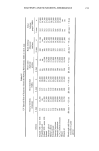
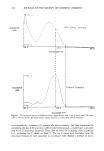
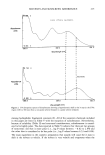
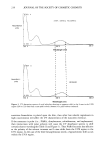
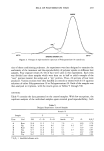
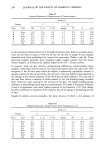
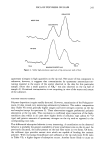
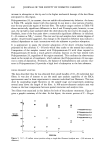
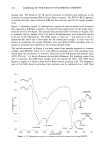
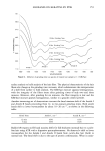
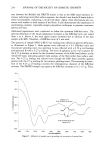
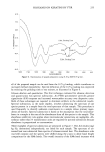
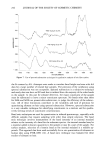
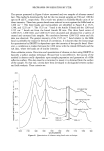
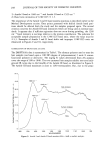
SOLVENTS AND SUNSCREEN ABSORBANCE 221 in such semi-polar solvents would require increasing the concentration of required sun- screen for maximum protection or, in the case of branched-chain liquid fatty esters, replacement with a more appropriate solvent. In conclusion, the wavelength of maximum absorbance (h. max) in the UVA and UVB regions of the spectrum and the resultant molar absorptivity (E) of a sunscreen chemical often will be affected by the solvent in which it is dissolved. The changes observed in these two important parameters appear to be strongly influenced by the polarity and chemical structure of both the sunscreen and the solvent. The results of the present study of the interaction between sunscreens and solvents provide practical information that cosmetic chemists may find useful in formulating sunscreen preparations. REFERENCES (1) S. Riegelman and R. P. Penna, Effect of vehicle components on the absorption characteristics of sunscreen compounds, J. Soc. Cosmet. Chem. 11, 280-291 (1960). (2) G. A. Groves, Factors influencing the formulation of sunscreens, Amer. Cosm. Perf., 87, 54-58 (July 1972). (3) B. M. Cumpelik, Sunscreens at skin application levels: Direct spectrophotometric evaluation, J. Soc. Cosmet. Chem., 31, 361-366 (1980). (4) K. Klein and I. Doshi, Sunscreen/solvent interactions: An in-vitro evaluation, 14th International IFSCC Congress, September 16-19, 1986, Barcelona, Spain. (5) For a more detailed explanation of the experimental procedure and results, refer to: L. E. Agrapidis- Paloympis, The Influence of Solvent on the UV Absorbance of Sunscreens, M.S. Thesis, St. John's University (1987). (6) Department of Health, Education and Welfare, US FDA, Sunscreen drug products for over-the- counter human use, Fed. Reg., 43(166), 36206-38269 (1978). (7) C. Vaughan, Using solubility parameters in cosmetic formulations, J. Soc. Cosmet. Chem. 36, 319-333 (1985). (8) Spectrometry nomenclature, Anal. Chem. 56, 125 (1984). (9) R. F. Rekker, The Hydrophobic Fragment Constant (Elsevier Scientific Publishing Company, New York), 1977. (10) N. A. Shaath, The chemistry of sunscreens, Cosmetics and Toiletries, 101, 55 (March 1986). (11) N. A. Shaath, On the Theory of Ultraviolet Absorption of Sunscreen Chemicals, Annual Meeting of the Society Cosmetic Chemists, New York, December 1986, J. Soc. Cosmet. Chem., 82, 193-207 (May/ June 1987). (12) J. Vogelman, E. Nieves, J. Brind, R. Nash, and N. Orentreich, A spectrophotometric method for determining relative SPF values of sunscreen preparations, J. Applied Cosmetol., 1, 1-11 (1985). (13) K. Klein, Van Dyk Division, Mallinckrodt, Inc., Belleville, NJ 07109, private communication.

J. Soc. Cosmet. Chem., 38, 223-231 (July/August 1987) Efficacy of the antimicrobial agent triclosan in topical deodorant products: Recent developments in vivo ASHLEY R. COX, Microbiology Department, FC 2.46, Ciba-Geigy AG, Dyestufj5 & Chemicals Division, CH-4002 Bask, Switzerland. Received February 10, 1987. Synopsis In vivo studies have been conducted to determine the effects of application of deodorant and antiperspirant products on aerobic axillary microbial populations and to quantify the influence of the antimicrobial agent triclosan on product efficacy. Antibacterial effects of alcohol and antiperspirant ingredients were augmented by inclusion of triclosan in deodorant compositions and, in the case of a deospray composition containing 0.15% triclosan, improve- ment in deodorancy was established by olfactory studies. The axillary microflora, predominently Gram-positive micrococci and coryneform bacteria, showed a sus- tained reduction during six months' usage of triclosan-containing deodorants, and Gram-negative bacteria, carried in low numbers by 50% of test subjects, were, in general, quickly eliminated. Resistant popula- tions, though, were not established, and no replacement or "overgrowth" with opportunist transients was evident. On discontinuation of deodorant application, bacterial numbers in the axillae returned to pre- usage levels within four to seven days. INTRODUCTION Although a variety of materials have been suggested to reduce perception of body and underarm malodor (1), the majority of deodorants (aerosols, pumps, sticks, roll-ons, creams, and soaps) currently marketed incorporate an antimicrobial agent as active in- gredient. Such compounds are included to inhibit growth of the microbial populations responsible for sweat degradation and malodor generation. The compound most widely used in this context has been triclosan. Marketed since 1967, • triclosan (2,4,4'-tri- chloro-2'-hydroxydiphenyl ether) exhibits broad-spectrum antimicrobial activity, in- cluding efficacy against bacteria of hygiene and clinical importance (2,3). Two main approaches are used to study in vivo efficacy of topical deodorants: determina- tion of effects on skin microbial populations and olfactory evaluation of skin odors. Both approaches have proved useful in our experience for determination of triclosan efficacy following both short-term (3 days) and long-term (6 months) application of aerosol deodorants. In addition, studies have been conducted to examine the influence of tri- closan inclusion on sustained antibacterial efficacy of antiperspirant roll-ons and sticks. • Irgasan © DP 300, Ciba-Geigy. 223
Purchased for the exclusive use of nofirst nolast (unknown)
From: SCC Media Library & Resource Center (library.scconline.org)