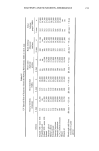
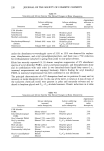
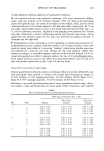
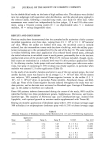
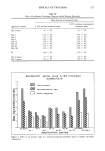
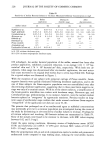
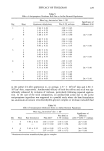
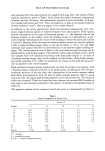
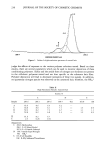
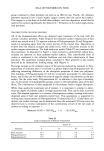
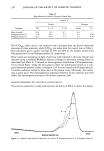
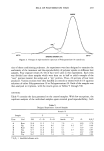
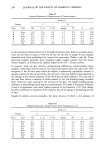
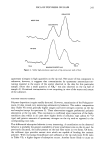
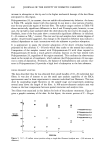
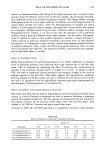
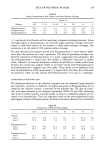
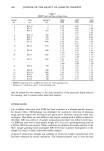
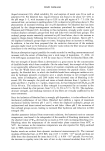
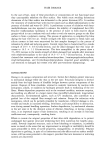
ESCA OF POLYMERS ON HAIR 245 Table X Surface Composition of Hair Treated with Non-Cellulosic Polymers Atomic % Polymer CH C - O C = O N N + O S Polyquaternium-5 52.0 11.8 11.7 7.3 0.8 13.8 2.4 Polyquaternium-7 58.2 12.4 6.9 7.0 0.8 12.3 2.4 Polyquaternium- 11 54.5 15.1 7.8 6.6 0.6 12.8 1.6 1:1 copolymers of acrylamide and the quaternary nitrogen-containing monomer. Given this high degree of quaternization, the relatively large quaternary nitrogen levels ob- served on these fiber surfaces do not translate to high surface polymer coverages. Our estimation is on the order of 10% polymer surface coverage. The data obtained from samples treated with Polyquaternium-11 show distinct differ- ences from the previous two vinyl copolymers. The level of quaternary nitrogen con- ferred by adsorption of Polyquaternium-11 is lower, suggesting lower adsorption. But the Polyquaternium-ll treated hair does exhibit a substantial reduction in surface sulfur, indicative of increased adsorption, whereas the similarity in surface sulfur levels between the control hair samples (Table I) and those treated with Polyquaternium-5 and Polyquaternium-7 suggests very little upake. These results can be explained if the level of quaternization of Polyquaternium-11 is appreciably lower than that of the other two polymers. Thus, the data indicate that Polyquaternium-11 is not a 1:1 copolymer. ADSORPTION ON BLEACHED HAIR The adsorption behavior of the cellulosic polymers was also examined using bleached hair substrates. As shown in Table XI, the higher adsorption of Polyquaternium-24, as judged by the cellulosic content, is observed on this substrate also. The data are consis- tent with those obtained in the designed experiment (Tables VI and VII), indicating that levels of surface polymer coverage similar to those on unbleached samples are ob- tained on the bleached hair. This is an important result in that prior experiments using radiotagged versions of Polyquaternium-10 showed increased substantivity on bleached Table XI Compositions of Bleached Hair Samples CH C-O C=O N N + O S Controls Area 1 53.0 12.8 9.1 8.3 -- 12.2 2.9 Area 2 51.6 13.6 9.6 7.2 -- 14.8 2.5 Polyquaternium- 10 Area i 45.6 16.9 12.2 6.8 0.6 14.5 2.7 Area 2 43.3 18.7 8.1 6.5 0.7 18.8 2.4 Polyquaternium- 24 Area 1 27.1 29.5 11.3 3.3 0.7 23.9 1.6 Area 2 31.7 33.9 6.7 1.4 0.4 23.6 0.9

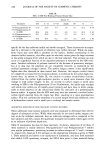
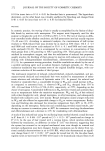
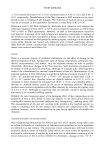
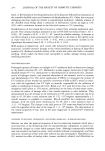
246 JOURNAL OF THE SOCIETY OF COSMETIC CHEMISTS hair (9). The equivalence of the surface polymer content as measured by ESCA indicates that this increased substantivity is most likely due to polymer absorption into the damaged hair fibers. SUMMARY AND CONCLUSIONS ESCA has proven to be useful for studies of polymer deposition and substantivity on hair fiber surfaces. Owing to the extreme surface selectivity of the ESCA technique, an indication of polymer surface coverage can be obtained that is not readily available by bulk analytical techniques. Both the cellulosic conditioning polymers tested exhibit relatively high levels of ad- sorption. However, retention of Polyquaternium-10 appears to be significantly in- fluenced by changes in the character of the hair surface along the length of the fiber, showing increased adsorption at the tip end of the hair fiber. In contrast, Polyquater- nium-24 shows higher overall levels of polymer deposition and does not exhibit this preferential adsorption. Post-treatment with SDS of hair samples exposed to Polyquaternium-10 and Polyqua- ternium-24 was shown to reduce the surface concentration of polymer on the hair. Deposition of three non-cellulosic cationic conditioning polymers has also been exam- ined. Of these, Polyquaternium-! 1 shows the highest substantivity. While this paper has emphasized analysis of adsorbed polymers, the ESCA technique is obviously well suited to the determination of other species, such as adsorbed surfactants and UV absorbers. ACKNOWLEDGEMENTS The data presented in this report were made possible by the skillful work of D. H. Scofield (ESCA) and E. Lesniak (hair treatments). T. Kinisky is also gratefully acknowl- edged for his contributions in performing the initial ESCA measurements. REFERENCES (1) E. D. Goddard, Substantivity through cationic substitution, Cosmetics and Toiletries, 102, 71-80 (1987). (2) D. T. Clark, "The Investigation of Polymer Surfaces by Means of ESCA," in Polymer Surfaces, Clark and Feast, Eds. (John Wiley & Sons, New York, 1978), pp. 309-353. (3) C. R. Robbins and M. K. Bahl, Analysis of hair by electron spectroscopy for chemical analysis,.]. Soc. Cosmet. Chem., 35, 379-390 (1984). (4) L. Zhao, S. Liu, and T. Wang, A study of the mechanism of the oxidation of hair keratin by photoelectron spectroscopy, Acta Biochimica et Biophysica Sinica, 13, 503- 507 (1981). (5) A. Dilks, Polymer surfaces, Anal. Chem., 53, 802A-816A, (1981). (6) Y. K. Kamath, C. J. Dansizer, and H.-D. Weigmann, Surface wettability of human hair. I. Effects of deposition of polymers and surfactants, J. Appl. Poly. Sci., 29, 1011-1026 (1984). (7) H.-D. Weigmann and Y. K. Kamath, Modification of human hair through fiber surface treatments: Characterization by wettability, Cosmetics and Toiletries, 101, 37-49 (1986). (8) J. A. Faucher and E. D. Goddard, Influence of surfactants on the sorption of a cationic polymer by keratinous substrates, J. Colloid Interface Sci., 55, 313-319, 1976. (9) E. D. Goddard, J. A. Faucher, R. J. Scott, and M. E. Turney, Adsorption of Polymer JR on kera- tinous surfaces,.]. Soc. Cosmet. Chem., 26, 539-550 (1975).
Purchased for the exclusive use of nofirst nolast (unknown)
From: SCC Media Library & Resource Center (library.scconline.org)