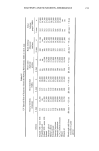
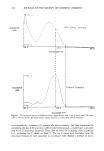
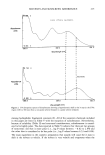
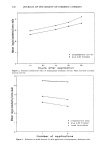
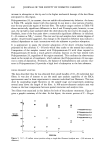
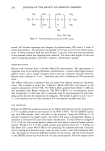
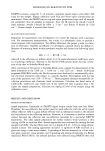
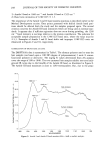
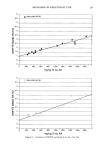
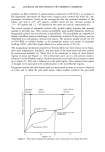
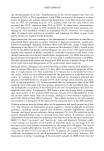
SILOXANES ON KERATINS BY FTIR 261 5.5 5 4.5 n-' 3.5 Z 3 [] 2.5 I- 2 n- 1.5 1 , ß 1260/1240 RATIO ß 200 400 600 800 1000 1200 1400 1600 1800 mg/kg Si by AA 5.5 O 4.5 I-- 4 n- 3.5 z 3 (/) 2.5 I.L. 2 t"l 1.5 [] 1260/1225 RATIO 200 400 600 800 1000 1200 1400 1600 1800 mg/kg Si by AA Figure 11. Correlation of DRIFTS and mg/kg Si by AA--hair data.

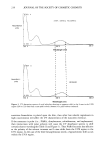
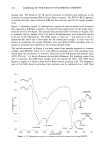
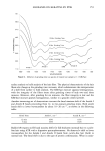
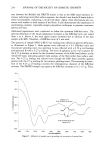
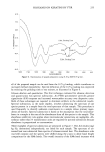
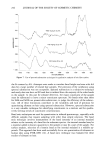
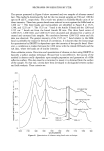
262 JOURNAL OF THE SOCIETY OF COSMETIC CHEMISTS was based upon a 100 DP 2 mole % amine-functional siloxane polymer (trimethylsilyl- amodimethicone) or derivative. Both treated and untreated hair samples were analyzed using DRIFTS and the band ratios of 1260/1240 and 1260/1225 measured for each sample. The band ratios correlate with the weight concentration of Si in the hair, and the result is a linear relationship. The lower detection limit for quantitation is about 250 mg/kg Si or 680 mg/kg siloxane polymer. The correlation is linear to 1840 mg/kg Si, which converts to 6800 mg/kg siloxane polymer. Detection and quantitation of siloxane on hair using DRIFTS is essentially a surface analysis technique. Criteria have been developed to distinguish between surface and bulk analysis. These criteria are: 1) Amide I band at 1660 cm-• and Amide II at 1520 cm-•, and 2) band ratio intensities of 1240/1225 • 1.3. The potential use of DRIFTS in further keratin fiber studies, as well as with other materials, is exciting. In fact, this technique has been successfully applied in our labora- tories to cloth fibers. The deposition of any material that has a distinctive IR band could be assayed by this method. DRIFTS should also be applicable to the study of hair surfaces for both chemical and environmental damage. REFERENCES (1) S. R. Wendel and A. J. DiSapio, Organofunctional silicones for personal care applications, Cow•etzcs & Toiletries, 98(5), 103-106 (1983). (2) M. S. Starch, Silicones in hair care products, Drug and Cosmetic Industry, 134(6), 38-44, (1984). (3) M. S. Starch, Silicones for conditioning damaged hair, Soap/Cosmetics/Chemical Specialties. 62(4), 34-39, (1986). (4) G. Kohl and E. Gooch, J. Soc. Cosmet. Chem., submitted for publication. (5) P. R. Griffiths and M.P. Fuller, "Mid-Infrared Spectrometry of Powdered Samples," in Advances in Infrared and Raman Spectroscopy, R. J. H. Clark and R. E. Hester, Eds. (Heyden, London, 1981), Vol. 9, Chap. 2. (6) G. J. Weston, The infra-red spectrum of peracetic acid-treated wool, Blochim. Biophys. Acta., 47, 462-464 (1955). (7) H. Alter and M. Bit-Alkhas, Infrared analysis of oxidized keratins, Text. Res. J., 39, 479-481 (1969). (8) C. B. Baddiel, Structure and reactions of human hair keratin: An analysis by infrared spectroscopy, J. Mol. Biol., 38 181-199 (1968). (9) M. J. D. Low and A. G. Severalia, Infrared spectra of a single human hair, Spectrosc. Lett., 16(11), 871-877 (1983). (10) J. Strassburger and M. M. Breuer, Quantitative Fourier transform infrared spectroscopy of oxidized hair, J. Soc. Cosmet. Chem., 36, 61-74 (1985). (11) P. Kubelka and F. Munk, Ein betrag zur optik der farbanstriche. Z. Tech. Phys., 12, 593 (1931). (12) H. M. Klimisch and G. Chandra, Use of Fourier transform infrared spectroscopy with attenuated total reflectance for in vivo quantitation of polydimethylsiloxanes on human skin, J. Soc. Cosmet. Chem., 37, 73-87 (1986).
Purchased for the exclusive use of nofirst nolast (unknown)
From: SCC Media Library & Resource Center (library.scconline.org)