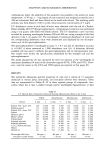
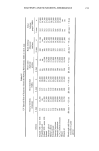
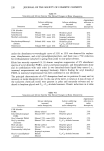
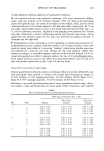
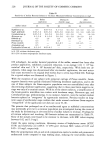
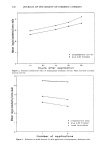
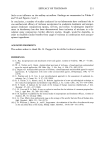
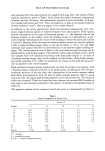
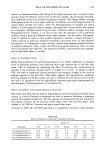
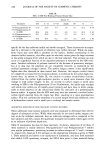
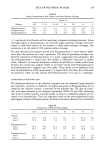
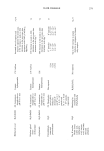
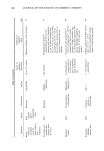
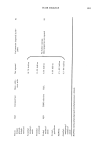
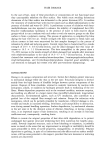
EFFICACY OF TRICLOSAN 225 Axillae population following application of antiperspirant deodorants. ß o/w emulsion roll-ons were produced containing 15% active aluminium chlorhy- drate, with and without 0.2% triclosan included. After one week's preconditioning period with placebo soap, the axillae of ten subjects were washed, dried, and the roll-on with and without 0.2% triclosan applied to left and right axilla, respectively, for 15 sec per axilla. Total aerobic bacteria counts in the axillae were determined before and 1, 4, 6, and 8 h following treatment. Application and sampling were repeated for a further four days. Following a second conditioning period with placebo soap alone, roll-on application was repeated, again over five days, but with the test products reversed, to eliminate any left-right bias. ß Antiperspirant sticks containing as active ingredient an aluminium-zirconium tet- rachlorohydrex-glycine complex, with and without 0.3% triclosan included, were eval- uated on twenty male subjects. A seven-day "washout" period using placebo soap alone was followed by a four-day test week. During the test week panelists' axillae were washed according to a controlled regimen, and test sticks with and without 0.3% tri- closan were applied once daily to opposite axilla at the rate of 0.4 g/axilla/application. Total aerobic bacteria counts in the axillae were determined before, and 4 h and 24 h after test product application on day 1 and 4 of the test week. OLFACTORY EVALUATION OF SKIN ODORS General guidelines for olfactory studies on deodorant efficacy have been defined (8), and such procedures were utilized to evaluate two aerosol spray formulations (Spray A: 0.15% triclosan, 0.75% isopropyl-myristate, 39.10% ethanol, 60.0% Freon 11/12. Spray B: 0.75% isopropyl-myristate, 39.25% ethanol, 60.0% Freon 11/12). Following a one-week preconditioning period using unperfumed placebo soap, thirty- two subjects, male and female (from an initial panel of fifty volunteers), were selected Table I Effect of Deodorant Sprays on Axillae Bacterial Populations Mean log•0 bacteriaJcm 2 skin _+ SD Plus 0.05% Plus 0.2% Day Hour Ethanol triclosan triclosan 1 2.82 -+ 0.54 2.62 _+ 0.78 1.83 -+ 0.68 4 3.36 -+ 0.22 3.09 -+ 0.50 2.07 -+ 0.83 7 3.58 -+ 0.26 3.46 -+ 0.31 2.40 -+ 0.56 9 4.09 -+ 0.08 3.64 _+ 0.46 2.55 -+ 0.66 1 2.77 -+ 0.37 2.40 _+ 0.36 1.61 -+ 0.50 4 2.98 -+ 0.23 2.85 _+ 0.53 1.94 -+ 0.66 7 3.59 -+ 0.22 3.25 -+ 0.39 2.56 -+ 0.65 9 4.09 -+ 0.20 3.65 -+ 0.25 2.82 -+ 0.68 1 3.28 _+ 0.65 2.90 + 0.23 1.96 + 0.29 4 3.57 + 0.69 3.26 + 0.36 2.40 + 0.46 7 4.05 + 0.32 3.53 + 0.40 2.93 + 0.56 9 4.13 + 0.48 3.83 --- 0.41 3.31 + 0.57

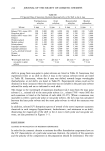
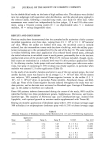
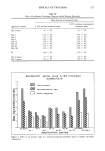
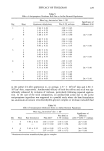
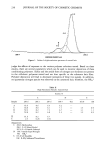
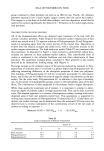
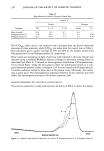
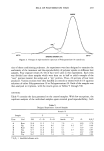
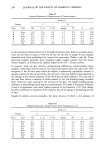
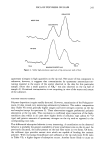
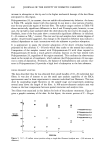
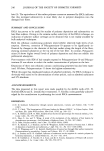
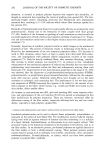
226 JOURNAL OF THE SOCIETY OF COSMETIC CHEMISTS for the double-blind study on the basis of high axillary odor. The subjects were divided into two subgroups with equivalent odor distribution, and the selected spray applied to the selected axilla, following a standard soap wash, once daily for three days. Odor assessments were carried out independently by four judges, 12 h and 24 h after treat- ment, using a 10-point scoring system (0 = no objectionable odor, 5 = moderate malodor, 10 = strong disagreeable odor). RESULTS AND DISCUSSION Previous studies have demonstrated that the unwashed axilla maintains a fairly constant microbial population over three days, varying from 4.9 x 10⁴ tO 5.9 X 10⁵ bacteria/ cm 2 skin. When the axillae are washed with soap, the microbial count is initially reduced, but the intermediate counts each day show a build-up, with the axillary popu- lation increasing up to the unwashed level by the end of the day (4). The same tendency is evident following three days' application of an ethanol-based aerosol spray, although the initial reduction in microbial count is much greater, presumably due to the intrinsic antibacterial action of the alcohol itself. With 0.2% triclosan included, though, micro- bial counts are maintained at a reduced level even 9 h after product application (Table I). In olfactory studies, both sprays with and without triclosan gave odor score reduc- tions, but spray A containing 0.15% triclosan was clearly superior, in particular when malodor was assessed 12 h after application (Table II). In the study of six months' duration and prior to use of the test aerosol sprays, the total aerobic bacteria count was found to be on average 5.2 x 10⁵/cm 2 skin. Of the sixteen test subjects, 50% normally carried Gram-negative bacteria in the axillae (5.2 x 10 •- 1.0 X 10³/cm 2 skin), in particular Proteus mirabilis, Enterobacter cloacae, and Kleb- sMla spp. None of the Gram-negative bacteria isolated throughout the study were oxi- dase-positive, and no bacteria were recovered on Pseudosel agar. Carriage of Pseudomonas spp. in the axillae is therefore not indicated. From 430 primary isolates characterized during the course of the study, 88% could be identified further into three predominent genera, Staphylococcus, Micrococcus, and Coryne- bacterium spp. The majority of Micrococcus spp. and Corynebacterium spp. isolated were lipophilic, with optimal growth on nutrient media supplemented with Tween 80. During six months' application of deodorant spray with 0.15% triclosan (average usage 580 ml/subject) or antiperspirant deodorant spray with 0.25% triclosan (average usage Table II Olfactory Evaluation of Deodorant Sprays: Axillae Malodor Levels 12 h and 24 h Following Application Application Time number Spray A Spray B % Diff. Sig. level 12 h 24 h 1 3.34 3.67 9.1 + 9.4 0.056 2 2.72 3.46 21.4 -+ 9.6 0.001 3 2.72 3.23 15.7 ñ 10.3 0.001 1 3.47 3.60 3.7 + 8.3 0.338 2 3.31 3.66 9.6 ñ 7.6 0.021 3 3.20 3.59 10.9 -+ 8.9 0.028
Purchased for the exclusive use of nofirst nolast (unknown)
From: SCC Media Library & Resource Center (library.scconline.org)