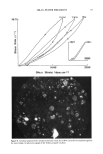
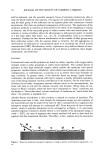
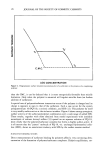
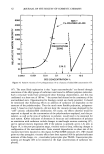
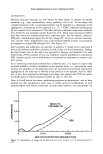
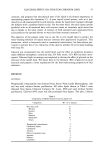
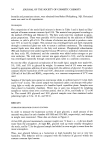
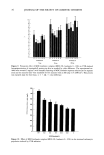
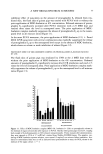
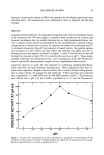
28 JOURNAL OF THE SOCIETY OF COSMETIC CHEMISTS 70 50 30 SDS + 0.1% POLYMER S ALONE SU R FACTANT/PO LYM E R Wt. RATIO f t f f f f _ 1:8 1:4 1:2 1:1 2:1 APPEARANCE c t pp sp c I I I -4 -3 -2 -1 LOG SURFACTANT CONCENTRATION (m/I) Figure 4. Surface tension/concentration curves of SDS with and without polyquaternium 10. The terms c, t, p, and sp refer to clear, turbid, precipitate, and slight precipitate, respectively (12). sodium decyl sulfate (SDecS) by PVP are presented in Figure 6 in the form of emf./ SDecS concentration plots at various levels of added polymer. Note that at zero polymer level the slope of the emf/log [SDecS] plot was linear until the CMC and was Nernstian, i.e., had a value of 59 mv. The presence of polymer caused a break in the linear slope (at "T•" concentration) and a shift of the apparent CMC, the shift increasing with increasing amount of polymer. For estimates of the degree of binding, these authors did not use the function T2-T • (see Figure 2) rather, a function T2-CMC' was used, where CMC' is a hypothetical or effective CMC in the presence of polymer. This ap- proach, strictly speaking, should be used when estimating degrees of binding from surface tension data. Thus in Figure 2 the amount of bound surfactant is given by T2'-T•, or, what should be equivalent, T2-CMC', rather than T2-T•, as used by Jones (6). Values of the binding obtained by these authors were 0.3 mols SDecS/base

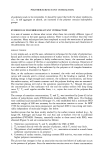
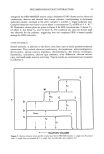
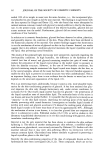
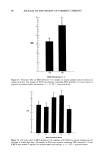
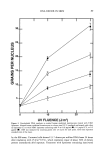
POLYMER/SURFACTANT INTERACTION 29 10.0 5.0 2.5 O/ - 0 n I• 2 I I I 0 0.5 1.0 1.5 2.0 2.5 CONCENTRATION OF "OUTSIDE" SOLUTION (SDS mM) Figure 5. Binding isotherm of PEO-SDS system in 0.1 M NaC1 solid line from Hill equation (14). mol PVP, in good agreement with the values obtained for SDS/PVP and SDS/PEO in salt-free solution obtained previously. Others who have used the specific ion electrode include Birch et al., who investigated the PVP/SDS and PVOH/SDS systems (17). Turning now to oppositely charged pairs, we refer to the extensive studies of Kwak and co-workers, who used membrane electrodes specific for cationic surfactants in studies of their interaction with a series of polyanions (3,18,19, and references contained therein). Typical data of Kwak et al. are given in Figure 7. Important aspects are: 1. The binding curves are steep, indicative of cooperative binding. 2. Binding occurs at very low surfactant concentrations, which are relatively higher for straight-chain alkyltrimethylammonium surfactants than for alkylpyridinium sur- factants, showing a lower affinity in the former case. 3. As the alkyl group is lengthened, the concentration for binding is reduced. Considerable differences in binding characteristics in a series of polyanions were found by Kwak, reflecting the effect of differences in polymer structure, polymer chain flexi- bility, and charge density. For the dodecyltrimethylammonium ion the strength of binding followed the sequence: polystyrene sulfonate dextran sulfate polyacrylate DNA alginate pectate NaCMC.
Purchased for the exclusive use of nofirst nolast (unknown)
From: SCC Media Library & Resource Center (library.scconline.org)