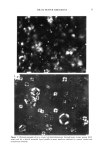
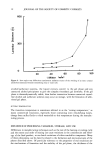
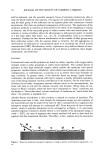
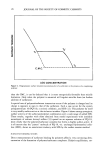
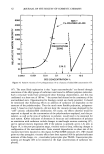
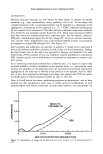
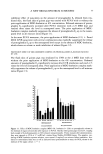
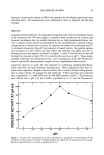
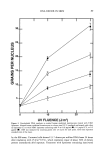
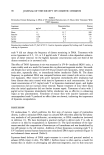
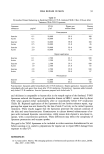
88 JOURNAL OF THE SOCIETY OF COSMETIC CHEMISTS compared over a 30-minute period with the maximum fluorescence measured in lipo- somes dissolved with Triton X-100 (Figure 2). Incubation of the liposomes at pH 8 did not change their fluorescence (closed circles), indicating no release of contents. Incuba- tion of the liposomes at pH 5 (open circles) increased their fluorescence over time, demonstrating release of their contents and their pH sensitivity. DNA repair was measured in normal human epidermal keratinocytes treated with T4N5 liposomes containing endo V by UDS (Figure 3). Unirradiated cells treated with liposomes showed no increase in UDS compared to unirradiated and untreated cells. Untreated cells irradiated with either 10 or 25 J/m 2 of UV-C showed increased grains over nuclei, representing normal DNA repair. Treatment with 0.02, 0.05, 1.0, and 2.0 Ixg/ml of endo V in liposomes enhanced UDS at both 10 and 25 J/m 2. The increase compared to untreated cells at each dose and for each T4N5 liposome concentration was statistically significant (p 0.00 ! by the Student t-test). Increasing concentrations of T4N5 liposomes produced increasing DNA repair responses. Liposome encapsulation is essential to enhancing repair incubation of cells with purified endo V or M. luteus UV-DNA endonuclease alone produces no effect (9,10). Repair of pyrimidine dimer photoproducts was measured in normal human keratino- cytes (Table I). Cells were irradiated with UV-C and treated with active and inactive T4N5 liposomes. Inactive liposomes were prepared with endo V that had been boiled for one hour to denature the enzyme, as confirmed by activity assays of the boiled endo V. DNA was extracted 24 hours after treatment, and dimer frequency was determined I-- LU U.I 120 __ 8O 6O 4O 20 -- 4 8 12 16 20 24 MINUTES Figure 2. pH Sensitivity of T4N5 liposomes. Liposomes with the composition of T4N5 liposomes but encapsulating ANTS/DPX were prepared and incubated either at pH 8 (O) or pH 5 (O). Duplicate aliquots were removed during incubation and their fluorescence measured. Results are plotted relative to fluorescence of liposomes dissolved with 1% Triton X-100.

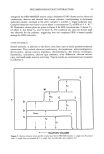
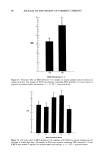
DNA REPAIR IN SKIN 89 30/ I I I I o z n" Z 0 10 20 UV FLUENCE (d/m •) Figure 3. Unscheduled DNA synthesis in normal human epidermal keratinocytes treated with T4N5 liposomes. Normal human epidermal keratinocytes in culture were UV-C irradiated and treated with either no liposomes ((2)) or with T4N5 liposomes containing endo V at 0.02 •g/ml (O), 0. ! •g/ml ([]), or 0.2 I•g/ml (I). UDS was measured by counting grains over 25 nuclei for each point. Error bars represent standard error of the mean. by the ESS assay. Untreated cells showed 13.7 dimers per million DNA bases 24 hours after irradiation with 25 J/m 2 UV-C, which represents repair of about 50% of dimers present immediately after exposure. Treatment with liposomes containing inactivated
Purchased for the exclusive use of nofirst nolast (unknown)
From: SCC Media Library & Resource Center (library.scconline.org)