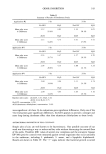
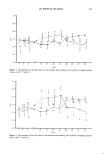
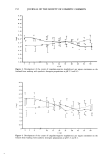
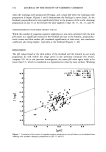
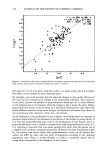
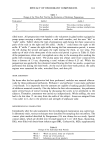
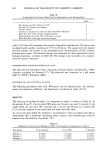
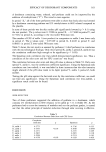
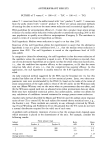
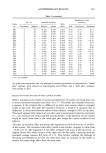
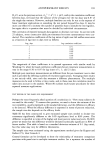
EFFICACY OF DEODORANT COMPONENTS 163 A deodorant containing water, ethanol, and perfume could not be improved by the addition of triethylcitrate ("Y"). The trend is even negative. In period "Z," all of the three perfumers were able to show that body odor was lowered by a deodorant containing perfume and 2% triethylcitrate in 60% ethanol compared to the placebo. In none of these periods was the skin surface pH significantly lowered (p 0.1) using the test product. The p values were 0. 15286 in period X, - 0.73660 in period Y, and 0.73432 in period Z, according to the two-tailed Wilcoxon test. The number of CFU of axilla 1 (test product) in comparison to axilla 2 was lower only in period Z. The p values were -0.93169 in period X, 0.4445 in period Y, and 0.00633 in period Z (two-tailed Wilcoxon test). Table V shows the test results as assessed by perfumer 1 (chief perfumer) in correlation with the microbiological findings. Only twice (period X, axilla 2 period Z, axilla 2) was the correlation coefficient high enough to be significant (p 0.05). The Spearman rank correlation test (two-tailed) demonstrated significance, too. Thus a correlation of low odor score and low CFU count/cm 2 was found. The correlation between odor score and skin pH value is shown in Table VI. Only once (period Y, axilla 1), was the correlation coefficient significant. Using the Spearman rank correlation test (two-tailed), it was concluded in three instances that the odor intensity might diminish if the pH value tends to be higher (period Y, axilla 1 period Z, both axillae). Testing the pH value against the bacterial score by the correlation coefficient, we could not find any significance. Using the Spearman rank correlation test (two-tailed), a significant result could not be found. DISCUSSION ODOR REDUCTION Two of three perfumers suggested the addition of perfume to a deodorant, which contains 2% triethylcitrate in 60% ethanol, to be useful (p 0.1) (Table IV). As the perfumers had to score the intensity of malodor and not the perfume grades, it turned out that the oldest principle of malodor reduction through odor covering is effective. Table V Correlation Between Odor Score and CFU Count Correlation coefficient p Spearman p X, axilla 1 0.2775 0. 1716 0.355 X, axilla 2 0.4345 0.05 0.3648 0.0495 Y, axilla 1 0.2371 0.2335 0.209 Y, axilla 2 0.2905 0.2905 0.118 Z, axilla 1 0.2958 0.2574 0. 165 Z, axilla 2 0.4178 0.05 0.4129 0.026

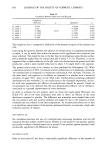
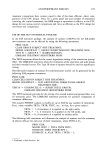
164 JOURNAL OF THE SOCIETY OF COSMETIC CHEMISTS Table VI Correlation Between Odor Score and Skin pH Correlation coefficient p Spearman X, axilla 1 0.019 0.0348 0.852 X, axilla 2 0.04 - 0.0289 0.876 Y, axilla 1 - 0. 3804 0.05 - 0.3557 0.055 Y, axilla 2 - 0. 3039 - 0.2964 0.110 Z, axilla 1 - 0.3307 - 0.3972 0.032 Z, axilla 2 - 0.289 - 0.3187 0.086 This might be due to competitive inhibition of the sensory receptors of the human nose (20). Concerning the question whether the addition of triethylcitrate to a perfumed deodorant is useful, it can be stated that within the present trial a significant odor reduction was never achieved. This might be due to the fact that in intertriginous areas the skin surface pH is markedly higher than the normal skin pH of about 5.5 (13). Therefore, it can be suggested that a slight reduction of the pH value even favors bacterial growth and odor production, while a more marked reduction (to about 5.5) might lead to the opposite. The present results seem to be contrary to those published by Osberghaus (12). With a statistical certainty of 99%, he showed a better performance of a deodorant containing 1% triethylcitrate as compared to a deodorant containing 0.16% triclosan. Triclosan, on the other hand, was superior in its efficacy as compared to a placebo with a statistical certainty of again 99%. Since in the USA other triethylcitrate-containing perfumed deodorants are also available (21), our results seem to be of general importance. In fact, for each new preparation the efficacy of triethylcitrate should be proved. Under no circumstances can it be deduced that the once-demonstrated efficacy (12) of triethylci- trate leads to a general improvement of every deodorant. In order to evaluate the test product used, we chose the single-tailed Wilcoxon test (Table IV). All of the three perfumers were able to detect an efficacy of the total deodorant compared to placebo. The difference was somewhat more marked than with the test product with and without perfume and might be due to the presence of both triethylcitrate and ethanol in the latter preparation. As triethylcitrate seems not to lead to a significant improvement of the present deodorant formula, we presume a high odor reduction potency of ethanol. SKIN SURFACE pH No correlation between the use of a triethylcitrate-containing deodorant and the pH change of the skin surface could be found. Neither in trial period Y (test product against test product without triethylcitrate) nor in period Z (test product against placebo) could statistically significant pH differences be found. BACTERIAL COUNT Only in trial period Z was there a statistically significant difference in the number of
Purchased for the exclusive use of nofirst nolast (unknown)
From: SCC Media Library & Resource Center (library.scconline.org)