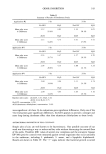
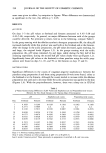
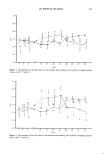
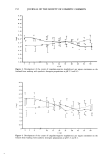
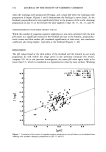
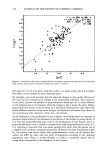
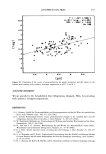
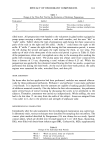
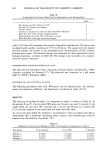
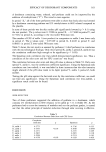
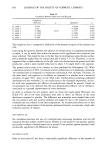
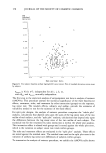
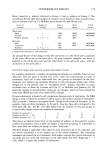
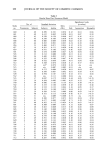
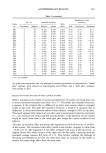
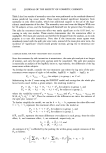
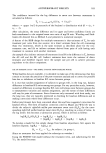
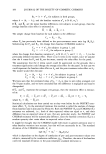
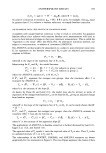
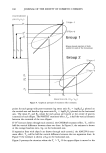
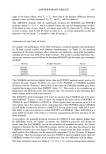
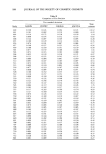
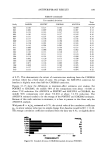
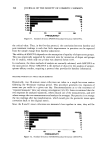
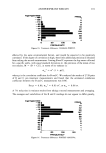
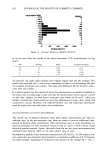
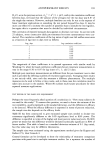
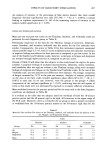
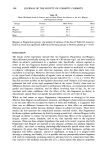
EFFICACY OF DEODORANT COMPONENTS 165 CFU found. The statistical probability here is even greater than 99%. This effect is neither attributed to the perfume component (period X shows no difference) nor to triethylcitrate (period Y shows no difference). Therefore, the explanation for the reduced number of CFU in trial period Z seems to be in relation to the ethanolic component of the deodorant. ODOR STRENGTH AND BACTERIAL COUNT A close connection between the intensity of malodor and the number of CFU on the skin was not found, although a significant correlation coefficient was found with the data obtained from the chief perfumer, twice in different contexts (Table V). In the placebo- treated axilla (period Z, axilla 2), however, both parameters seemed to be more closely related in relative terms. This seems to confirm the conventional hypothesis on the development of body odor due to bacterial degradation of sweat (6). ODOR STRENGTH AND SKIN SURFACE pH Correlating odor strength and skin surface pH value, we found an interesting result. By using triethylcitrate, and therefore possibly lowering the skin pH, skin surface enzymes are said to show a reduced activity, which leads to a slower decomposition of sweat, horny cells, and sebum (12). In the present trial, however, in three of six instances (Table VI, column 5), an inverse result was found. In the trial periods Y and Z we were able to show that with higher pH values the odor intensity was significantly lower. A possible reason for this fact is the presence of an environment still favorable to bacterial growth, even at a moderately lower pH. With respect to the complex deodorant formula tested here, it is tempting to increase the triethylcitrate concentration in order to assure a decrease in the skin surface pH to a value close to 5.5. Fewer skin bacteria seem to have their growth optimized at this physiological skin surface pH value (14). ACKNOWLEDGMENTS The authors express their gratitude to Markus Ollert, M.D., Munich, for critical review of the manuscript, and to Gerhard Harem, Ph.D., Munich, for his statistical advice. REFERENCES (1) K. Laden, "Introduction and History of Antiperspirants and Deodorants," in Antiperspirants and Deodorants, K. Laden and C. B. Felger, Eds. (Marcel Dekker, New York, 1988), pp. 1-13. (2) I. K. Emery, Antiperspirants and deodorants, Cutis, 39, 531-532 (1987). (3) J. S. Strauss and A.M. Kligman, The bacteria responsible for apocrine odor, J. Invest. Dermatol., 27, 67-71 (1956). (4) A.M. Kligman and N. Shehadeh, Pubic apocrine glands and odor, Arch. Dermatol., 89, 461-463 (1964). (5) H. P. Fiedler, Mikrobiologische Probleme der Hautpflege unter besonderer Berficksichtigung der Desodorierung, ,4rztl. Kosmetol., 10, 50-56 (1980). (6) J. J. Leyden, "Bacteriology of the Human Axilla: Relationship to Axillary Odor," in Antiperspirants and Deodorants, K. Laden and C. B. Felger, Eds. (Marcel Dekker, New York, 1988), pp. 311-320.

166 JOURNAL OF THE SOCIETY OF COSMETIC CHEMISTS (7) J. M. Labows Jr., "Odor Detection, Generation, and Etiology in the Axilla," in Antiperspirants and Deodorants, K. Laden and C. B. Felger, Eds. (Marcel Dekker, New York, 1988), pp. 321-343. (8) A. R. Cox, Efficacy of the antimicrobial agent triclosan in topical deodorant products: Recent devel- opments in vivo, J. Soc. Cosmet. Chem., 38, 223-231 (1987). (9) J. Stellpflug, Deosprays, Oko Test, Suppl 2, 72-75 (1988). (t0) F. Enders, B. Przybilla, and J. Ring, Patch testing with fragrance mix at 16% and 8%, and its individual constituents, Contact Dermatitis, 20, 237-238 (1989). (lt) N. Lowicki, M. Sidillo, and O. Neunhoeffer, Primiir-Desodorierung, •rztl. Kosmetol., 2, 75-79 (1974). (12) R. Osberghaus, Nonmicrobicidal deodorizing agents, Cosmet. Toiletr. 95, 48-50 (1980). (13) O. Braun-Falco and H. C. Korting, Der normale pH-Wert der menschlichen Haut, Hautarzt, 37, 126-129 (1986). (14) H. C. Korting, A. Bau, and P. Baldauf, pH-Abhiingigkeit des Wachstumsverhaltens von Staphylo- coccus aureus und Propionibacterium acnes, ,•rztl. Kosmetol., 17, 41-53 (1987). (15) P.M. Baxter andJ. V. Reed, The evaluation of underarm deodorants, Int. J. Cosmet. Sci., 5, 85-95 (1983). (16) J. Faergemann, The use of contact plates for quantitative culture of Pityrosporum orbiculare, Mykosen, 30, 298-304 (1987). (17) C. G. Schirren, Does the glass-electrode determine the same pH values of the skin surface as the quinhydrone electrode?J. Invest. DermatoL, 24, 485-488 (1955). (18) L. Sachs, Angewandte Statistik (Springer-Verlag, Berlin, 1984). (19) B. Ramm and G. Hofmann, Biomathematik, (Enke, Stuttgart, 1987). (20) E. A. Seitz, Jr. and D. I. Richardson, "Deodorant Ingredients," in Antiperspirants and Deodorants, K. Laden and C. B. Felger, Eds. (Marcel Dekker, New York, 1988), pp. 345-390. (21) Deodorant and antiperspirant formulary. Cosmet. Toiletr. 100, 65-77 (1985).
Purchased for the exclusive use of nofirst nolast (unknown)
From: SCC Media Library & Resource Center (library.scconline.org)