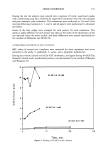
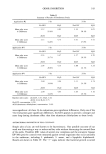
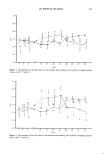
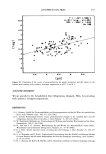
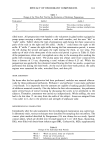
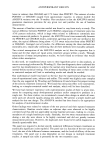
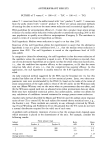
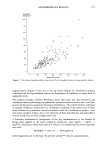
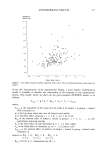
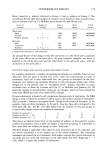
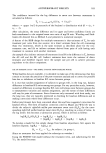
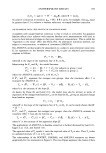
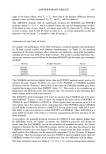
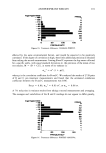
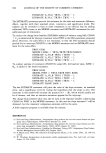
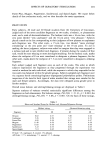
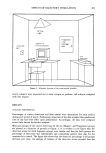
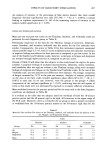
ANTIPERSPIRANT RESULTS 177 Standard Deviation 0.8 0.7+ 0.6+ 0.5+ 0.4+ 0,3+ 0.2+ 0.1 0.0+ i A A B A A AA AA A AA A A A A A A A A AA AA ABAB AA A A A A AABA A AA A AB CC A A A B AC ABAAB A A ACAB C ABAAAB A AA AA B •B A ABABA A A ABA CAAA B C A A A A A BA AA A A A A A A A A 0,6 0 1.0 1.2 1.4 1.6 Mean Sweat Ratio Figure 7. Test subject baseline axillary right/left sweat ratios: Plot of standard deviation versus mean by subject. Given this interpretation of the experimental design, a more explicit mathematical model is available to describe the relationship of the response to the experimental factors. This model, which we shall call the post-treatment (POSTRT) model, is as follows: Yijkm = •-m-'Yi -m- •j(i) -m- )k k "{- "r m "{- ejkm(i) where: Yijkm is the logarithm of the sweat rate for axilla k of subject j in group i, treated with treatment m is the log mean sweat rate over all subjects and axillae is the fixed effect of groupi, i = 1 (k = m), 2 (k • m) 0j(i) is the random effect of subject j nested in group i, j = 1, 2, . .., ni, the parentheses denoting nesting is the fixed effect of side (laterality) k, k = 1,2 (left, right) m is the fixed effect of treatment m, m = 1,2 (control, test) oejkm(i) is the random effect of axilla k of subject j nested in group i treated with treatment m. subject to: Z•/i = 0, •)k k = 0, •'r m = 0 i= 1,2 k= 1,2 m= 1,2 0ii) is N (0, eL2), independent for all i, j,

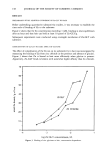
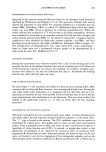
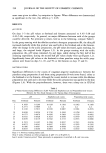
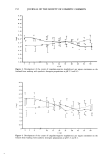
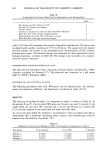
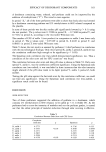
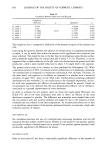
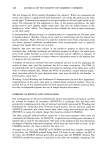
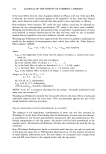
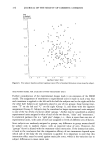
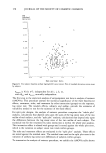
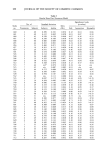
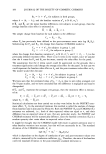
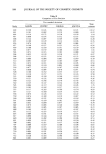
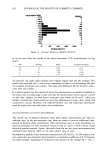
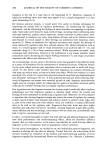
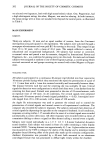
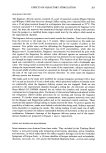
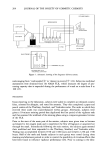
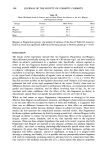
178 JOURNAL OF THE SOCIETY OF COSMETIC CHEMISTS Log Standard Deviation 0.225 + 0.200 0.•75 + 0.150 0.125 0.100 0.075 0.050 + + A A AB A A A A A A A A A A AA A AA A AA A A A A BA A B AA AA A A A A B A B AAA BA AAA ADC AAA AAA A A A B A B B A A B A AAAAA B AA A ACBA B A AAA AAB AAAB AA A A A A A AAA A B AB A A A A A A A 0.025 0.1 2 O. Mean Log Sweat Ratio Figure 8. Test subject baseline axillary log(right/left sweat ratios): Plot of standard deviation versus mean by subject. •jkmi) is N (0, (•2), independent for all i, j, k, m, with d/)i(i) and ½ikm(i) mutually independent. The first step in the statistical analysis of antiperspirant test data is analysis of variance (ANOVA). This procedure assesses the statistical significance of the three fixed-factor effects, treatment, sides, and treatment by sides interaction (groups) on the response, log sweat rate. The random effects, subjects and axillae, provide the estimates of variability needed to test for the existence of the fixed effects. For split plot designs, the analysis of variance procedure comprises the "whole plot" analysis, calculations that depend only upon the sums of the log sweat rates of the two axillae of each subject, and the "split plot" analysis, calculations that depend only upon the differences between the log sweat rates of the two axillae of each subject. The statistical test for the treatment by sides interaction is within the whole plot analysis. This interaction effect is aliased with groups and is tested against the whole plot error, which is the variation in subject sweat rate totals within groups. The sides and treatment effects are evaluated in the "split plot" analysis. These effects are tested against the residual error. The residual error used as the split plot error is the variation of axillary log sweat rate differences of subjects within groups. To summarize the analysis of variance procedure, we exhibit the ANOVA table shown
Purchased for the exclusive use of nofirst nolast (unknown)
From: SCC Media Library & Resource Center (library.scconline.org)