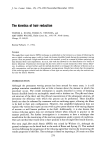
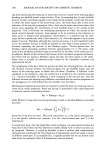
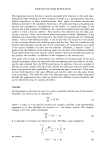
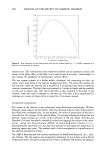
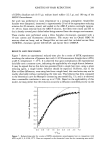
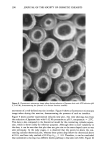
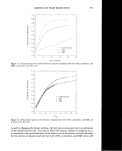
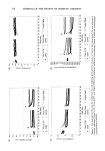
312 JOURNAL OF THE SOCIETY OF COSMETIC CHEMISTS BALLAST AIR L HOUSE AIR hANDmETER FI(IJRE la TREATaENT TREATaENT SOLUTION SOLUTION TEST RESERVOIR RESERVOIR SOLUTION 1 2 RESERVOIR v PRESSURE V TRANSDUCER O? V3 FL O COAPDTER-ACTDATED 2-rAY SOLENOID X •ANUAL 2-rAY VALVE • • •ANDAL 3-rAY VALVE DRA I N Figure 1. The schemes of the apparatus performing dynamic electrokinetic and permeability measurements of fiber plugs: (a) the valve diagram (b) control system diagram. •./R = 1 - (Qa/Q) ø-25 (2) where Q and Qa are the flow rates before and after deposition, respectively, and R is the average radius of the pores through which the test solution is passed. For the experi- ments described in this report, the calculated average pore radius, R, in the fiber plug is equal to 21.4 I. tm (3). Based on the calculated thickness of the deposited conditioning layer, a buildup coef- ficient could be defined as:

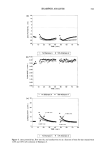
SHAMPOO ANALYSIS 313 TREATPENT I I--[-- -- .,•--•--• SOLUTION • ........... 1 ANO 2 • TEST L_• • • • OlC•T^L SOLENOlO AIxD RELAY CONTROl- "n-r PRESSLT• __ TRAN•R REt42•UT OPOT RELAY CONOJCT I V I TY METER Rr'o AOC BOARO, DIGITAL [/O PORTS PORTS 1 & 2. 11•PUT COM1 BALANCE FIQJRE lb COMPUTER OIGITAL [/0 BOARID. PC•T 8. OUTPUT DIGITAL IYO EOARO. PORTS 3 & 4. IlXl:4JT Figure 1. Continued. (after treatment) - 8 a (before treatment)] X 100%/8 a (before treatment) (3) 3. A parameter characterizing buildup can also be derived from the zeta potential (•) measurements. In this case, it is assumed as an approximation that the zeta potential is proportional to the number of charged sites on the surface (4), and thus reflects the surface concentration of the conditioning species. The buildup coefficient is defined as' (after treatment) - • (before treatment)] X 100%/1• (before treatment) (4)
Purchased for the exclusive use of nofirst nolast (unknown)
From: SCC Media Library & Resource Center (library.scconline.org)