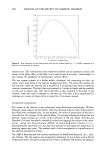
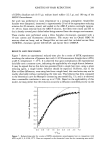
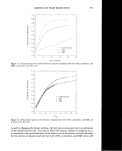
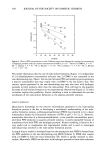
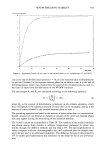
286 JOURNAL OF THE SOCIETY OF COSMETIC CHEMISTS 0.7 o.s - 0.4 - 0.3 - 0.2 Contracting area 0.1 - ?irst order 0.0 0.1 0.2 0.3 0.4 0.5 0.6 0.7 0.8 0.9 ?taction of Reaction Figure 4. First derivatives of the reduced-time plots for the first order and contracting area models, expressed as a function of the fraction of reaction. In this particular instance the specific reaction rate constant can be equated to the velocity with which the interface is moving (v) and the radius of the cylinder (r) by the equation v k - (17) r To help distinguish between theoretical curyes of close proximity it is often useful to normalize at times other than to. 5. For example, normalizing at to. 9 will allow greater spacing between curves at lower values of o•, while normalizing at to. • allows greater spacing between curves at higher values (see Figure 5). However, experimentally, longer-range extrapolation will, of course, give rise to an increased source of error. Another heterogeneous kinetic model that may be potentially applicable to hair reduc- tion is the Avrami-Erofeev equation. (see ref. 7). This expression is so called as it was simultaneously and independently derived by both authors while working in different fields. In its general form the equation is expressed as [--In(1 - ot)] •/" = kt (18) where n is the summation of the number of stages involved in nucleation, [3, and the number of dimensions of growth, k, i.e., n = [3 + k (19) In our hair reduction experiments we can assume that nucleation is instantaneous (i.e., [3 = 0). Therefore, for one-dimensional growth (i.e., branching chains, no interface), n = 1 and the Avrami-Erofeev expression reduces to the first order equation. However, for two-dimensional growth of an interface, n = 2 and the reaction can be described by the A2 expression:

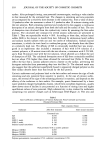
KINETICS OF HAIR REDUCTION 287 '• 0.7 • 0.• • 0.5 / // - / • 0.3 /•// -- -moving boundary - 0.2 // -- -first order - / -contracting area 0.1 - 0.0 I • 0 5 10 15 20 t/t0.1 Figure 5. Theoretical reduced-time plots for the first order, moving bounda•, and contracting area expressions, normalizing at • = 0.1. [-ln(1 - o0] ¾2 = kt (20) This theoretical model also produces a sigmoidal reaction profile, as shown in Figure 6. EXPERIMENTAL TENSILE TESTING The tensile testing was carried on an Instron Model 1122. The hair samples included unaltered European hair from a single donor (supplied by DeMeo), Japanese hair (ob- tained from Helene Curtis Inc., Japan), or hair collected from internal donors. Our testing method differs from Wickett's in that as opposed to conventional stress relaxation, we use a 2% intermittent stress relaxation. As such, our experiment involves imparting a 2% strain on the fiber, measuring the stress, and then removing the strain. This process is repeated every 30 seconds at a rate of 0.5 inches/rain, allowing the progression of the reaction to be mapped via the decrease in the stress. This intermittent approach is assumed to be more appropriate for following changes during a chemical reaction than the existing dynamic method, for the following reason. During a static stress-relaxation experiment, the hair fiber is under strain at all times and because of its viscoelastic properties, it will constantly be trying to relax the stress. Superimposed over this mechanical stress relaxation is the chemically induced change in modulus that is caused by the breaking of the disulfide bonds. Therefore, these two factors are convo- lured. As long as the mechanical relaxation is considered to be faster than the chemically induced change, the experiment can be concluded to be measuring the resultant effect of the reducing agent. However, should the chemically induced relaxation be faster than the mechanical relaxation, then the data that is produced is not a true reflection of the
Purchased for the exclusive use of nofirst nolast (unknown)
From: SCC Media Library & Resource Center (library.scconline.org)