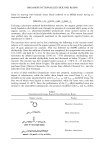
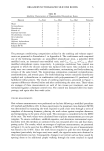
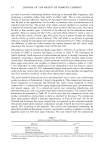
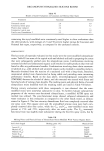
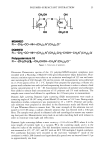
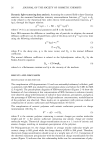
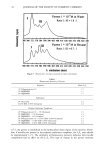
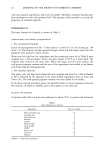
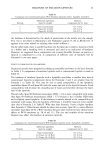
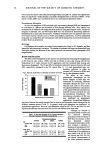
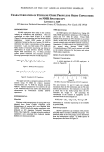
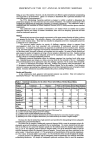
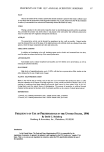
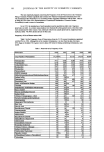
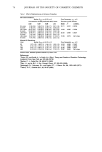
4 JOURNAL OF THE SOCIETY OF COSMETIC CHEMISTS were not included in this investigation. The C26_28 and higher olefin functional products were hard, brittle waxes that were not stable in the formulation utilized in these evaluations therefore, they were not included in the study either. The ester groups reacted onto the siloxysilicate resins were prepared in-house by a Fischer esterification reaction of an organic acid and an alcohol--one of the groups being unsaturated. The reaction was carried out in an aliphatic hydrocarbon solvent using p-toluene sulfonic acid as the catalyst. Table II lists the particular acids and alcohols employed in these reactions to produce the various esters utilized in this investigation. The solubility characteristics of representative organomodified siloxysilicate resins are presented in Table III. COMBING EVALUATIONS All hair used in these experiments was virgin medium-brown European hair purchased from DeMeo Bros., NY. Combing and volume measurements were performed on 6-in, 3-g tresses by means of a Diastron miniature tensile tester, model MT600, with a crosshead speed of 50 ram/min. Combing evaluations were performed on wet hair using a modified procedure of Garcia and Diaz (25). Baseline combing values were taken on tresses that had been shampooed twice for 30-sec intervals using 0.5g/g hair of a commercially available non-conditioning (non-silicone containing) shampoo product. The tresses were then rinsed for 30 sec under running warm tap water (-80øF) at a flow rate of approximately 1 liter per min. The tresses were allowed to air dry and then shampooed twice again, and one pair of tresses was set aside to function as the shampoo control. The conditioning formulations were then applied (2.0 g/g hair) to the remaining tresses and massaged into the hair for 60 sec. This procedure was followed by a 30-sec rinse under running tap water. The combing values were again measured on wet hair. Table II Typical Acids and Alcohols Used to Prepare Ester Groups to be Grafted Onto Siloxysilicate Resins Typical acids Typical alcohols O CH 2 = CH(CH2)sCOH CH3(CH2)•7OH Undecylenic acid Stearyl alcohol O II CH•(CH2)•6COH CH2 = CHCH2OH Stearic acid Allyl alcohol O CH3(CH2)•oCOH Lauric acid CH 3 O I II CH3CH(CH2)•4COH Isostearic acid CH2OH I CH 2 = CHCH2OCH2-C-CH2CH 3 I CH•OH Trimethylol propane monoallyl ether TMPMAE

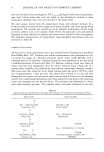
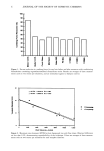
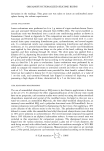
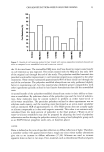
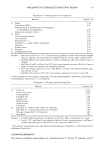
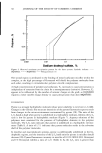
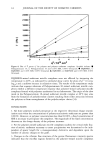
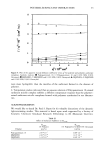
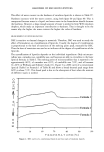
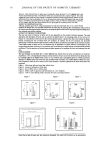
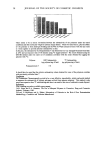
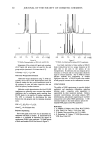
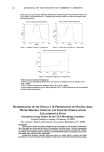
ORGANOFUNCTIONALIZED SILICONE RESINS 5 Table III Solubility Characteristics of Organomodified Siloxysilicate Resins Material %8 Ester %0 Alkyl C20 Alkyl Polyether Water I I I S Cyclomethicone I S S I Dimethicone I I I I Mineral oil S S S S Isopropyl myristate S S S Octylmethoxy cinnamate S I I S Octyl salicylate S -- -- -- Glycerin I I I S Aliphatic hydrocarbons S -- -- -- Myristyl propionate S S S I Ethanol SD-40 I I I S The prototype conditioning compositions utilized in the combing and volume experi- ments are presented in Formulation 1 in Appendix A. The conditioners each comprised one of the following materials: an unmodified siloxysilicate resin, a polyether (EO) modified resin, an isostearyl ester-modified resin, and C•o , C•6_•8 , or C20_24 alkyl- modified siloxysilicate resins, respectively. A prototype conditioner base control was prepared in which the silicone content was replaced with water. Also included in this study were two commercially available conditioners, moisturizing and body-enhancing versions of the same brand. The moisturizing composition contained cyclomethicone, amodimethicone, and several quats. The body-enhancing version contained dimethicone copolyol and cyclomethicone in combination with polyquaternium-10, panthenol, and hydrolyzed wheat protein. The results of combing experiments, presented in Figure 1, represent differences observed before and after conditioning the same tress. These values are averages of three measurements on each of two tresses per treatment, and were normalized against a shampoo control tress. The control was measured after two sham- pooings, and again after four wash cycles. VOLUME MEASUREMENTS Hair volume measurements were performed on dry hair following a modified procedure of Crawford and Robbins (26). In these experiments the maximum tress diameter (MTD) was determined by measuring the work required to pull a hair tress through a series of templates of decreasing diameter, plotting the work values against template diameter, and extrapolating to the point of zero work. This intercept is considered to be the MTD of the tress. The work values were calculated from triplicate measurements per tress per template. To ensure confidence, establish expertise, and determine instrumental repro- ducibility with this method, an untreated tress was measured after two and four sham- pooing cycles. The results, which are averages of triplicate measurements, are presented in Figure 2. It can be seen that the difference in MTD for these two sets of measurements was found to be 0.46%. Since the work forces required to pull the tress through the templates (particularly the larger ones) were small, the signal-to-noise ratio obtained in these experiments was low. Consequently, changes in air current such as those caused by opening doors or by additional people walking through the room resulted in signal
Purchased for the exclusive use of nofirst nolast (unknown)
From: SCC Media Library & Resource Center (library.scconline.org)