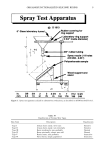
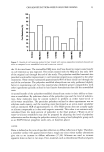
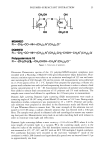
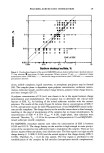
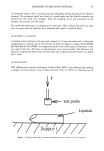
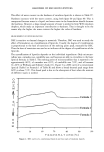
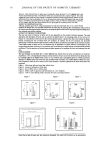
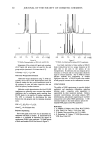
HARDNESS OF EMULSION LIPSTICKS 43 of unsmooth surfaces due to cooling and rapid shrinkage during pouring of the lipstick mixture. The preheated mold was tilted to a small angle and the lipstick mixture was poured into the mold very carefully. Thus the trapping of air was prevented as the mixture was poured into the mold. The mold was then kept in a refrigerator for one hour. After cooling, the mold was split into two parts and the lipsticks were removed and stored in lipstick bases. MEASUREMENT OF HARDNESS A lipstick with a diameter of 8 mm and a length of 35 mm was subjected to diametral compression at a testing rate of 30 mm/min, as shown in Figure 1, using a SUN RHEO METER (Model CR-2000D). A compression probe with a flat surface of diameter 5 mm was used in the test. The force vs displacement curve was recorded. The hardness of a lipstick is represented by the force exerted when the compression probe moves to a depth of 0.1 mm. DSC MEASUREMENT DSC (differential scanning calorimetry Perkin Elmer DSC7) was performed by heating a sample cell (with about 4 mg of lipstick) from 30øC to 120øC at a heating rate of test probe Lipstick pport Figure 1. Lipstick subjected to diametral compression at a testing rate of 30 mm/min.

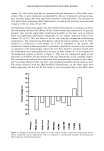
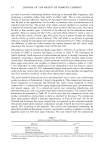
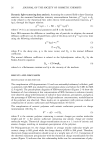
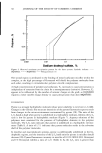
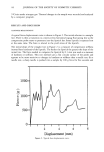
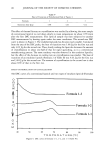
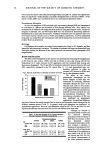
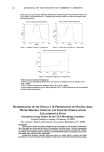
44 JOURNAL OF THE SOCIETY OF COSMETIC CHEMISTS 5 øC/min under nitrogen gas. Thermal changes in the sample were recorded and analyzed by a computer program. RESULTS AND DISCUSSION HARDNESS MEASUREMENT A typical force-displacement curve is shown in Figure 2. The initial relation is a straight line. There is then a transition to a more-or-less horizontal zigzag fluctuating line as the compression probe starts to penetrate into the lipstick bar. Some lipstick is squeezed out at the same time. The force is related to the yield stress of the lipstick. The initial slope of the straight line in Figure 2 is a measure of compression stiffness (termed here hardness) of the lipstick. The harder the lipstick the greater the slope of the initial line. The force needed to compress the lipstick by 0.1 mm was used as a measure of hardness or stiffness. This test method uses a flat circular surface of the probe and appears to be more sensitive to changes in hardness or stiffness than a needle test. (In a needle test, a sharp needle is pushed into a sample by 100 g force for five seconds and 15'00- 1000 500 0 2 4 6 8 Displacement (mm) Figure 2. Typical force-displacement curve.
Purchased for the exclusive use of nofirst nolast (unknown)
From: SCC Media Library & Resource Center (library.scconline.org)