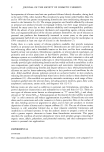
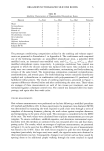
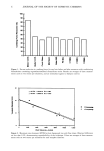
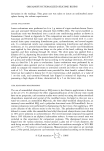
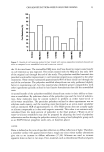
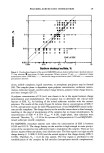
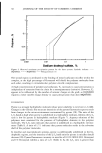
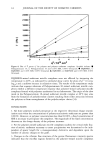
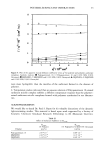
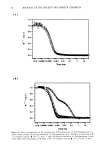
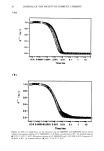
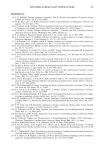
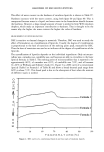
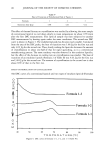
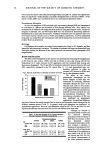
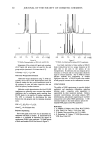
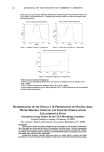
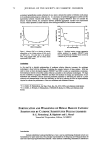
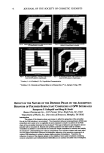
PREPRINTS OF THE 1997 ANNUAL SCIENTIFIC SEMINAR 61 A REVIEW OF RHEOLOGICAL AND THERMAL ANALYSIS TESTING TECHNIQUES - TESTING CONSIDERATIONS, APPLICATIONS AND NOVEL APPROACHES FOR THE COSMETIC INDUSTRY Deborah A. Gerenza Rheometric Scientific, Inc., Piscataway, NJ 08854 Introduction Conducting experiments in any testing environment requires knowledge of the testing technique and the effects of the testing conditions on the results. In rheological testing techniques, the choice of test type, test conditions, and test geometry are important considerations, with the combinations being numerous. In thermal analysis testing techniques, the choice of thermal proffie, sample size and sample preparation are key elements. Together, rheology and thermal analysis can provide necessary characterization, processing, and application behavior information of materials. This paper will explore the utility of a combined rheological and thermal analysis test technique. There are combined analytical techniques currently being used in industry. Thermal analysis techniques have been combined with mass spectroscopy and Fourier transform infrared spectroscopy and rheological techniques have been combined with optical and dielectric methods. The material components used in cosmetic formulations and the cosmetic formulations provide a challenge for these and other testing techniques. Flow properties are key to the handling of these materials and are modified by the material's structural nature(1). Thermal properties are useful in understanding the thermal stability and phase behavior of these complex cosmetic formulations. Considerations in making measurements on these materials will be discussed. Experimental A 50% by weight alcohol ethoxylate (Shell Neodol tm 25-3) solution was prepared for this study. This material was chosen based on known phase behavior characteristics of nonionic surfactants that occur with temperature (2). Rheological testing was performed using a controlled stress rheometer (Rheometric Scientific, Inc., Model SR 5000) equipped with 40 mm diameter parallel plate geometry and a Pe]tier environmental system for controlling temperature. Thermal measurements were recorded simultaneously with the rheological measurements by a thermal cell embedded in the testing surface [Rheometric Scientific, Inc., Differential Thermal Rheometer (DTR) option, U.S. Patent 5,520,042]. Dynamic shear tests were performed with the following test parameters being controlled: deformation magnitude (stress), deformation rate (frequency) and thermal ramp rates. Background on Test Method Rheological tests can be performed under steady or dynamic test conditions. In this paper, dynamic testing in shear is the focus and will be discussed hereafter. Under dynamic shear conditions the material is subjected to a sinusoidal stress or strain. The magnitudes of the imposed deformation, frequency of oscillation, and temperature can be controlled. The properties most commonly reported in dynamic shear testing include the storage modulus, G', the loss modulus, G", the complex viscosity, •*, and the loss tangent, tan b. Storage modulus is a measure of the material's ability to store energy (elastic component), loss modulus is a measure of the material's ability to dissipate energy (viscous component), and complex viscosity is a measure of the material's resistance to flow. Loss tangent is the ratio of the loss modulus to the storage modulus, or the tangent of the phase angle. The thermal property measured is the differential in temperature between the control point and the material, AT. This measurement is made under the test conditions programmed for the rheological test. Test Results The test technique of measuring rheological and thermal characteristics simultaneously proved useful in detecting phase behavior characteristics of the aqueous alcohol ethoxylate solution. Rheological measurements show the distinct changes in flow properties from the resultant change in structural rearrangement occurring at the phase change of the material (Figs. 1 and 2). The thermal measurement data indicate a change in thermal characteristics of the material occurring in the temperature range of the phase change (Fig. 3).

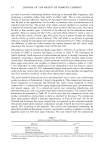
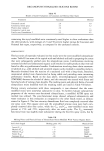
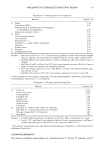
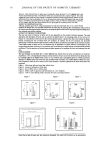
62 JOURNAL OF THE SOCIETY OF COSMETIC CHEMISTS Measurements made under different deformation conditions probe the structural nature of each region of material behavior. Changing the thermal profile can affect theological and thermal properties. 50% by wt. Aqueous Alcohol Ethoxylate Solution1 104 I '• lO.7 10 .2 15.0 --• .... __. , . 25.0 350 450 55 0 Temp ['CI Figure 1 - Complex Viscosity vs. Temperature 50% by wt Aqu•s Alcohol Ethoxylate Sot•fio• 10 s A lo • • 150 250 :•50 450 55.0 Temp [øC[ Figure 2 - Storage and Loss Moduli vs. Temperature 50% by w[ AqueOus Alcohol Ethoxylate Solution 002 o Ol }Go.0 -o 01 •_•• -o.o2 15.o 25.0 35 o 45 o 55.0 Temp ['C] Figure 3 - Temperature Differential vs. Temperature References and Acknowledgments 1. Dennis Laba, Rheological Properties of Comnetics a•d Toiletries, Marcel Dekker, New York, c 1993. 2. Th. F. Tadros, Surfactants, Academic Press, New York, c 1984. A specifil acknowledgment goes to Rhyta Rounds, Ph.D., of Fluid Dynamics, for the material and invaluable discussions. DETERMINATION OF THE EFFICACY OF PRESERVATION OF NON-EYE AREA WATER MISCIBLE COSMETIC AND TOILETRY FORMULATIONS: COLLABORATIVE STUDY Presented by George Fischler I for the CTFA Microbiology Committee 2 •Colgate-Palmolive Company, Piscataway, NJ 08855 •The Cosmetic, Toiletry and Fragrance Association, Washington, D.C. 20036 Introduction Water miscible cosmetic and toiletry formulations may be susceptible to microbiological contamination due to their high water content and the nature of the ingredients which they contain. Microbial contamination of a formulation may result in off odor, separation of emulsions, and the production of undesirable metabolic by-products. fithe organisms which are growing in the contaminated formulation are pathogens, they may also pose a health risk to the u•oxs of these formulations. Antimierobial chemicals, commonly called preservatives, are usually added to cosmetic and toiletry formulations to prevent the growth of microorganisms which may be inadvertently introduced during making,
Purchased for the exclusive use of nofirst nolast (unknown)
From: SCC Media Library & Resource Center (library.scconline.org)