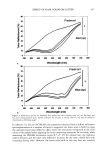
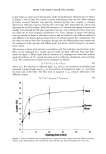
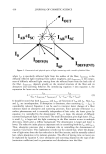
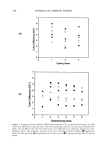
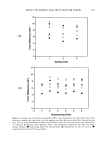
j. Cosmet. Sci., 55,423-436 (September/October 2004) Effect of hair color on luster K. KEIS, K. R. RAMAPRASAD, and Y. K. KAMATH, TRI/Princeton, P.O. Box 625, Princeton, NJ 08542. Accepted for publication July 7, 2004. Presented at the Annual Scientific Meeting and Technology Showcase of the Society of Cosmetic Chemists, New York, December 4-5, 2003. Synopsis The effect of color on instrumentally evaluated luster of hair dyed to different colors and depths of shades is studied. For natural hair colors, such as blond, brown, and black, the increase in luster with increasing color is associated with a decrease in diffusely scattered light as a result of light absorption by melanin granules. On dyed hair the interpretation of data from a goniophotometer (GP) is more complicated. Using the colors covering the extremes and middle of the visible spectrum, our results demonstrate how dye composition (single or multicomponent), concentration, and penetration depth into the fiber affect the absorptive and scattering processes within the hair fiber to impact luster. Finally, we make an attempt to study the effect of hair color on subjective evaluation of luster. An equation for perceived luster, taking into account the spectral sensitivity of the human eye is derived. Theoretical considerations show that the luster of hair of different colors is perceived differently by the human eye. INTRODUCTION The luster of hair is an essential quality for hair beauty. It is an optical phenomenon resulting from the specular reflection of light at the air-cuticle interface. Although the mechanism of specular reflection from the air-cuticle interface is relatively simple, optical processes contributing to the diffuse reflection are complicated because of the cellular structure of the hair. So far, many models of light reflection from hair fibers have been described in the literature however, there is no simple relationship between luster and the light reflected from hair (1-6). The great interest in luster has resulted in a large number of studies on the effect of various cosmetic products on luster and the devel- opment of a variety of methods for measuring it (1-12). At TRI, luster is arbitrarily calculated from the amounts of specularly and diffusely reflected light from goniopho- tometric measurements (13). The wide range of natural hair colors is determined by the total amount of melanin (either eumelanin or pheomelanin, or a mixture of the two) present in the cortex of the hair fiber (14). For natural hair colors, such as blond, brown, and black, luster is highest for the one with the darkest hue, explained by the low intensity of the diffusely scattered light, while the intensity of the specularly reflected light remains the same. This is attributed to the effective light absorption by melanin granules, dark hair containing 423

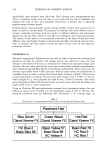
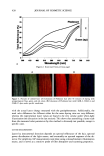
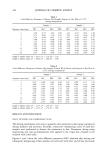
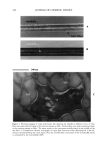
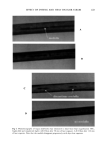
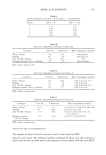
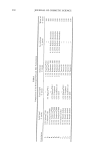
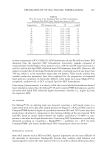
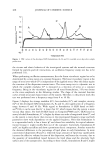
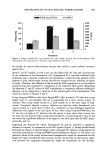
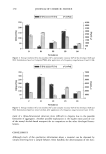
424 JOURNAL OF COSMETIC SCIENCE significantly more melanin than light hair. Hair coloring with semipermanent hair colors is nowadays widely used not only to cover gray hair but also to highlight and brighten the color of one's own naturally colored hair, a practice that is especially popular among younger people. Semipermanent colors generally consist of large number of dyes with various hues in order to achieve a desired shade. The presence of multiple dyes with different concen- trations, molecular structures, and sizes results in different affinities and penetration depths into the hair fiber, which in turn affect the absorptive and scattering processes. The interest of this work is in instrumental evaluation of the luster of hair dyed with different colors and depths of shade, to demonstrate the effect of artificial color on luster. Also, an attempt has been made to study the effect of hair color on the subjective evaluation of luster. EXPERIMENTAL Naturally unpigmented Piedmont hair was used in order to prevent the scattering and absorption of light by melanin. The dyeing process was selected to cause the least damage to the interior of the hair, to minimize the influence of structural change upon coloring. The hair colors used in this study were commercially available semipermanent dyes: Clairol Xtreme FX Blue Denim, Green Weed, and Hot Red. These colors cover the extremes and middle of the visible spectrum. Selected colors consist of combinations of a number of dyes in order to achieve the desired shade, as shown in Table I. Tresses were not pretreated prior to coloring. For each color, three tresses of size 2.5 (W) x 15 (L) cm, with a weight of 2 g, were prepared and dyed for five, 20 and 45 minutes. The tresses were thoroughly washed with aleionized water to remove excess dye from the surface and finally dried in air at room temperature. Using an UltraScan XE spectrophotometer equipped with integrating sphere, the total reflectance spectra were recorded over the wavelength range of 360 to 780 nm. The operating conditions were the following: D65 illuminant, a 10 ø viewing angle, an Table I Dyes Present in Semipermanent Clairol Colors Used for Dyeing Piedmont Hair I I Blue Denim Clairol Xtreme FX I HC Blue 2 Basic Blue 99 Piedmont Hair I Green Weed Clairol Xtreme FX I Basic Yellow 57 Basic Blue 99 HC Yellow 4 Hot Red Clairol Xtreme FX I Basic Red 76 HC Red 3 HC Red 1
Purchased for the exclusive use of nofirst nolast (unknown)
From: SCC Media Library & Resource Center (library.scconline.org)